



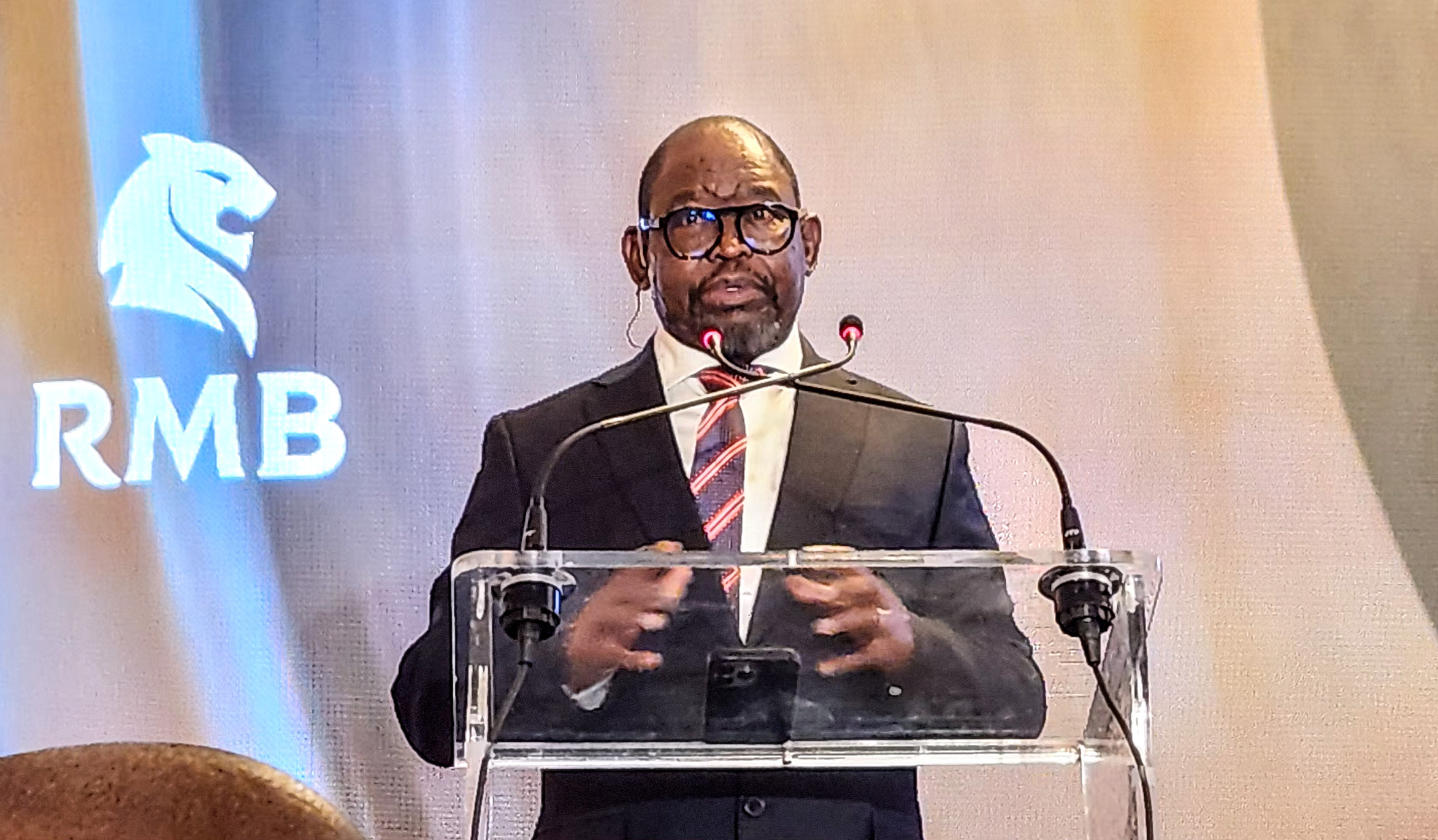
 Finance Minister Enoch Godongwana was candid with business at an RMB Think Budget breakfast on 13 November. (Photo: Neesa Moodley)
 At the age of 68, donning his signature jaunty hat (always with a feather), Finance Minister Enoch Godongwana carries a quiet strength that should not be underestimated. Those at the RMB Think Budget breakfast had the opportunity to hear his thoughts on the process leading up to the Medium-Term Budget, what informed the measures adopted by National Treasury and his candid opinion on several other matters.
In a loose adaptation of a Karl Marx quote, Godongwana started his address by noting that “we are making changes, but we do so in circumstances not of our choosing”.
“Nobody predicted before the elections that we are likely to have a coalition government,” he said, noting that, as an example, the issues around the Budget earlier this year “had nothing to do with the substance of the Budget and everything to do with the disagreement of the parties on certain policy positions.”
/file/dailymaverick/wp-content/uploads/2025/11/20251113_082031.jpg "Finance Minister Enoch Godongwana at the RMB Think Budget breakfast on 13 November. (Photo: Neesa Moodley)")
This time around, both Godongwana and National Treasury Director-General Duncan Pieterse had to make a presentation on the Medium-Term Budget ahead of 12 November. “That’s why … virtually all members of the Government of National Unity were on the same page in supporting the budget, not a single member of the Government of National Unity took a different line,” he said proudly.
The National Treasury also learnt some valuable lessons from the debacle around the Budget Statement earlier in the year. “We had to make sure that by the time we make this announcement (the MTBPS), there is political buy-in,” Pieterse said. As Godongwana tells it, he asked deputy minister Ashor Sarupen to “manage his crowd and I will manage mine” to ensure that there was political buy-in by the time of the announcement on 12 November.
Commenting on the MTBPS, Albert Botha, head of fixed income at Ashburton Investments, said the adjustments in the budget show where the policy rubber meets the road.
“Provinces receive R14.4-billion more via the equitable share to stabilise frontline services like education and health. Disaster funds are allocated to repair infrastructure, and rollovers (unspent funds from the previous fiscal year) help unblock delivery bottlenecks. These are not headline-grabbing moves, but they matter. The contingency reserve is increased, and debt switches, alongside flows from the Gold and Foreign Exchange Contingency Reserve Account, lower the gross borrowing requirement. This gives Treasury more flexibility in issuance and helps reduce term premia. In plain terms: better cash balances, smoother redemptions and a funding mix that leans less on long-dated nominal bonds when the curve is steep,” he observed.
On Targeted and Responsible Savings
/file/dailymaverick/wp-content/uploads/2025/11/20251113_090145.jpg "Treasury Director-General Duncan Pieterse says the Tars programme is expected to bring in R6.7bn in savings over the next year. (Photo: Neesa Moodley)")
Over the years, Godongwana has often been described (usually around budget announcements) as a minister walking a tightrope, and that has never been truer than this year, caught between political parties and financial choices. “It became clear to us during the budget that if we want to maintain the debt-to-GDP pathway, we can’t increase borrowing and increasing taxes is not an easy option,” he said.
That left the path of managing expenditure in an efficient way. “We talked about spending reviews. Duncan (Pieterse) and his team have become creative. They call it Targeted and Responsible Savings,” Godongwana said with a chuckle, adding that one of the challenges is that departments and ministers have vested interests in defending their programmes.
On the Madlanga Commission
“What is coming out in the Madlanga Commission is clearly a demonstration of how the security cluster has been used for purposes other than to combat crime. So, you can see that, coming out in the Madlanga Commission, it is a product of the State Capture period… On our side, we must shoulder the blame. I can’t even say, no, it was the Zuma period. Truth of the matter, it was an ANC period. We must accept it and take responsibility that, you know, we dropped the ball.”
Read more: ‘It’s like we’re powerless and watching criminals take over SA’ – NPA boss Shamila Batohi
On NSFAS
The minister said that if it was up to him, he would close NSFAS (the National Student Financial Aid Scheme) tomorrow “with my eyes closed… because NSFAS is supposed to be taking money from the Department of Higher Education and transferring it to universities. You don’t need that conduit. You just need to transfer money to the universities, and universities can do the task,” he said.
According to Godongwana, he had a discussion with President Cyril Ramaphosa, and when the President heard how much the NSFAS CEO earned, his reaction was “I can’t believe… they’re earning more than me?”
“I said, yes. The CEO of NSFA earns R4-million,” Godongwana said.
Waseem Carrim is the acting CEO of NSFAS. My colleague, Siyabonga Goni, reported earlier this month that the institution has been plagued by budget shortfalls despite receiving funds of R13.3-billion to support 34,000 students, with blocked registrations and second-semester registrations of 15,000 students, late payments to landlords and issues with an irregular board.
Read more: Minister Manamela admits to NSFAS challenges after board chair Stander’s shock resignation
“Not only that (the big CEO salary). They have decided to outsource their own work. They have employed four other service providers to do what they (NSFAS) [were] created to do,” Godongwana said.
On public wages
The minister acknowledged that this was a difficult point. “We structured an agreement and locked ourselves to inflation around 4%, so for the next two years, wages will be sticky in that sense.”
On state-owned entities
Moving on to state-owned entities, the minister observed that the government had spent a great deal of time trying to deal with the power crisis. “We spent a lot more time trying to fix Eskom than trying to fix the grid – and those two are different things. We are not going to use [that] template to fix Transnet,” he said.
On the inflation target
On the much-lauded change in the inflation target, the minister pointed out that South Africa was already operating on an inflation rate of around 3%. “It’s in the interest of this country to target a lower inflation [rate], which will have an influence on interest rates. Lower interest rates are in the interest of the broader economy – for jobs, employment, investment, household expenditure and the GDP,” he said.
Hugh Hacking, executive head of structured investments and annuities at Momentum Corporate, summed it up in a statement shared with Daily Maverick.
“A central theme of this budget is a shift from reactive spending to strategic investment, aimed at growing the economy and reducing dependency on the state welfare system. The MTBPS presented a solid, data-backed plan that, if consistently executed, could set a foundation for medium-term stability and growth, significantly improve investor confidence, lower the country’s risk premium and ultimately prompt a positive change in South Africa’s credit outlook,” he said.
Godongwana’s parting words at the RMB Think Budget breakfast: “Relax. That’s all that I’m saying.” DM