



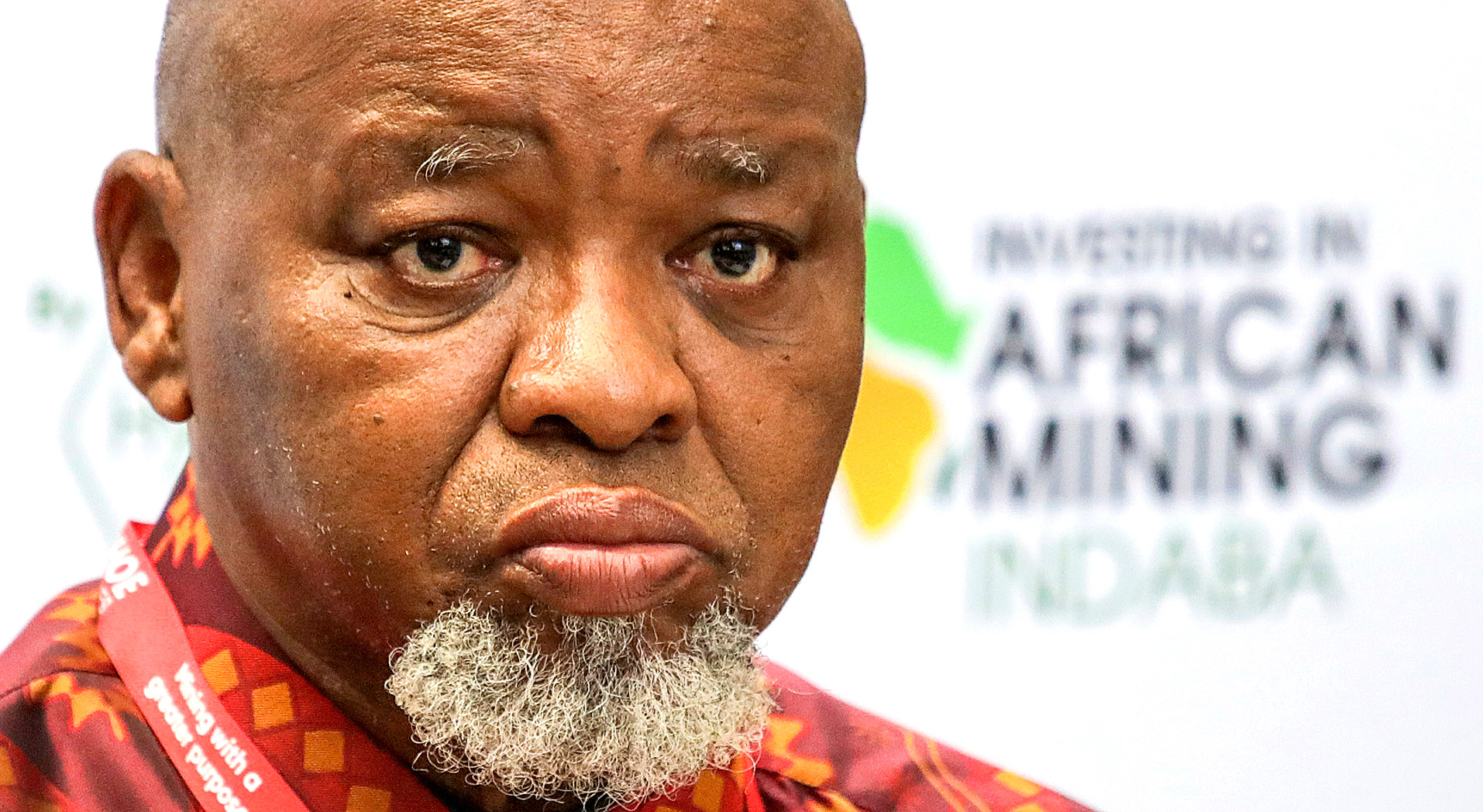
 Minerals and Petroleum Minister Gwede Mantashe has been accused of endless and needless mining cadastre delays under his tenure. (Photo: Dwayne Senior / Bloomberg via Getty Images)
One of South Africa’s priorities for its G20 Presidency is “harnessing critical minerals for inclusive growth and sustainable development” in Africa.
“Critical minerals are at the centre of Africa’s industrialisation, the global energy transition, technological innovation and inclusive economic growth. South Africa will prioritise increased investment in exploration, increased beneficiation at source and the integration of artisanal mining into mainstream economies,” it proclaims.
This is an understandable push for Africa to reap the long-denied benefits of its minerals endowment to fuel industrialisation and development. But analysts warn it should not try to compete head to head with China and India on this front.
“There have been growing calls in several African cobalt- and copper-producing countries to ‘leapfrog’ straight into building domestic battery factories and even full electric-vehicle industries. But that development path risks repeating Ghana’s painful experience of trying to outcompete Asia on textiles with a smaller market, higher costs and weaker ecosystems,” Glen Nwaila, director of the African Research Centre for Ore Systems Science at Wits, told Daily Maverick.
“The hard truth is that China and India already dominate key parts of the battery and EV value chain, from precursor chemicals and cell manufacturing to motor magnets and power electronics, backed by decades of industrial policy, logistics and skills.”
Instead, Nwaila said Africa and the Asian giants should find ways to collaborate in this area to the benefit of both.
“Africa’s strategy should not be to mirror this model on a smaller, more fragile base, but to negotiate progressive collaboration which should include co-designed industrial hubs where Chinese and other partners bring capital, process know-how and market access, while African states bring resources, land, labour, power and a clear framework for local value addition and capability transfer,” he said.
Africa is rich in many of the critical metals and minerals needed for the green energy transition to curb the greenhouse gas emissions linked to rapid climate change. These include by far the biggest reserves of platinum group metals (PGMs), manganese, chromium and cobalt.
According to Nwaila, Africa hosts about 30% of the world’s mineral resources – the lion’s share, which are mostly processed in Asian tigers, a point underscored by the trade data.
What this means
Africa is resource rich, but this has not historically translated into wider benefits for its people. With 30% of the world’s known mineral wealth, Africa should seek ways to use it for development and industrialisation. But it needs to be strategic and seek ways to leverage its resource wealth without trying to compete with the likes of China.
“UN Trade and Development (Unctad) estimates that trade in critical minerals and closely related products reached about $2.5-trillion in 2023, with Africa and Oceania functioning mainly as upstream suppliers of ores and intermediate products, and Asia, particularly China, acting as the central processing and manufacturing hub,” Nwaila said.
“The DRC supplies roughly 70-75% of global mined cobalt, but mostly exports hydroxide and concentrates to Chinese refineries. Copper from the DRC and Zambia leaves as concentrate, matte or blister, with smelting and refining capacity periodically stranded by power shortages, tax changes and price swings. Guinea’s bauxite feeds alumina and aluminium plants in China and the Gulf.”
These are just a few examples, but the picture that emerges is gin clear.
Shining the light of transparency
To unlock its mineral wealth – and reverse a long and bloody history of extractive exploitation – African countries also need to shine the light of transparency on their policies and regulations.
“Africa’s articulation of its aspiration on critical minerals for national development must be matched with an indication of its intention to improve operating procedures and regulatory clarity,” Chris Vandome, a senior research fellow at Chatham House’s Africa programme, told Daily Maverick.
“Longstanding challenges of regulatory uncertainty, including over permitting, licensing and tenure, in many of the continent’s major mining jurisdictions have been key factors for the under-exploration of potential deposits. The development of transparent and usable cadastre systems is key to this.”
On these issues, South Africa – while it is driving the initiative in its G20 presidency role – is a laggard rather than a leader.
“What examples can South Africa provide? They’re just bad examples,” said Peter Major, director of mining for Modern Corporate Solutions.
The absence of a functional cadastre in South Africa — an online portal that displays a country’s mineral wealth while allowing companies to seamlessly apply for mining and prospecting rights — has long been a deterrent to mining investment and exploration, leading to a massive backlog in applications.
Read more: Explainer – a mining cadastre and public transparency
There have been endless and needless delays under the tenure of Minerals and Petroleum Minister Gwede Mantashe. After the latest delay, one is finally supposed to be rolled out next year.
South Africa is far behind other African countries such as Botswana and Namibia, which are leading the way in this regard.
South Africa has said one of its priorities on the G20 critical minerals front is to increase exploration investment. But it remains far below its own target of attracting at least 5% of global exploration spend, a level it last reached more than two decades ago.
Still, the G20 is a good platform to launch this initiative from.
“This is a strategic move, to leverage the African Union’s participation within the G20 for the first time as a full member, and given the hosting of the event in one of the world’s most historically significant mining cities,” Vandome said.
South Africa can be a leader in other ways. Its mining sector has decisively turned the page on its history of colonial and apartheid exploitation and exclusion to a new chapter that is delivering wider social and economic benefits – benefits that still elude several other resource-rich nations in Africa, a state of affairs this initiative seeks to address. DM