




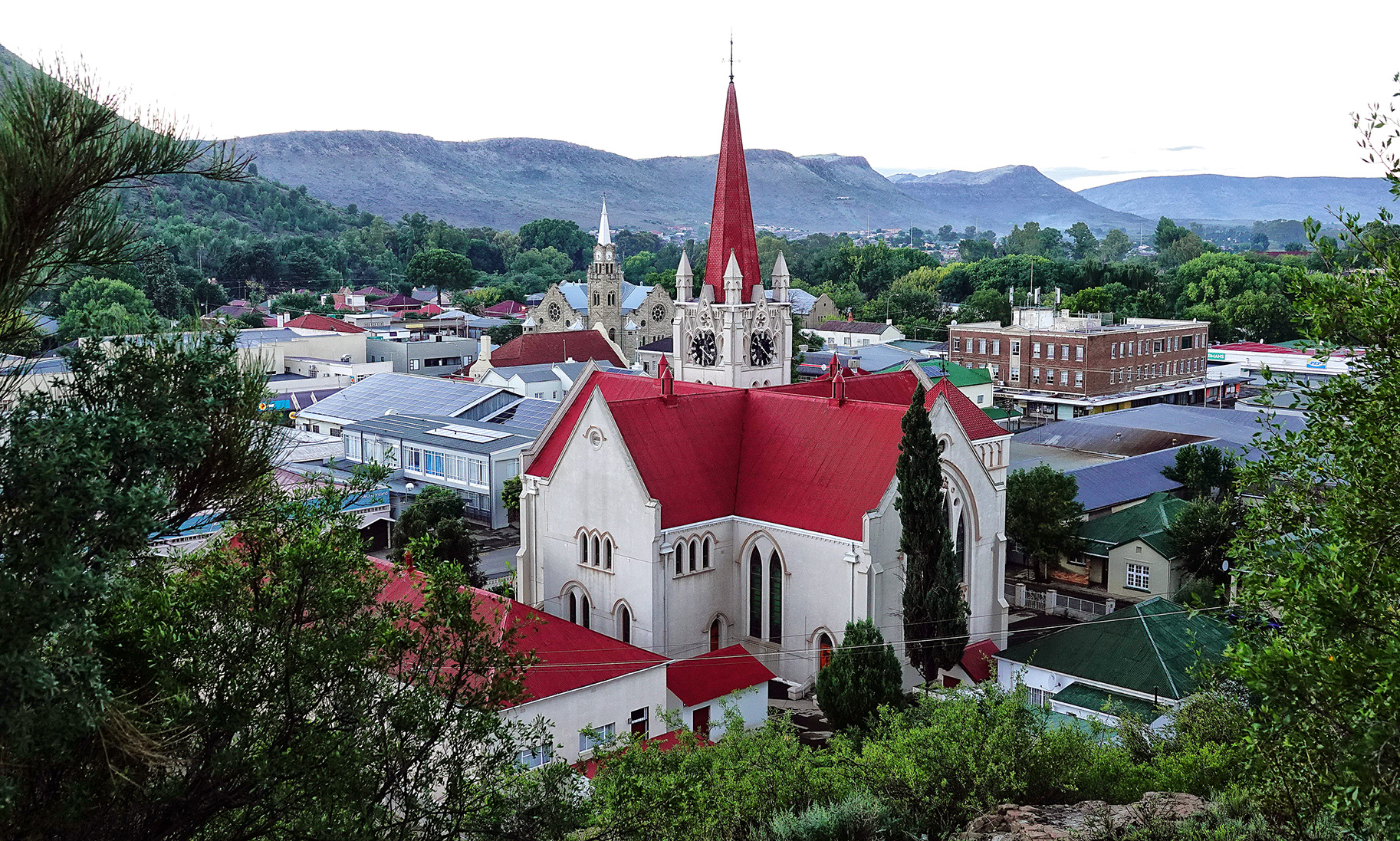
 Just before dawn, Burgersdorp turns into a Bavarian chocolate box village. (Photo: Chris Marais)
 Just before dawn, we go rambling through Burgersdorp. A few steps past the retirement centre (Huis Dirk Postma) on the hill descending, the road takes a curve. If you look over town from that vantage point just before the sun peeps over the ridges, you will be presented with what initially appears to be a chocolate box Bavarian village. It’s the combination of church spires and rooftops, surrounded by summer-green trees, with grey-blue mountains in the distance.
These two elegant churches below us lie at the heart of historical Burgersdorp, a traditional Merino sheep farming town (with a sideline in cattle and ostriches) that is actually named after the people who live there. Not a dominee or a president or a fortune hunter. Just the burgers themselves.
Burgersdorp lies in a valley in the shadow of the Stormberg Mountains on the northeastern frontier of the Karoo. Its Dutch Reformed Church was built from dressed sandstone, with a silver-glinting dome and cupola added for style. The roof burnt in 2020, and millions of rands in damage was done. Insurance covered most of the costs, and the community collected the R5-million shortfall.
/file/dailymaverick/wp-content/uploads/2025/11/The-Wagon-Shed-at-the-Burgersdorp-Museum_Chris-Marais.jpg "The Wagon Shed at the Burgersdorp Museum. (Photo: Chris Marais)")
The other equally imposing place of worship is the breakaway Reformed Church (often referred to as the Dopper Kerk), first led by the Reverend Dirk Postma in 1860.
Rev Postma launched the Theological Seminary of the Reformed Church in South Africa, and its second lecturer was Jan Lion-Cachet. The seminary later moved to Potchefstroom where it formed the seed of the later university, but Lion-Cachet’s former home is now the Burgersdorp Museum, which we’ll visit later in the day.
Christmas box in a blockhouse
Down the hill we go, the skyline above us is broken by Brandwag, one of the two South African War blockhouses that loom over Burgersdorp. Brandwag is one of 440-odd masonry blockhouses built in South Africa around 1900.
How did they cope, all those years ago? Were they bored? Were they occasionally sent care packages from home? They were indeed, according to war correspondent Edgar Wallace, who penned these words in an article titled Christmas Day on the Veldt and published in the New Zealand Star on 10 February, 1902:
“In the little box that serves as a pantry is a Christmas pudding, which the good people of England have sent out; there is a prime cut of beef, which the Cold Storage Manager has arranged for; there are vegetables, and a pint of beer a man – it came last night on a gangers’ trolley; and there are letters and papers to be read – they came last night, too.
/file/dailymaverick/wp-content/uploads/2025/11/The-Brandwag-blockhouse-looming-over-Burgersdorp_Chris-Marais.jpg "The Brandwag blockhouse looming over Burgersdorp. (Photo: Chris Marais)")
/file/dailymaverick/wp-content/uploads/2025/11/The-blockhouse-at-Stormberg-Junction_Chris-Marais.jpg "The blockhouse at Stormberg Junction. (Photo: Chris Marais)")
“Phew! but it’s hot. The blockhouse smells of warm paint and warm food and old clothes. There is a fire in the tiny kitchen dug-out, white smoke rises straight up, no breath of air moves on the veldt, and the light of the fire is made nothing by the light of the sun that beats down from the white-hot sky.”
Strolling into town, we find ourselves in Burger Park, wondering why the ornate drinking fountain admonishes passers-by to “Keep the Pavement Dry”. It is adorned with white storks (that closely resemble our local cattle egrets), creeping salamanders, and a bunch of doves fluttering all over the dome.
/file/dailymaverick/wp-content/uploads/2025/11/The-Jubilee-Fountain-in-Burger-Park_Chris-Marais.jpg "The Jubilee Fountain in Burger Park. (Photo: Chris Marais)")
Queen Victoria’s Diamond Jubilee was back in 1897, and to celebrate the occasion, the people of Burgersdorp clubbed together and bought a Jubilee Fountain from Walter Macfarlane’s Saracen Foundry in Glasgow, Scotland.
A couple of years later, matters between Brit and Boer took a turn for the worse, but the Jubilee Fountain still stands proudly in the park.
The Headless Woman
Nearby the Jubilee Fountain is a cluster of interesting statues, one of which is missing a head and an arm. The Afrikaans language was formally recognised in 1882, and to celebrate the occasion a statue of a woman pointing a finger at a tablet was erected at the park. The inscription read: “De Overwinning de Hollandsche Taal”.
Along came the South African War, and the statue was damaged by occupying British forces. The Brits took it away, had a replica made and set it up in 1907. In 1939, the original, which stands just behind the replica, was found in a King William’s Town (now Qonce) scrapyard and was returned, minus the head and one arm.
/file/dailymaverick/wp-content/uploads/2025/11/The-headless-Taalmonument-standing-behind-its-replica_Chris-Marais.jpg "The headless Taalmonument standing behind its replica. (Photo: Chris Marais)")
The park also displays memorials to fallen Boers and to five anti-apartheid activists.
The afternoon belongs to the Burgersdorp Museum complex. We have a soft spot for country museums, which are normally (if still well-tended) lifestyle insights to the local past.
There are always shop dummy ladies and gents dressed to the Victorian-era nines, there is always a platteland kitchen sporting incredible old-school devices for peeling and cutting and cooking food – and there is always a batch of baby dolls and prams from long ago.
The Burgersdorp Museum goes a few steps further.
The complex includes two Karoo homesteads, the old parsonage and the aforementioned theological school, plus the Brandwag blockhouse. There’s even a language room dedicated to the evolution of Afrikaans. There’s a beast room and a gun room as well.
We are welcomed and shown around by Mkhuseli Saleni, museum curator and education officer. I dash off to the beast room (officially called the Carl Malcomess Trophy Room) to see if the rampant American cougar is still there, between the bosvark and the vlakvark. It is.
/file/dailymaverick/wp-content/uploads/2025/11/Mkhuseli-Saleni-museum-curator-and-education-officer_Chris-Marais.jpg "Mkhuseli Saleni, museum curator and education officer. (Photo: Chris Marais)")
Some years back, a local Museum Board member, Gerrit Coetzee, showed us around and posed for our cameras among nearly two dozen animal heads. On that same visit, I came across a little pile of South African War photographs, in stiff stereoscopic format. They must be stashed away somewhere today, because I cannot find them. Those old images capture day-to-day wartime life, in the field hospital, in the middle of a skirmish, detraining at a railway station, parade-ground marching, and disgruntled Boer prisoners glaring at the cameraman. Precious mementos for a travel hack with a nose for the past.
/file/dailymaverick/wp-content/uploads/2025/11/A-window-into-Victorian-era-womens-fashions_Cris-Marais.jpg "A window into Victorian-era women’s fashions. (Photo: Chris Marais)")
The Stormberg Junction
All roads lead to the middle-of-nowhere mountain town of Burgersdorp. From here you can drive six ways, to Aliwal North, Jamestown, Molteno, Steynsburg, Venterstad and Bethulie.
But no matter the route you take out of Burgersdorp, you cannot tear your gaze from the landscape. In the rainy season, it’s all about cloud castles, sweeping prairies toned in greens and oranges, low sandstone hills, rocket-shaped poplars and windmills that tether the skyscape to the land.
On a broody autumn afternoon, when all about is pure Pierneef and a slight breeze shivers the grasslands, we come upon an old wartime blockhouse near a railway junction called Stormberg.
/file/dailymaverick/wp-content/uploads/2025/11/The-drive-out-to-Stormberg-Junction-is-pure-Pierneef_Chris-Marais.jpg "The drive out to Stormberg Junction is pure Pierneef. (Photo: Chris Marais)")
The Stormberg Junction blockhouse conforms to the design of Major General E Wood, chief engineer of the British forces at the time – an almost exact replica of those back in Burgersdorp.
Mention Burgersdorp or neighbouring Molteno to British South African War aficionados and they will invariably remember the Battle of Stormberg – but not with much military pride.
Hark back to 9 December 1899, Boer fighters occupied a hill next to the railway line. General William Forbes Gatacre commanded a brigade of British soldiers and was positioned 30km away, at Sterkstroom village. Arthur Conan Doyle, another famous author who worked here as a military correspondent, wrote:
“The force with which General Gatacre advanced consisted of the 2nd Northumberland Fusiliers, 960 strong, with one Maxim; the 2nd Irish Rifles, 840 strong, with one Maxim, and 250 Mounted Infantry. There were two batteries of Field Artillery, the 74th and 77th. The total force was well under 3,000 men.
“About three in the afternoon the men were entrained in open trucks under a burning sun, and for some reason, at which the impetuous spirit of the General must have chafed, were kept waiting for three hours.
/file/dailymaverick/wp-content/uploads/2025/11/Burgersdorp-farmers-have-a-good-sideline-in-ostriches_Chris-Marais.jpg "Burgersdorp farmers have a good sideline in ostriches. (Photo: Cris Marais)")
“At eight o’clock they detrained at Molteno, and thence after a short rest and a meal they started upon the night march which was intended to end at the break of day at the Boer trenches. One feels as if one were describing the operations of Magersfontein once again and the parallel continues to be painfully exact.”
Long story short: Nearly 700 very tired Brit soldiers were taken prisoner by the men on the higher ground, after not doing the sensible thing and simply skirting the koppie where the Boers were. The Brits lost 26 men to enemy fire.
And although British reinforcements arrived and promptly secured the area, this brief victory at Stormberg was a great morale boost for the Boers. DM
/file/dailymaverick/wp-content/uploads/2024/06/book-promo.jpg "Karoo Space books by Julienne du Toit and Chris Marais.")
For an insider’s view on life in the South African Heartland, get the Karoo Quartet set of books (Karoo Roads I-IV with black-and-white photographs) for only R960, including taxes and courier costs in South Africa. For more details, contact Julie at julie@karoospace.co.za