




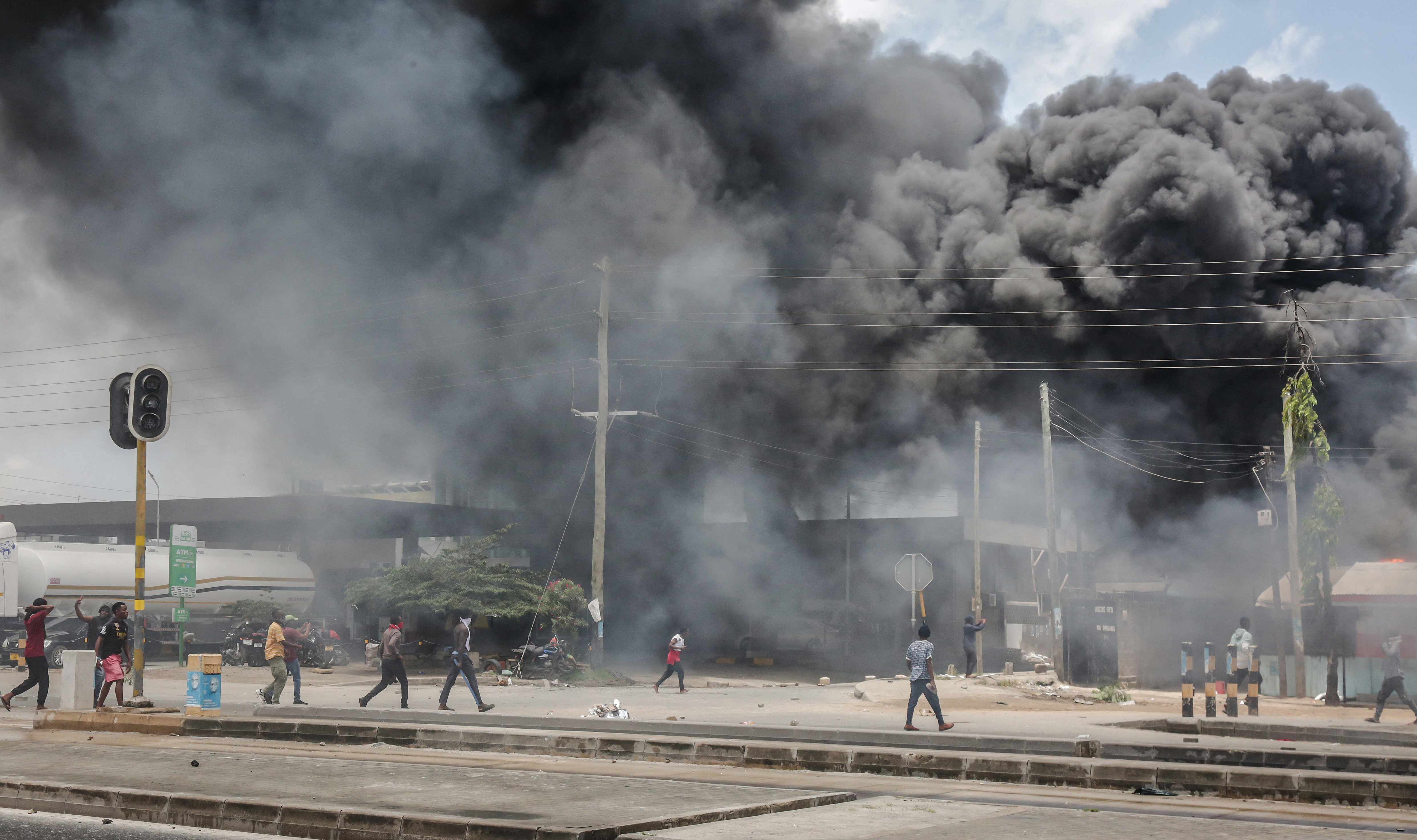
 Protesters gather near burning buildings and barricades as clashes erupt in Dar es Salaam on 29 October 2025, during Tanzania’s presidential elections. Tanzania charged more than 100 people on 7 November 2025 with treason over their alleged involvement in protests around the election, according to two judicial sources. (Photo: AFP)
Counting the bodies in the aftermath of Tanzania’s bloodiest election is no easy task. The protests were not confined to one city or one region; they broke out across the country — from the port streets of Dar es Salaam to the lake shores of Mwanza, from Mbeya in the highlands to Arusha at the foot of Mount Meru. The violence was swift, coordinated, and, according to witnesses, unmistakably deliberate.
Hardly any foreign journalists were present. International election observers had either been restricted or never invited in the first place. Doctors and nurses say the security forces removed corpses from public streets before dawn, loaded them onto military trucks and drove to unknown sites.
Lawyers and clergy report that entire neighborhoods now speak only in whispers of mass graves. Ordinary citizens know the truth, but fear is a muzzle more total than any gag order.
Yet, even under these conditions, an outline of the toll is emerging. Though these numbers are tentative, medical associations and legal human rights groups say they have been able to confirm at least 3,500 dead through direct access to morgues, burial registers and hospital records.
In Dar es Salaam alone, doctors counted 800 bodies. Families and community networks report another 6,500 missing — sons, daughters, husbands, students, vendors, teachers — last seen being taken by the police or intelligence units during the demonstrations.
/file/dailymaverick/wp-content/uploads/2025/11/13294047-scaled-1.jpg "Tanzania's President Samia Suluhu Hassan. (Photo: EPA / Anthony Siame)")
These are not small numbers. These are not “disturbances”. These figures, if true, describe a mass political killing.
Yet where is the outcry?
Where is the seriousness proportional to the scale of the crime?
Instead, we are witnessing one of the most chilling silences in African public life in recent memory.
Read more: Crackdown on popular dissent in Tanzania as sham election goes ahead
A lesson in fear
President Samia Suluhu Hassan — declared the winner with an implausibly inflated 97% of the vote — insists that the casualty figures are fabrications. She blames “foreign agitators”, “paid activists” and the opposition for staging their own deaths.
This is not a credible defence.
When the state finds itself unable to justify violence, it denies the bodies.
But the scale of the killing is not the only horror. What is more disturbing is the apparent intent behind it. Witness accounts suggest that security forces were not trying to disperse protests — they were trying to teach a lesson. A lesson in fear. A warning against ever again challenging the 63-year rule of the Chama Cha Mapinduzi (CCM), one of the longest unbroken political monopolies in the world.
If the opposition is exaggerating, or if these numbers are wrong, there is one straightforward solution: an independent international investigation. UN High Commissioner for Human Rights, Volker Türk, has already called for one. So have Tanzanian human rights lawyers, religious leaders and the families of the missing.
Yet this call has not been supported with any real pressure from the major diplomatic players.
International blackout
China has invested heavily in Tanzania for decades. Tanzania is one of the Chinese Communist Party’s most important ideological export sites. The party-to-party training schools in Bagamoyo and Dar es Salaam teach the virtues of centralised control and “political discipline”.
The United States has a different stake. It is eyeing Tanzania’s nickel, cobalt, graphite and rare earths — minerals central to the energy transition — and no longer concerns itself with democracy, governance or human rights in Africa. The US will not jeopardise its strategic resource interests unless forced to.
/file/dailymaverick/wp-content/uploads/2025/05/Lissu-with-fist-raised.jpg "Opposition leader Tundu Lissu is defiant as he is brought into court surrounded by court officials. (Photo: Ikoti Lissu)")
The United Arab Emirates is now deeply embedded in Tanzanian logistics, aviation and energy concessions. It is not known for intervening against state repression where commercial advantage is at stake.
And South Africa, which rightly took Israel to the International Court of Justice over the slaughter of civilians in Gaza, has so far been quiet. Tanzania was the ANC’s refuge and staging ground during the liberation Struggle. That history has turned into an emotional paralysis.
The result is a political blackout.
Not Nyerere’s country
If thousands of Tanzanians are dead, then we are not dealing with a contested election. We are dealing with a crime against humanity, as described in the African Charter, the UN Human Rights Covenant, and the Rome Statute.
This is not about foreign interference.
This is about African accountability.
- The African Union Peace and Security Council has the authority to call for a commission of inquiry.
- The Southern African Development Community has the responsibility to prevent regional destabilisation.
- The East African Community cannot ignore the collapse of civic trust in its second-largest member.
- African civil society, including churches and professional associations, must not allow this violence to be normalised.
Tanzania has not always been like this. This is not the legacy of the country’s founding father, Julius Nyerere.
Nyerere believed political power required moral discipline. He believed governance was a trust, not an entitlement. He believed unity was built through persuasion, not fear. He believed leadership meant service, not domination.
One cannot imagine Nyerere celebrating a victory won with blood on the pavement.
Silence is not an option
Tanzania is one of Africa’s most beautiful countries — a land of plains and mountains, coral islands and small farms, wildlife and music, and cultures interwoven for centuries. It has been a place where political disagreement could exist without descending into violence.
That is what is now at risk.
If this violence goes unchallenged, it will not end. Tanzanians have shown an unwillingness to be silenced, and now they can only be subdued.
There is only one route out of this political cul de sac — and that is to engage in a genuine dialogue with the representatives of all Tanzanians — including Tundu Lissu, the leader of the opposition Chadema party, who has been jailed for seven months and charged with treason for agitating for electoral reform.
Had he and other voices in political opposition, civil society and the faith community been listened to, this tragedy could have been averted.
So, to be clear: if there are mass graves, they must be opened. Silence is not an option. DM
Phillip van Niekerk is the managing partner of Calabar Consulting, a risk consulting company specialising in Africa. The views expressed are his own.