




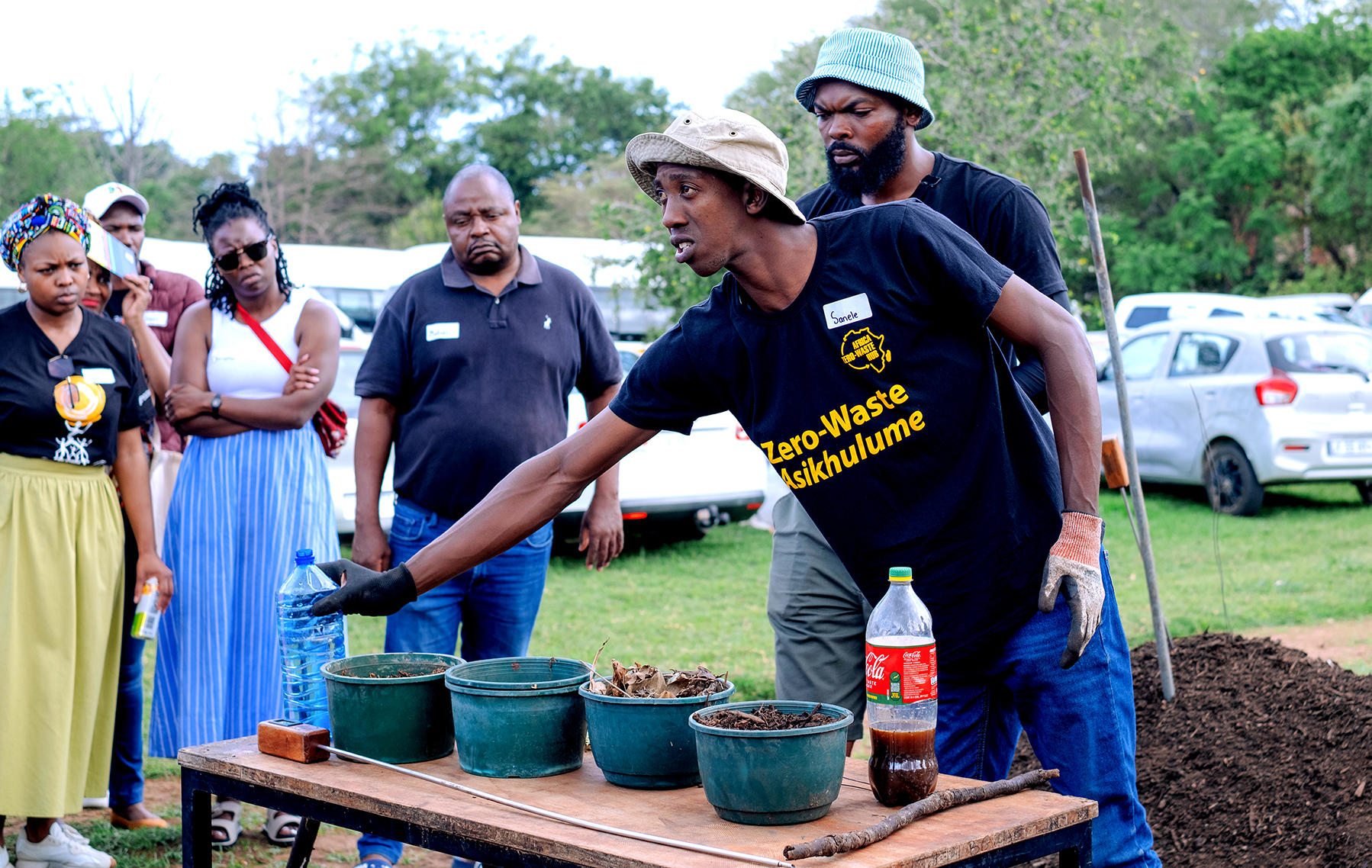
 Participants from the Zero Waste Project demonstrate their knowledge about making compost. (Photo: Tasha Hoseken / Amehlo Productions)
 At the end of October 2025, community activists gathered at Africa’s oldest botanical garden, in Durban, to attend the community-led Just Transition Learning Festival, hosted by groundWork.
The festival brought together various stakeholders such as civil society, academics, waste pickers, rate payers, and informal traders to share their experiences of what it means to be at the forefront of a movement for a truly just transition in South Africa — a transition that centres the knowledge, leadership and lived experiences of people and communities who are dealing with the direct impacts of of environmental degradation and climate change.
Building a just transition from the bottom up
While policymakers, politicians, and financial institutions go back and forth trying to figure out the logistics of a just transition, ordinary citizens are already responding, developing innovative bottom-up methods and coalitions to bring the just transition to life.
/file/dailymaverick/wp-content/uploads/2025/11/101025_Learning_Fest-53-of-138.jpg "The programme for the community-led Just Transition Learning Festival. (Photo: Tasha Hoseken / Amehlo Productions)")
Rather than waiting for a top-down directive, community activists have started doing their own monitoring and research, and have started sharing information and inspiration for how just transition efforts can be pursued in other communities across the country.
At the two-day learning exchange, activists reflected on five seminal projects and campaigns: the People’s Plan for the Right to Housing in an age of Climate Change, the Zero-Waste Project, Energy Democracy, Health and Air Quality, and Community Activist Research. The power behind these projects is their inclusion of marginalised voices — the projects foreground the experiences of people who are often quickly forgotten when our response to sustainability focuses on an elite few and the profits to be gained.
Although the different projects focus on various aspects of a just transition, a review of each project brought to light various cross-cutting themes that were central to mobilising, organising, building alliances and sharing resources. In the case of the Zero Waste Project, project leads highlighted the fact that without their partnership with the eThekwini Municipality, the project would not have been as impactful.
/file/dailymaverick/wp-content/uploads/2025/11/101025_Learning_Fest-135-of-138.jpg "A poster created by the Health and Air Quality campaign detailing the success and challenges that the group has navigated in the past few months. (Photo: Tasha Hoseken / Amehlo Productions)")
What started as a simple collection of organic waste from one market has turned into an organic waste model that diverts waste from three markets, includes informal workers and saves the municipality money. In this instance, informal traders, waste pickers, academics and the municipality have come together, allowing the municipality to save thousands of rand and produce high-quality compost that can be used across eThekwini.
The People’s Plan also bound together myriad people with seemingly vastly different interests. After much engagement, however, it became clear that there was only one interest that trumped them all. The wellbeing of the people. Today, rate payers, hostel dwellers and other civil society actors are working diligently to do their part towards a community-led transition.
What was most apparent during this learning festival was the readiness and eagerness of ordinary citizens to come together and plan for a more sustainable future. Rather than being despondent about the challenges they face daily, these groups have chosen to take the challenges in their stride and work through them with the determination to achieve tangible change.
Difficult relationships
Activists took the learning festival as a chance to focus on what works, how to build alliances, how to manage difficult relationships with diverse stakeholders (with competing priorities), how to listen and how to recognise and value expertise that doesn’t come neatly packaged in a university degree.
When we start to see waste pickers as experts in waste, rather than a nuisance to the peace on bin collection day, we realise the power of coming together and drawing on various strengths to live a just transition.
/file/dailymaverick/wp-content/uploads/2025/11/101025_Learning_Fest-11-of-138.jpg "A member of the Community Activist Research campaign shares a moment with a waste picker who attended the festival. (Photo: Tasha Hoseken / Amehlo Productions)")
/file/dailymaverick/wp-content/uploads/2025/11/101025_Learning_Fest-78-of-138.jpg "A participant takes note of information about engaging with community leaders in the interests of building dynamic coalitions. (Photo: Tasha Hoseken / Amehlo Productions)")
/file/dailymaverick/wp-content/uploads/2025/11/101025_Learning_Fest-63-of-138.jpg "A poster created by the Durban coalition highlighting the lessons they learnt in building coalitions across varying interests. (Photo: Tasha Hoseken / Amehlo Productions)")
These community-led campaigns remind us that a just transition will not be delivered from above; it is built from below, through relationships of trust, shared struggle and collective imagination. A truly just transition begins when those most affected by extractive economies take the lead in shaping regenerative futures grounded in dignity, solidarity and care.
A just transition may not happen overnight; it may be progressively achievable, but one must not underestimate the power of the work that is being done.
Preparing for disaster
Activists are already finding fair ways to prepare for disaster, to power all households, to manage waste, to create responsive healthcare systems for high pollution zones, and to document levels of pollution that justify the level of restorative healthcare needed for fenceline communities. The blueprint for a just transition is being plotted steadily across the country by the biggest stakeholders of this country — the people.
According to groundWork project lead and senior researcher at the Environmental Learning Research Centre, Dr Taryn Pereira, in fenceline communities across South Africa people are showing that the just transition is not a policy slogan — it is a lived, collective practice. From campaigns for improved health services in air quality danger zones to socially owned renewable energy, from zero waste movements to people-centred planning for climate resilient housing, communities are not waiting to be invited into the just transition — they are making it real.
Bobby Peek, groundWork’s executive director, explained that a just transition was not just about swapping coal for solar panels. It’s not just about renewable energy; it’s about the people, you and I, governing from the bottom; it’s about democracy, it’s about ensuring that the people of South Africa live dignified lives and have the means to take care of themselves and their families. DM
Nomatter Ndebele is a freelance writer specialising in social justice and human interest stories.