




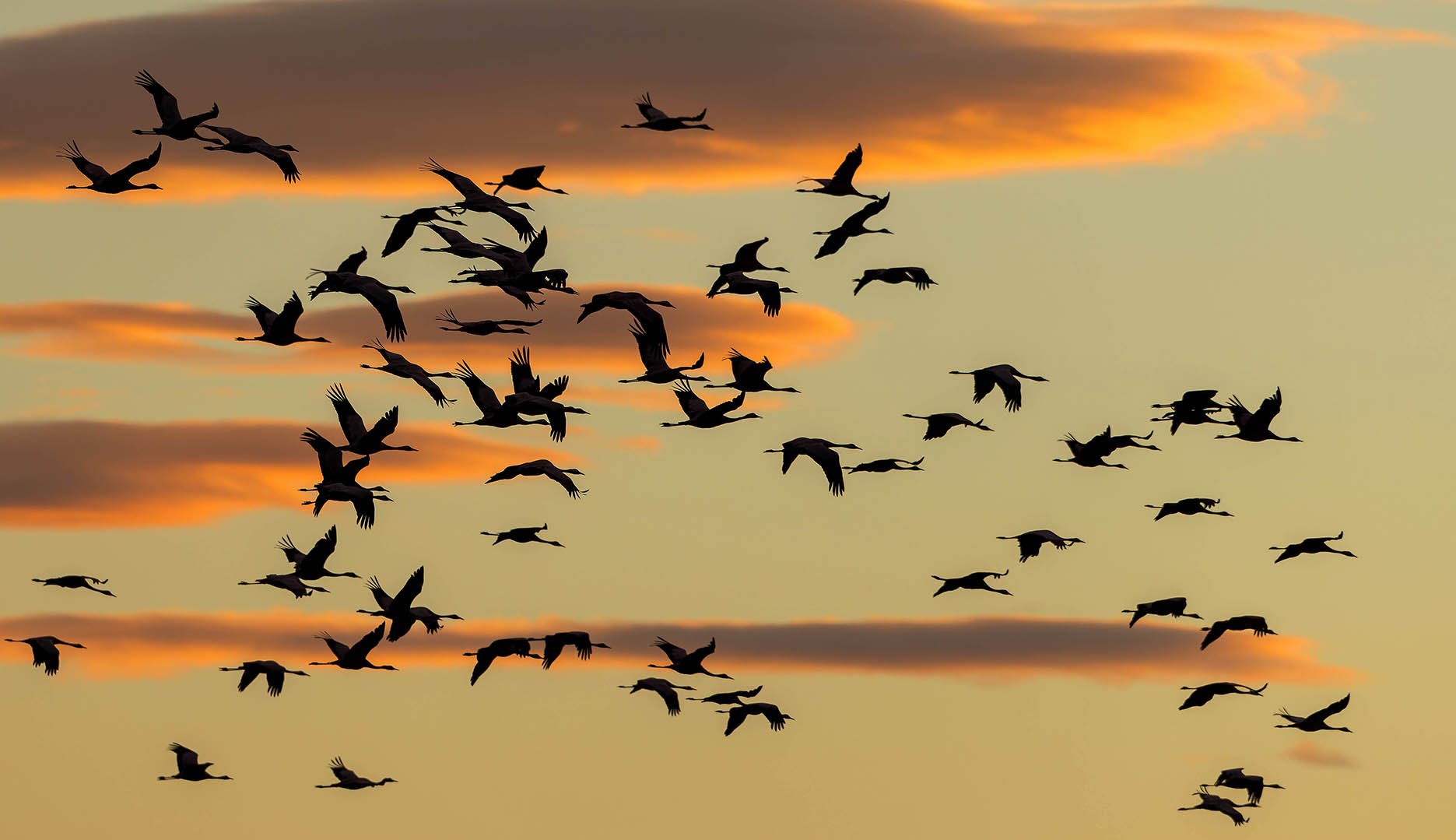
 Common cranes fly over Hungary en route to their wintering grounds in North Africa. Their breeding range extends from Denmark to China. (Photo: Sergey Dereliev)
 The threats to the migratory movements of land-bound wild animals are quite well known. Boundary fences, busy highways, human settlements and other physical obstacles have increasingly blocked or limited their ability to disperse in search of new territory, water or food.
Birds, on the other hand, can fly over many of these obstacles.
/file/dailymaverick/wp-content/uploads/2025/11/migbirds-2-Grey-Crowned-Crane_Balearica-regulorum_Amboseli-NP_Kenya_March-2022_copyright-Sergey-Dereliev-6.jpg "Bird experts have urged governments to develop action plans to protect several bird species, such as African cranes. These include the wattled crane (above), blue crane and black crowned crane. (Photo: Sergey Dereliev)")
Nevertheless, just as motorists need to pull off the highway to rest and refuel on long journeys, several bird species also require places to rest and feed en route during their annual migrations – or during shorter, regional hops in search of food and water.
/file/dailymaverick/wp-content/uploads/2025/11/Migbirds-8-Mangrove-Senegal-image-Wetlands-International.jpg "Mangrove swamps such as this one on the coast of Senegal provide vital stepping stones for travelling birds. (Photo: Wetlands International)")
An expert report published this week has detailed some of the increasingly wide range of threats to predominantly migrant water birds scattered across the vast African-Eurasian “flyway”, spanning 119 countries from the southern tip of South Africa to the frozen tundra of Siberia.
/file/dailymaverick/wp-content/uploads/2025/11/Migbirds-3-map_en_2023_-Source-AEWA.jpg "Migratory waterbirds travel thousands of kilometres each year, crossing continents and oceans between their breeding and wintering grounds. During these journeys, they rely on a network of suitable habitats and encounter a wide range of threats. The Agreement on the Conservation of African-Eurasian Migratory Waterbirds (AEWA) is an environmental treaty dedicated to protecting 255 species of waterbirds and their habitats across Africa, Europe, the Middle East, Central Asia, and a small part of Eastern Canada. (Source: AEWA)")
The report, produced by members of the African-Eurasian Migratory Waterbird Agreement (AEWA), was presented at the beginning of a four-day meeting of government officials and bird experts (November 11-14) from more than 60 countries in Bonn, Germany.
The aim of the meeting is to reduce the pressures and threats faced by 255 species of waterbirds across Africa, Europe, the Middle East, Central Asia and a small part of eastern Canada.
The UN agreement was signed 30 years ago to focus specifically on birds that depend on wetlands and also migrate across borders.
/file/dailymaverick/wp-content/uploads/2025/11/migbirds-4-power-line-pic-tony-carnie.jpg "Powerlines and wind turbines add to the multiple threats faced by migratory birds. (Photo: Tony Carnie)")
AEWA executive secretary Dr Jacques Trouvilliez says the agreement has become a symbol of international collaboration, guiding science-based conservation on a flyway scale for millions of migratory waterbirds.
“Despite commendable progress made under AEWA, the latest population trends available show that too many populations continue to decline. It is clear our collective efforts must be intensified if we want to reverse these trends and secure the long-term survival of migratory waterbirds.”
Biggest threats
The three biggest threats identified in the latest status report are “biological resource use” (unsustainable hunting and bycatch in fisheries), human infrastructure development and the expansion and intensification of agriculture.
/file/dailymaverick/wp-content/uploads/2025/11/Migbirds-5-agriculture-image-Szabolcs-Nagy.jpg "The clearance of land for intensive farming operations is one of the single biggest threats to migratory waterbirds. (Photo: Szabolcs Nagy)")
/file/dailymaverick/wp-content/uploads/2025/11/Migbirds-9-Coastal-construction-image-Szabolcs-Nagy.jpg "Sport, leisure and tourist development can destroy or degrade vital feeding areas for avian migrants. (Photo: Szabolcs Nagy)")
Roughly 40% of AEWA waterbird species are affected by these threats, with hunting reported to affect 106 waterbird populations – mostly ducks, geese and swans, as well as sandpipers, snipes and phalaropes.
The report notes that large sections of inland and coastal wetlands are being drained for farming or developed for sports, tourism and leisure facilities.
Drainage alone, for farming and the development of urban and industrial areas, now affects the habitat of one-third of the AEWA bird populations.
/file/dailymaverick/wp-content/uploads/2025/11/Migbirds-6-African-Skimmer_Rynchops-flavirostris_Botswana_September-2023_copyright-Sergey-Dereliev-4.jpg "The African skimmer is an intra-African migrant, moving south to breeding areas like the Zambezi and Okavango rivers during the dry season and returning north with the rainy season. Its distribution extends from Senegal in the west to Ethiopia and Mozambique in the east, and south to northern Namibia and Botswana. (Photo: Sergey Dereliev)")
/file/dailymaverick/wp-content/uploads/2025/11/Migbirds-7-Shoebill-cropped-pic-Sergey-Dereliev.jpg "The odd-looking shoebill is a large waterbird mainly found in freshwater swamps of eastern and central Africa. Although not a migratory species, these birds are forced to move seasonally in search of fish as water levels vary. The total population has been estimated at around 5,000-8,000 birds after declining in several areas, including the Sudd swamplands of South Sudan, due to oil exploration. (Photo: Sergey Dereliev)")
It also warns that the impact of highly pathogenic avian influenza outbreaks in wild birds since the early 2020s has yet to be adequately assessed.
For example, more than 26,000 Cape cormorants died along South Africa's Western Cape and the Namibian coast during 2021-2022, representing 7% of the population.
First detected in Europe, it later spread to Africa, Asia, the Americas and Antarctica and had led to “significant mortality in both bird and marine mammal populations”.
“The virus has been detected in over 500 species of wild birds, though global estimates of some ~300 million bird deaths to date are mainly based on carcasses recorded, which clearly represents a significant underestimate.”
More than 2,200 great skuas and 13,300 barnacle geese died during an outbreak in Scotland. The death of 5,200 common terns wiped out about 1% of the West African population of this species.
The authors emphasise the importance of protecting a chain of healthy wetland “stepping stones” for migrant species that cross national boundaries.
These vital habitats included areas such as the Okavango Delta and the Banc d’Arguin in Mauritania, a vital spawning ground for numerous fish species.
Disturbingly, Africa was now home to the highest number of AEWA-listed species on the IUCN Red List of Threatened Species.
/file/dailymaverick/wp-content/uploads/2025/11/Migbirds-10-extict-bird-Source-AEWA.jpg "One of the last slender-billed curlews, photographed by Michel Brosselin on the coast of France. The species was declared officially extinct in October 2025. (Source: AEWA)")
One species was crossed off permanently from the list just last month when the International Union for Conservation of Nature (IUCN) officially declared the slender-billed curlew as extinct.
The last confirmed sighting of the species was at Merja Zerga, Morocco, just over 30 years ago. This migratory bird once travelled between 30 range states from Siberia to North Africa. DM