




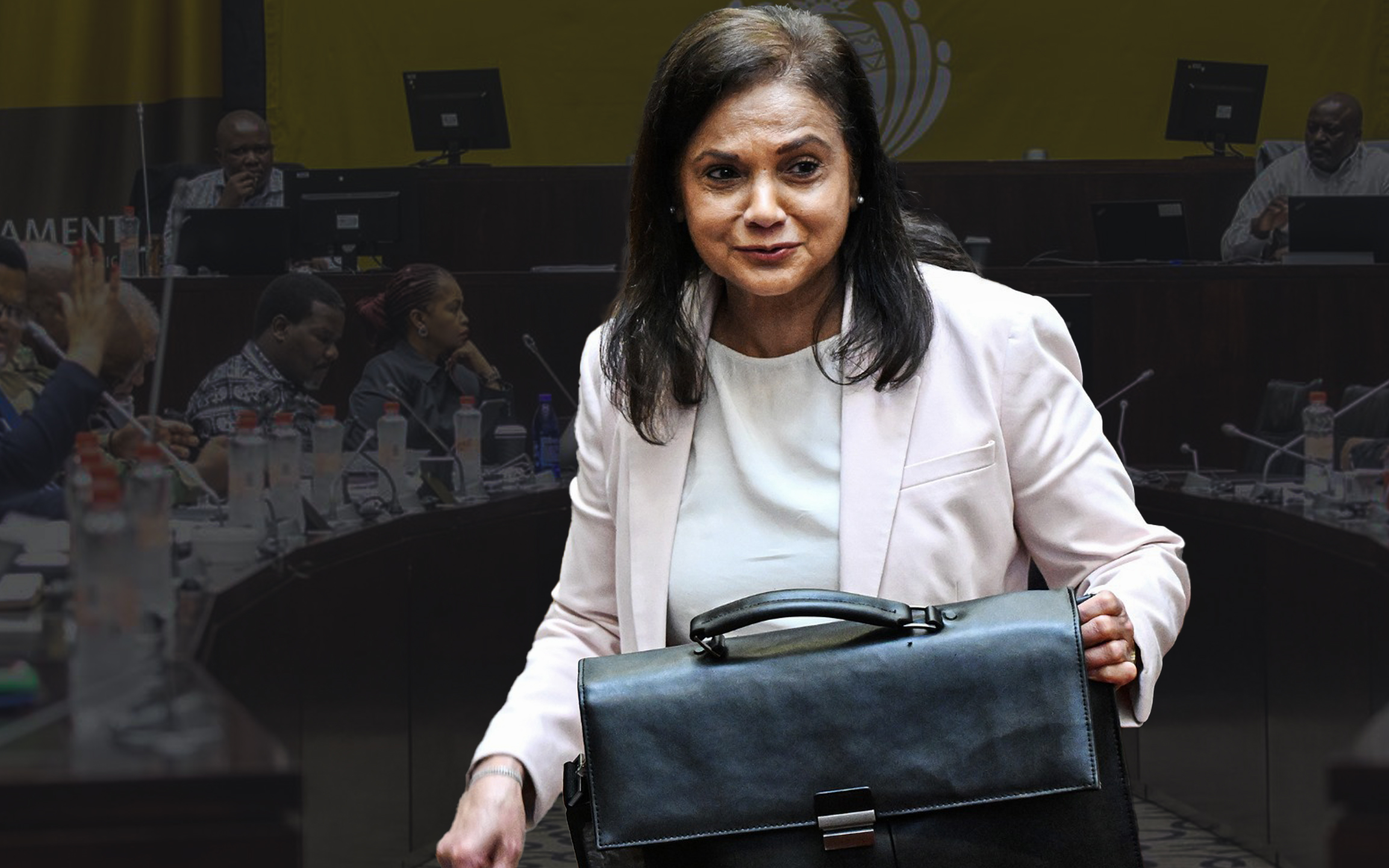
 Illustrative image | Advocate Shamila Batohi, National Director of Public Prosecutions, appears before the ad hoc committee that is investigating the allegations made by KZN commissioner Nhlanhla Mkhwanazi. (Photo: Phando Jikelo / Parliament RSA)
 “Our crime is ravaging our country, and it seems like we are watching this movie in front of us in slow motion, and those of us in power that should be doing something about it are powerless to do anything about it… that the criminals are taking over our country, organised criminals.”
These are the words of National Director of Public Prosecutions Shamila Batohi, who was testifying on Tuesday, 11 November 2025, before Parliament’s ad hoc committee.
It is investigating accusations that a drug trafficking cartel has infiltrated the country’s politics and criminal justice system, including the South African Police Service (SAPS) and the National Prosecuting Authority (NPA).
Members of the #AdHocCommittee questioning NPA Head Adv Shamila Batohi on what steps have been taken since Gen #Mkhwanazi’s media briefing.
Adv Batohi says she’ll write to the National Commissioner to obtain names of prosecutors allegedly involved in criminal activities #PKTT… pic.twitter.com/jOpNbZzAUy
— Justice-and-security-Cluster (@JustSecuCluster) November 11, 2025
Batohi on Tuesday emphasised that there were honest prosecutors in the country who were working very hard.
She also pointed out that their work environment left them unsure of who to trust and that there had been attempts to infiltrate the prosecuting authority.
At the same time, organised crime was unwieldy.
‘We’re not winning’
Batohi referenced high-profile cases and said: “The reality is that we are not winning the fight against organised crime in this country.”
She said solid intelligence was needed for proper investigations and that the “follow the money” adage was accurate.
Money trails needed proper investigation.
During a question-and-answer session with MPs, Batohi was asked what had “broken” in the country that was resulting in the organised crime situation.
She first responded by saying: “How much… time do you have? I really don’t know where to start.”
Read more: Kidnapping and ‘body bags threat’ add sinister edge to SA’s clashing State Capture narratives
This was when Batohi likened what was happening in South Africa to watching a slow-motion movie in which figures of authority were powerless to act as criminals took over.
Part of her work to tackle high-level lawbreaking included authorising racketeering prosecutions.
But she said the number and type of related cases did not instil “confidence” that top-tier criminality was being dealt with.
Appearing to highlight staff shortages in the SAPS, Batohi said the former Hawks head, Godfrey Lebeya, previously pointed out that the unit, which focuses on tackling priority crimes, was functioning at 50% capacity.
She also said that a clean Crime Intelligence was needed to deal with lawbreaking.
The Crime Intelligence unit, though, is now central to accusations that a drug trafficking cartel has infiltrated law enforcement.
‘We don’t know who to trust’
During Tuesday’s ad hoc proceedings, Batohi acknowledged that crooks had also targeted the prosecuting authority.
She confirmed that in a media interview in June this year, she made comments about the infiltration of the NPA.
Batohi had sought to clarify this the next day.
She did so again in Parliament during the ad hoc proceedings on Tuesday.
Batohi said: “I had received confidential intelligence that there was a very concerted attempt to compromise members of the prosecuting authority, also [a] concerted attempt to undermine and attack the National Director by individuals who are seeking to undermine the rule of law in this country.”
She added that this was not “passage talk,” but conveyed to her in a formal meeting with a member of a particular agency.
Batohi did not identify the agency and individual.
She had told the Minister of Justice and briefed President Cyril Ramaphosa about the infiltration information.
Batohi also said that the infiltration, which she spoke about publicly, had caused concern among prosecutors, most of whom were “hard-working” and “committed”.
“We work in a work environment where we don’t know who to trust; that is the reality,” she said.
“Even sometimes within the prosecuting authority, definitely within the SAPS.”
Suspect colleague
During Tuesday’s ad hoc proceedings, Batohi confirmed that former Crime Intelligence head Dumisani Khumalo and National Police Commissioner Fannie Masemola told her about “a particular member” of the prosecuting authority who was allegedly involved in “organised criminality”.
She had referred this matter to the NPA’s Investigating Directorate Against Corruption (Idac).
Batohi refused to name the individual in Parliament on Tuesday, saying the allegations had not yet been proven.
Several MPs pushed her to name the person, but she would not budge.
Read more: Andrea Johnson rejects ‘Witch-Hunt’ claims as policing scandal exposes deep rifts
EFF leader Julius Malema pointed out to Batohi that the ad hoc committee had even discussed “pillow talk here, that’s how far we go”.
He was referencing Idac head Andrea Johson, who last week told MPs that she and her Crime Intelligence officer husband never discussed their work because “pillow talk gets people killed”.
After an hour-long lunch break during Tuesday’s proceedings, Batohi said she would get a legal opinion on whether to submit the wanted name to the ad hoc committee in a document or to provide it during a closed session.
MPs were still unhappy with this.
Committee chairperson Soviet Lekganyane said a closed session would be held on Tuesday evening for Batohi to reveal the name to only MPs.
But after a later adjournment, Batohi said the committee should reconsider requesting the individual’s name as it involved an active investigation, and the person concerned “is not even aware” they were under investigation.
All political parties present agreed to withdraw the request for the name.
Fitness for office
Earlier this year Ramaphosa suspended Gauteng Director of Public Prosecutions Andrew Chauke, and an inquiry into his fitness to hold office was established.
Batohi had recommended Chauke’s suspension about two years earlier.
She said there had been a delay between that and the suspension’s implementation.
Batohi added that when new Justice and Constitutional Development Minister Mmamoloko Kubayi was appointed in December 2024, this was one of the first issues Kubayi looked at.
/file/dailymaverick/wp-content/uploads/2023/08/Screenshot-2023-08-14-at-20.55.06.png "South Gauteng Director of Public Prosecutions Andrew Chauke. (Image: YouTube / SABC | Image sharpened using AI)")
Read more: Ramaphosa suspends Andrew Chauke, alleged State Capture enabler and South Gauteng prosecutions head
When MPs questioned if the delay in Chauke’s suspension had been caused by the inaction of the previous minister, Thembi Simelane, Batohi did not want to comment on possible reasons.
Batohi told MPs on Tuesday that the inquiry into Chauke’s fitness to hold office was set to commence this coming Monday.
She assured South Africans: “When there are allegations against any prosecutors… we do not sweep it under the carpet.”
Earlier this year, KwaZulu-Natal police commissioner Nhlanhla Mkhwanazi sparked the law enforcement scandal that the ad hoc committee is now investigating when he made the accusations that a drug trafficking cartel had infiltrated structures, including the NPA.
Batohi on Tuesday said she would request the names of individuals in the authority against whom Mkhwanazi made the accusations.
Earlier during the proceedings, she said: “We are at a… critical inflection point, in terms of consolidating the rule of law and accountability.
“We should use this as a catalyst for comprehensive institutional reforms.”
Going after the Guptas – again
Batohi’s tenure as prosecutions boss was focused on during Tuesday’s proceedings.
She started as the national public prosecutions head in 2019 and is set to retire at the end of January.
Batohi had taken over the role following a period of State Capture that coincided with Jacob Zuma’s presidency.
At that stage, there were “huge challenges” in the NPA.
Batohi said this had included a lack of resources, capabilities, and demotivated staff.
The plan had therefore been to rebuild and strengthen the NPA, and Batohi said that even though much still needed to be done, she was proud of what had so far been accomplished.
She testified on Tuesday that the Zondo Commission of Inquiry, which investigated State Capture mostly under Zuma’s presidency, had not provided a blueprint for prosecutions, but rather leads that still needed some investigation.
Read more: ‘Respiratory failure’ and illness in India — how wanted Gupta brothers have skirted SA enforcement
The Guptas were also referenced.
Rajesh and Atul Gupta are wanted in South Africa in connection with State Capture crimes, including fraud and money laundering.
In 2022, they were arrested in Dubai in the United Arab Emirates and the following year managed to avoid extradition to South Africa.
Batohi on Tuesday testified that the prosecuting authority was “still trying to understand” why they had not been successful in extraditing the Guptas.
The United Arab Emirates had provided reasons, but she said these did not make sense.
Batohi said another request, with additional charges, would be made for their extradition “fairly soon”.
She hoped this would be before the end of the year and said it would happen before she concludes her time in office – January next year.
The ad hoc committee is expected to proceed on Thursday when sidelined police minister Senzo Mchunu’s chief of staff Cedrick Nkabinde is set to testify. DM