




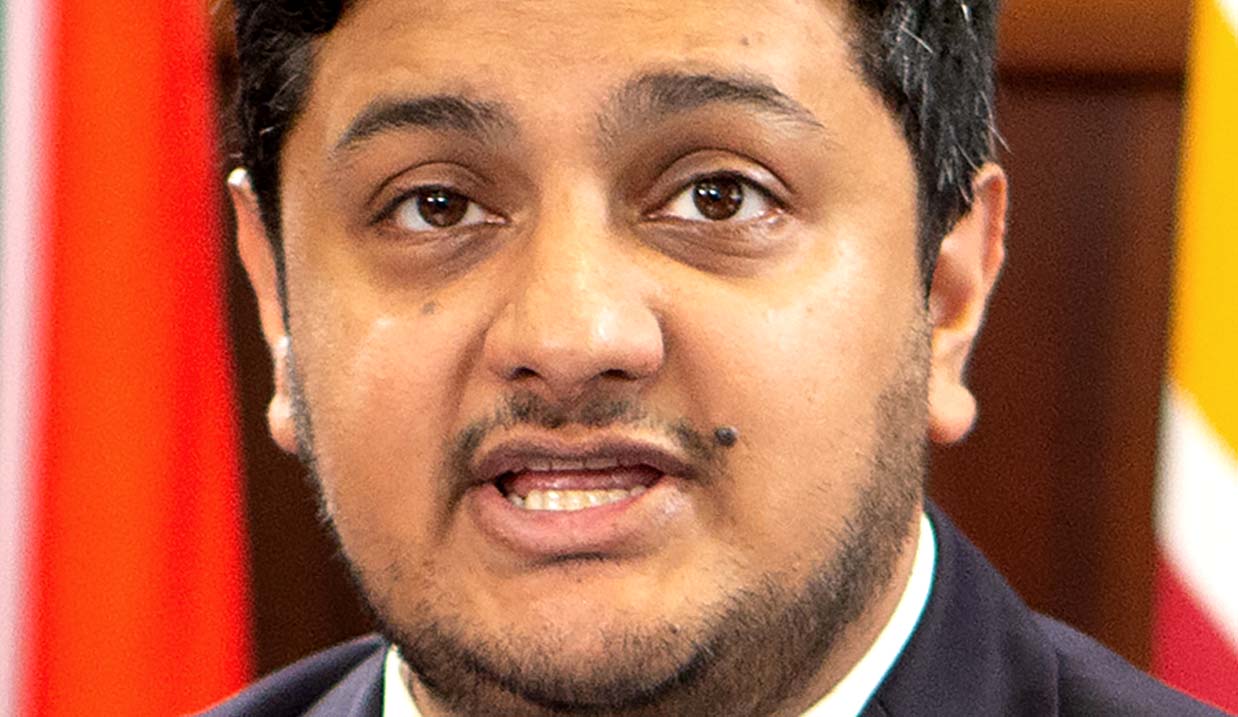
 Deputy Finance Minister Ashor Sarupen (Photo: Gallo Images / Misha Jordaan)
 Kicking off the media briefing, Deputy Finance Minister Ashor Sarupen noted that South Africa’s economic outlook is on an upward trend, with the government meeting fiscal targets and economic growth of 1.8% per year expected over the next three years.
“The reliability of Eskom has improved dramatically while Transnet has stabilised port volumes. The good news is that the healthier public finances will benefit South Africa both now and in the future. Fiscal discipline builds credibility and even in a low growth environment, we are on track to meet our targets,” he said.
In his speech, Finance Minister Enoch Godongwana said the strategy for faster growth and healthier finances continues to be anchored by four pillars:
- The first is maintaining macroeconomic stability;
- The second is implementing structural reforms;
- The third is building state capability; and
- The fourth is supporting growth-enhancing infrastructure.
Debt down
South Africa’s debt service costs now cost 21 cents of every rand in revenue, while the primary fiscal surplus is set to grow over the next three years. “Government debt will stabilise in 2025/26, at 77.9% of GDP. This is the first time since the 2008 financial crisis that public debt will not grow as a percentage of GDP,” Godongwana said.
Sanisha Packirisamy, economist at Momentum Investments, observed in an economic note ahead of the MTBPS that the government’s spending profile remains dominated by civil servant wages, debt-service costs and social transfers, which together absorb more than two-thirds of total expenditure.
“Encouragingly, a recent moderation in government bond yields has eased some pressure on interest payments, though debt-service costs have still risen sharply since FY2021/22 – outpacing the growth of GDP, revenue and non-interest spending,” she said.
The MTBPS pointed out that for much of 2025, government borrowing rates have been declining, leading to a reduction in debt-service costs. “This is in part due to positive sentiment associated with the steady improvement in the fiscal position,” the document stated.
Procurement payments dashboard
To improve transparency and public accountability, National Treasury launched a Procurement Payments Dashboard today. It will draw procurement information from various government payment systems, supplemented by contract data reported on the eTender Portal and supplier information from the Central Supplier Database.
The published data will include supplier and ownership details, as well as details on the procurement transactions and payments made to suppliers. This will enable members of the public to scrutinise procurement data, strengthening accountability and trust.
“This is an enormous step forward in transparency, which we will be supplementing and improving continuously. It will certainly be a strong mechanism, with an impact on quality of service delivery and overall accountability,” Treasury director-general Duncan Pieterse said.
Ghost worker audit
Using new data-driven approaches, the government has also launched a process to remove ghost workers from the payroll. Initial results from this process flagged 8, 854 cases where individuals were receiving payments from multiple departments, were inactive employees or had bank account anomalies. The ghost worker identification process will also identify individuals appearing on multiple government systems.
Pieterse elaborated during the media briefing: “The programme will identify ghost workers using cross-references looking at tax data and the national population register. The idea is to identify high-risk jobs – for example, where there are multiple basic salary cases, a mechanism will be introduced to get workers to identify themselves. The plan is to start eliminating ghost workers next year,” he said.
The MTBPS said the partnership between Treasury, the Department of Home Affairs and the South African Revenue Service would analyse payroll, population and tax data to identify potential ghost workers.
A two-month verification process will begin in January 2026, followed by appropriate legal action.
The next phase of this project will use a single sign-on application being developed for public servants as well as improvements to the government payroll system to automate monitoring to prevent irregularities and improve spending efficiency. DM
Comments
Scroll down to load comments...