



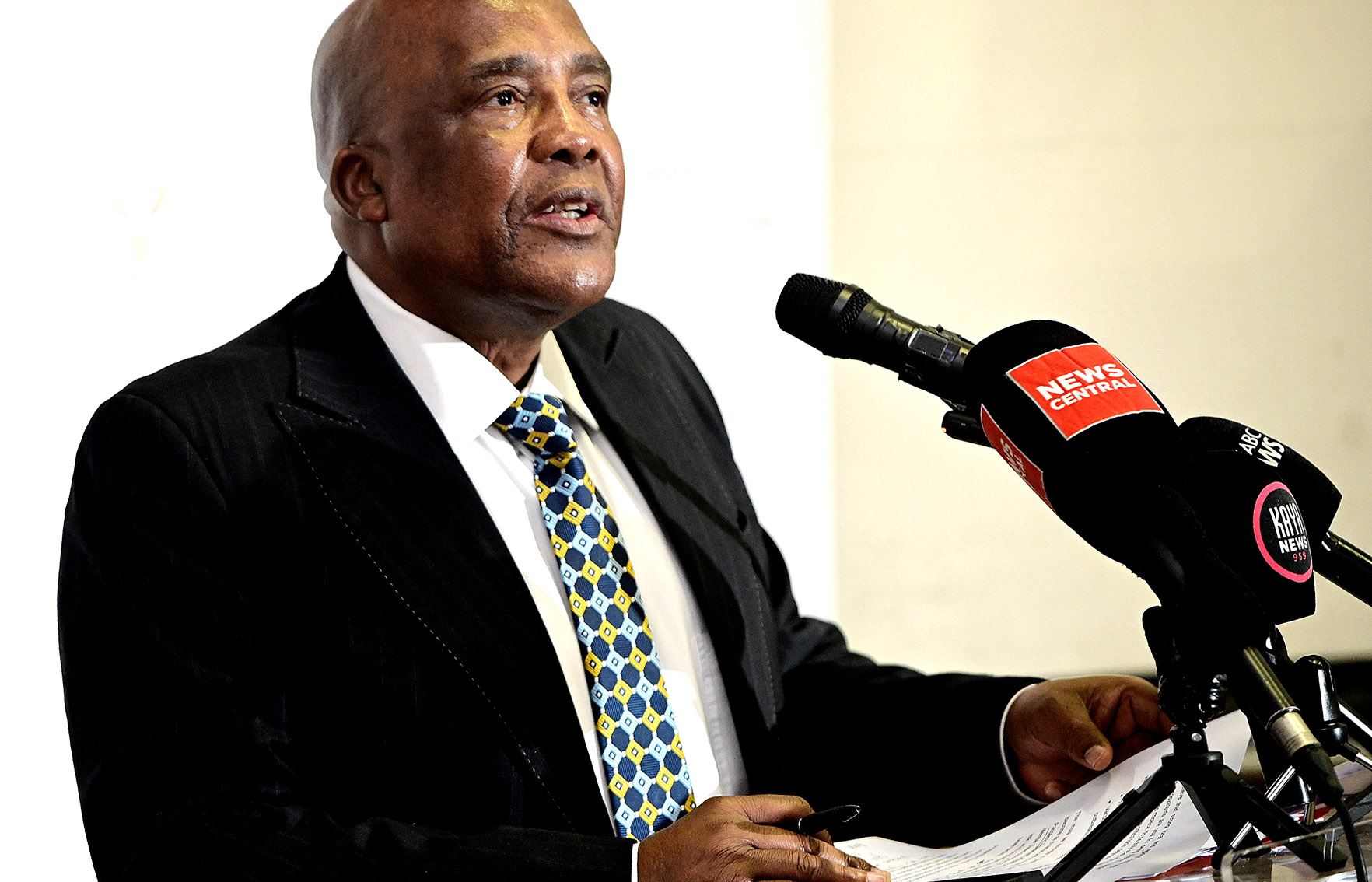
 Health Minister Dr Aaron Motsoaledi speaks at the launch of the clinical trial for the oral cholera vaccine, the first vaccine to be fully developed in SA in over 50 years, at Chris Hani Baragwanath Hospital in Johannesburg on 11 November. (Photo: Supplied / Biovac)
 The South African biopharmaceutical company Biovac has launched clinical trials for its oral cholera vaccine (OCV-S), after receiving approval for the process from the South African Health Products Regulatory Authority (Sahpra). It marks the first time a vaccine has undergone end-to-end development in South Africa in more than 50 years.
Biovac CEO Dr Morena Makhoana said cholera was a “relevant disease” affecting developing countries across Africa. The oral cholera vaccine has been in development at the company since 2022, following a technology transfer from the International Vaccine Institute in South Korea.
“It’s the first time that we have our own regulator [Sahpra] scrutinising a locally made vaccine, from our facilities where it was manufactured — what we call drug substance — [to] ... the design of the clinical trial,” said Makhoana at Chris Hani Baragwanath Hospital, Johannesburg, on Tuesday, 11 November.
/file/dailymaverick/wp-content/uploads/2025/11/MAIN.jpg "Dr Morena Makhoana, CEO of Biovac, speaks at the launch of the clinical trial. (Photo: Supplied / Biovac)")
The South African Medical Research Council (SAMRC) will be leading the clinical trials for the vaccine. Professor Glenda Gray, SAMRC chief scientific officer and distinguished professor in the Faculty of Health Sciences at Wits University, said the OCV-S trials were a “historical landmark” for South Africa and a “vital step” in strengthening the country’s response to infectious diseases.
“The SAMRC has extensive experience in designing and conducting clinical trials, and this project aligns with our mandate to drive research and innovation that improves the health and wellbeing of all South Africans,” she said.
/file/dailymaverick/wp-content/uploads/2025/11/Chosen-3.jpg "Professor Glenda Gray speaks at the launch of the clinical trial. (Photo: Supplied / Biovac)")
Read more: Biovac launches ’state-of-the-art’ Cape Town lab to manufacture end-to-end vaccines
Preventative measure
In an interview with Daily Maverick, Makhoana noted that the OCV-S would typically involve two doses for patients, and could be used as a preventative measure for the disease during an outbreak.
Biovac has budgeted for an 18-month clinical trials process, with the hope of enrolling 3,000 participants. The first stage will involve a “safety study” in which a small group of people will undergo health screenings and receive the vaccine.
“Historically, there was no clear forecast and demand certainty for manufacturers to get into the cholera game, because how can you predict outbreaks? And then what if you just manufacture for outbreaks? It’s not a sustainable model.
“But … over the past few years, the vaccine community, led by [the World Health Organisation], Unicef, Gavi [the Vaccine Alliance] and others, have come out with a forecast that says that we do need to respond to outbreaks, but it’s important that we … prevent disease,” explained Makhoana.
Biovac received funding support for the development of the OCV-S from the Gates Foundation, the Wellcome Trust, Open Philanthropy and Elma Philanthropies.
/file/dailymaverick/wp-content/uploads/2025/11/Chosen-4.jpg "The launch of the clinical trial at Chris Hani Baragwanath Hospital. (Photo: Supplied / Biovac)")
Makhoana anticipates that once approved, the vaccine will largely serve an African market. He identified Democratic Republic of the Congo, Ethiopia and Nigeria as “hotspot” areas that had been affected by cholera outbreaks.
“We are happy that our product can go anywhere, because we don’t have a limitation. But … [if we] assume that there’s only 30 million doses that we can produce, we think a lot of that will be absorbed on the continent,” he said.
When asked what measures Biovac had taken to ensure the vaccine would be affordable for its prospective market, Makhoana said the technology transfer the company received from the International Vaccine Institute allowed it to develop a “simplified” version of the vaccine. While an older iteration of the vaccine was made up of five “ingredients”, OCV-S required only two.
“That reduces your cost of goods. Instead of manufacturing five things and repeating the whole process, you only have to do two,” said Makhoana.
State in support
In a statement on Tuesday, the Department of Science, Technology and Innovation said the number of cholera outbreaks had been growing in Africa, coinciding with repeated shortages of cholera vaccines that left communities vulnerable to unnecessary disease and deaths.
“The African Union has set a target for 60% of all routine vaccines used in Africa to be manufactured on the continent by 2030, a major advancement from today’s level of less than 1%. Biovac’s achievement represents tangible progress towards this goal,” stated the department.
At the launch of the clinical trials for the OCV-S, Minister of Health Dr Aaron Motsoaledi noted that the Covid-19 pandemic had exposed the “dangers of dependence” when it came to vaccine access.
“Building local vaccine manufacturing capability is not a luxury; it is a national necessity. It strengthens our sovereignty, enhances our health security, and ensures that our people are not left behind when the next global health crisis strikes,” said Motsoaledi.
South Africa had faced periodic cholera outbreaks, said Motsoaledi, including a deadly surge in cases in 2023 that pushed the National Department of Health to review its National Cholera Guidelines, aligning them with the Global Task Force on Cholera Treatment.
“If we have a locally manufactured oral cholera vaccine, it would mean that we will be better equipped to protect vulnerable populations, respond quickly to outbreaks and save lives,” he said. DM