




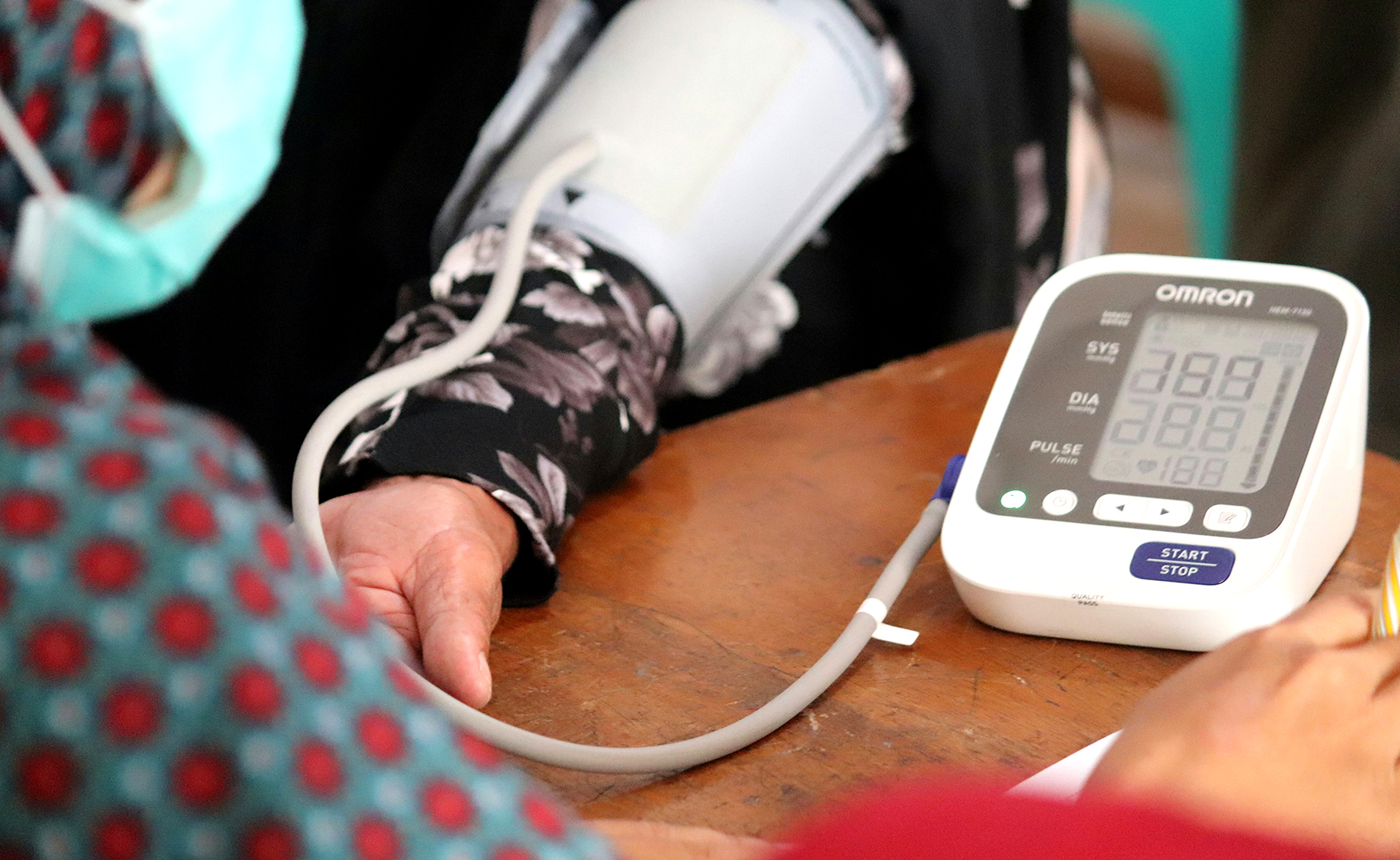
 High blood pressure is a major contributor to South Africa’s growing burden of noncommunicable diseases. (Photo: Mufid Majnun / Unsplash)
 Often described as a “silent killer”, high blood pressure (hypertension) is a major contributor to South Africa’s growing burden of noncommunicable diseases, because of its many complications, including cardiovascular disease, kidney disease, heart failure, heart attack and stroke.
The recently published Global Burden of Disease 2023 report explained that noncommunicable disease rates are rising rapidly in low- and middle-income countries. High blood pressure was ranked the fifth-highest risk factor driving the most death and disability combined in South Africa in 2023, according to the report. The top risk factor was unsafe sex, followed by malnutrition.
/file/dailymaverick/wp-content/uploads/2025/11/Lancet-1.jpg "Leading Level 3 causes of global deaths and age-standardised mortality rate per 100 000 population for all sexes combined, 1990, 2019, 2021, and 2023The 20 leading causes of death are shown in descending order. Causes are connected by lines between time periods; solid lines represent an increase or lateral shift in rank and dashed lines represent decreases in rank. Alzheimer's disease=Alzheimer's disease and other dementias. Cirrhosis=cirrhosis and other chronic liver diseases. COPD=chronic obstructive pulmonary disease. Lung cancer=tracheal, bronchus, and lung cancer. (Source: The Lancet)")
Yet, as Spotlight has reported, South Africa is falling short of the targets set out in its National Strategic Plan (NSP) for the prevention and control of NCDs (2022-2027). The hypertension targets are that 90% of people over 18 will know whether they have raised blood pressure; 60% of people with raised blood pressure will receive interventions; and 50% of people receiving interventions for hypertension will have controlled blood pressure levels. The available data suggests that, on the first target in particular, South Africa is falling far short, with cascading effects for the other two.
Some good news is that findings from a new study point to how we might improve hypertension control among adults who know they have high blood pressure (the second target in the NSP). The innovation is not a new pill or injection, but simply to use community healthcare workers to take the management of blood pressure out of clinics and into people’s homes.
/file/dailymaverick/wp-content/uploads/2025/11/Lancet-2.jpg "Percentage change in global age-standardised mortality rate from 1990 to 2023 among the leading 30 Level 3 causes of death, for males and femalesFigure shows the top 30 causes according to their global age-standardised mortality rate, sorted by percentage change from 1990 to 2023 in females, in descending order. COVID-19 and causes affecting only one sex (ie, cervical cancer) were omitted. (Source: The Lancet)")
How the study was conducted
The researchers split 774 adults in KwaZulu-Natal into three groups. One group (257 people) was cared for at home by community health workers, the other group (258 people) received enhanced care at home by community health workers, and the last group (259 people) received the standard of care at the clinic. Almost all of the study participants remained in the study for the full six months of follow-up.
The participants were screened for high blood pressure – defined as two readings of at least 140 millimetres of mercury (mm Hg) systolic and/or 90mm Hg diastolic, taken at least six months apart. Systolic pressure is the upper number you’ll see on a blood pressure monitor and diastolic is the lower number. Systolic blood pressure is the pressure in the arteries when the heart beats, and diastolic blood pressure is the pressure in the arteries when the heart rests between beats.
All participants were seen by a nurse when they were enrolled so they could be started on the appropriate antihypertensive medicines available in the public sector. These were either hydrochlorothiazide, lisinopril, amlodipine or a combination of these drugs. They were then randomised to the three study arms.
In the standard-of-care arm, participants had to go to the clinic every month to have their blood pressure measured by a nurse, have their blood pressure medications adjusted as needed, and then collect those meds from the pharmacy at the clinic.
In the community health worker group, participants were given an automated blood-pressure machine and were trained to use it by the community healthcare workers. They had to take their blood pressure every day (or six to 10 times per week), and the community healthcare workers visited about once a month to check on the participants and to record the readings on a mobile app. The data was then sent to the nurses at the clinics to be reviewed and they then entered a prescription for the appropriate medicine and dose based on the average blood pressure readings. The community healthcare workers then got a prompt to pick up the medicine and deliver it to the participants.
In the enhanced community healthcare workers group, participants got a blood pressure machine with mobile connectivity. The daily readings (or between six and 10 readings per week) were sent directly to the app used by the nurses. Community healthcare workers would visit the participants about once a month to check that the machines were working, check on the participants and to deliver the medicines. With the exception of the blood pressure readings getting sent straight to the nurses, everything was done in a similar way to the previous group.
Remarkable findings
The result showed that, after six months of care, both groups of participants who were cared for at home by community healthcare workers had a greater reduction in blood pressure than those receiving the standard of care at clinics.
In the standard-of-care arm, the average systolic blood pressure of participants did not really change much compared with what it was at the start of the study, going down by about 1.9mm Hg. In the community care arms, the average systolic blood pressure for participants was strikingly different than at the outset. It was about 9.1mm Hg lower in the community healthcare group and 10.5mm Hg lower in the enhanced community healthcare group.
If you compared the groups, the average systolic blood pressure of the community healthcare group was 7.9mm Hg lower than in the standard-of-care group after six months. The participants in the enhanced community healthcare group had an average systolic blood pressure that was 9.1mm Hg lower than the standard-of-care group after six months.
In the standard-of-care group, 32.5% of people had their blood pressure under control at six months, compared with 57.4% in the community health worker group, and 61.3% in the enhanced community health worker group.
The study findings were published in September in the New England Journal of Medicine, one of the world’s top medical journals.
‘The amount you really want to get’
“We basically moved chronic disease care from the clinic, which we think is inconvenient and costly, to the patient’s home,” Professor Mark Seidner, the study’s principal investigator, told Spotlight. Seidner is a health systems researcher and a clinical triallist working at the Africa Health Research Institute in KwaZulu-Natal, and professor of medicine at Harvard Medical School in Boston.
The challenges with how hypertension care is currently delivered, Seidner said, include the inconvenience of going to the clinic for a blood pressure reading, blood pressure machines not working, long clinic waiting times, the expense of travelling to the clinic, and nurses being overwhelmed by the long queues of patients waiting for care.
He said reducing someone’s blood pressure at the levels that were seen in the home-based care arms is on par with the ideal “amount you really want to get” as a healthcare system and is “clinically significant”.
Seidner said that lowering the blood pressure of people with hypertension by between 5mm and 10mm Hg is associated with a 25% reduction in their risk of heart attack, stroke or kidney damage. “Those numbers are really impactful over the life course of people with hypertension,” he said.
Apart from the substantial improvements seen with home-based care, another striking aspect of the study is how little improvement was seen in patients receiving clinic-based care.
“[I]f you look at the blood pressure in the control arm; it didn’t really change much over time. One or two points. That just says to me our system is not working,” said Seidner.
Professor Brian Rayner, a senior research scholar specialising in nephrology and hypertension at the University of Cape Town, concurred that “an awful finding” coming out of the study is that broadly the standard of care for people with hypertension isn’t necessarily helping people to keep their blood pressure under control. Rayner is also a past president of the South African Hypertension Society.
He told Spotlight that hypertension control is “pretty poor in both the private and public sector, so we’ve got a lot of work to do”.
“We’re going to work with the Department of Health to think about how this study may have implications for policy in South Africa,” Seidner said.
Potential integration
The study team presented their findings at a workshop with officials from the KwaZulu-Natal health department and the national Department of Health, Foster Mohale, spokesperson for the national department, told Spotlight. (his full response is here).
“The department is engaging with the research team to explore the potential integration of the IMPACT-BP model into existing national initiatives,” he said. The study’s use of community health workers (CHWs) to deliver home-based hypertension care, Mohale said, aligns with the department’s community-based screening and linkage to care campaign launched in KwaZulu-Natal in March 2024.
“This national campaign mobilises CHWs and Traditional Health Practitioners (THPs) to screen for blood pressure and diabetes at household level as part of the first phase. Both CHWs and THPs have been trained and equipped with point-of-care testing devices, including blood pressure monitors and glucometers,” said Mohale. This campaign, he said, has already been rolled out in six of the country’s nine provinces, and is expected to be operational in all 52 districts in South Africa by 2029.
“The department is using the lessons from the IMPACT-BP study to strengthen monitoring, referral pathways and patient follow-up mechanisms within this community-based model of care,” Mohale added.
Positive feedback
Interviews of participants, the nurses and the community healthcare workers involved in the study are still being analysed, but Seidner said that so far the feedback has been tremendously positive.
“I think people really appreciated the fact that… they could take control of their own health; they could measure their own blood pressure. They certainly appreciate the fact that they didn’t have to come to a clinic,” he added.
The next step for the researchers is to do a cost-effectiveness analysis to determine whether it would be feasible to implement home-based care, Seidner said. They are hoping to have these results in the next few months.
This will include calculating how much it costs to run a programme like this, Seidner said, and what the health benefits of the programme are, such as the impact of people living longer, reducing strokes, heart attacks and kidney failure.
“Our job now is to say: what is that ratio of cost to benefit? And is it something that is affordable, and efficient, and effective within the South African health sector?” he added.
Another aspect that still needs to be investigated, said Seidner, is how well this type of home-based care would perform in an urban setting.
The future of hypertension care
Asked what the future of hypertension care in the country should look like, Rayner said that for the average patient, care should be much more accessible, with more nurse-based care and care protocols. He suggested a tiered approach in which care for primary hypertension is mainly offered by nurses either in clinics or in patient’s homes. For more complicated cases as well as secondary hypertension, there should be a referral structure where patients can be cared for at secondary or tertiary level.
“There has to be a big investment in nurse-based hypertension care because there’s not enough doctors in the public health system,” he said. “[E]ven with the budgets we have, I think you can, with these types of studies, implement, get more nurses involved, get home-based care going.”
Other changes include reducing salt and sugar content in foods, making medication more accessible to patients by bringing it closer to their homes, reducing medicine stockouts, more high blood pressure screening programmes, and offering blood pressure medications as combination pills (rather than multiple pills).
Ultimately, Seidner said that while their results from home-based care are compelling “there’s really important questions about costs and benefits that we still need to hash out”. And he is adamant that those questions must in fact be hashed out. “We really need to push the envelope, think outside the box, and really ask ourselves: is clinic-based care the best way of delivering chronic disease care in 2025?” DM
This article was first published by Spotlight – health journalism in the public interest. Sign up to the Spotlight newsletter.
