




 Riaan-CrimeStats
 A Flying Squad without cars, an under-resourced Anti-Gang Unit, declining numbers at specialist units, and the morale of police in Nelson Mandela Bay at an all-time low.
Crime in the Bay is at concerning levels, and the tip of the law enforcement spear is blunt.
The extent of these issues was highlighted when Ian Cameron, the chairperson of Parliament’s Portfolio Committee on Police, visited Gqeberha on Monday.
/file/dailymaverick/wp-content/uploads/2025/10/ED_577591-1.jpg "Ian Cameron. (Photo: Brenton Geach / Gallo Images)")
He made oversight visits to the 10111 Call Centre — where he met with commanders of the Anti-Gang Unit — the Flying Squad, and the K9 Unit.
“There is a clear leadership vacuum, not on the ground, but higher up. Resources, in particular vehicles, are probably the biggest concern across all the units we visited. And ultimately, these factors cause a concerning drop in morale among the members,” said Cameron.
Cameron’s trip to Gqeberha came after his committee recommended in Parliament that urgent steps be taken to improve police intelligence and resources in Nelson Mandela Bay in its fight against rampant gangs and violent crime.
These recommendations were never implemented, prompting DA mayoral candidate Retief Odendaal to write a letter to the acting police minister, Firoz Cachalia, compelling him to consider the steps Cameron’s committee recommended.
Read More: Nelson Mandela Bay DA sends an SOS to police minister over metro crime onslaught
Meetings with the leadership of the various units brought shocking figures to light.
Anti-Gang Unit
The metro’s Anti-Gang Unit (AGU), which consists of 110 members, only has four operational vehicles.
The unit, which was established to counter violent street gangs in Gqeberha’s northern areas, has since been spread thin, and its operations include parts of Kariega and even Humansdorp in the Kouga Municipality.
“Meaning that services in Nelson Mandela Bay suffer when one or two of their four vehicles are suddenly sent to conduct operations in Kouga,” said DA MP Yusuf Cassim, who accompanied Cameron.
The AGU has also assisted in cases of kidnapping, hijacking and other operations and investigations, further stretching its capacity.
“When the AGU was formed, members from various stations and units were pulled in to form the new specialist unit. However, they were never vetted and no specialised training was ever provided,” said Cassim.
Flying Squad
After visiting the AGU, the delegation arrived at the Flying Squad headquarters, where they discovered the police’s rapid response unit was down to a single vehicle.
Not a high-performance vehicle, capable of high-speed chases, hairpin turns or quick response to an active crime scene, but a single-cab Toyota bakkie.
The Flying Squad is supposed to have eight vehicles, but its books reflect that it currently has seven. Two are allocated to the Accident Response Unit, which covers the entire Eastern Cape and investigates high-mortality incidents. Three BMWs and one double-cab bakkie are non-operational, leaving the unit with just the single-cab bakkie.
“One of the BMWs came back from the workshop and was on the road for one day before it broke down again,” said the Flying Squad’s support head, Warrant Officer Jacques Landman.
/file/dailymaverick/wp-content/uploads/2025/11/Ian-Cameron-3.jpg "DA mayoral candidate Retief Odendaal and DA MP Yusuf Cassim accompanied Ian Cameron on his visit to Nelson Mandela Bay's Flying Squad. This BMW, one of the unit's high-performance vehicles, came back from repairs and broke down again the following day. (Photo: Riaan Marais)")
Landman said the unit had 54 operational members divided over four shifts. Those who do not have a vehicle either take leave, assist at police stations across the metro, or ask around for open seats with other units, like the AGU or K-9.
In addition, Landman said, their office landline had been down for three years because of cable theft, forcing members to use their personal phones.
K9 Unit
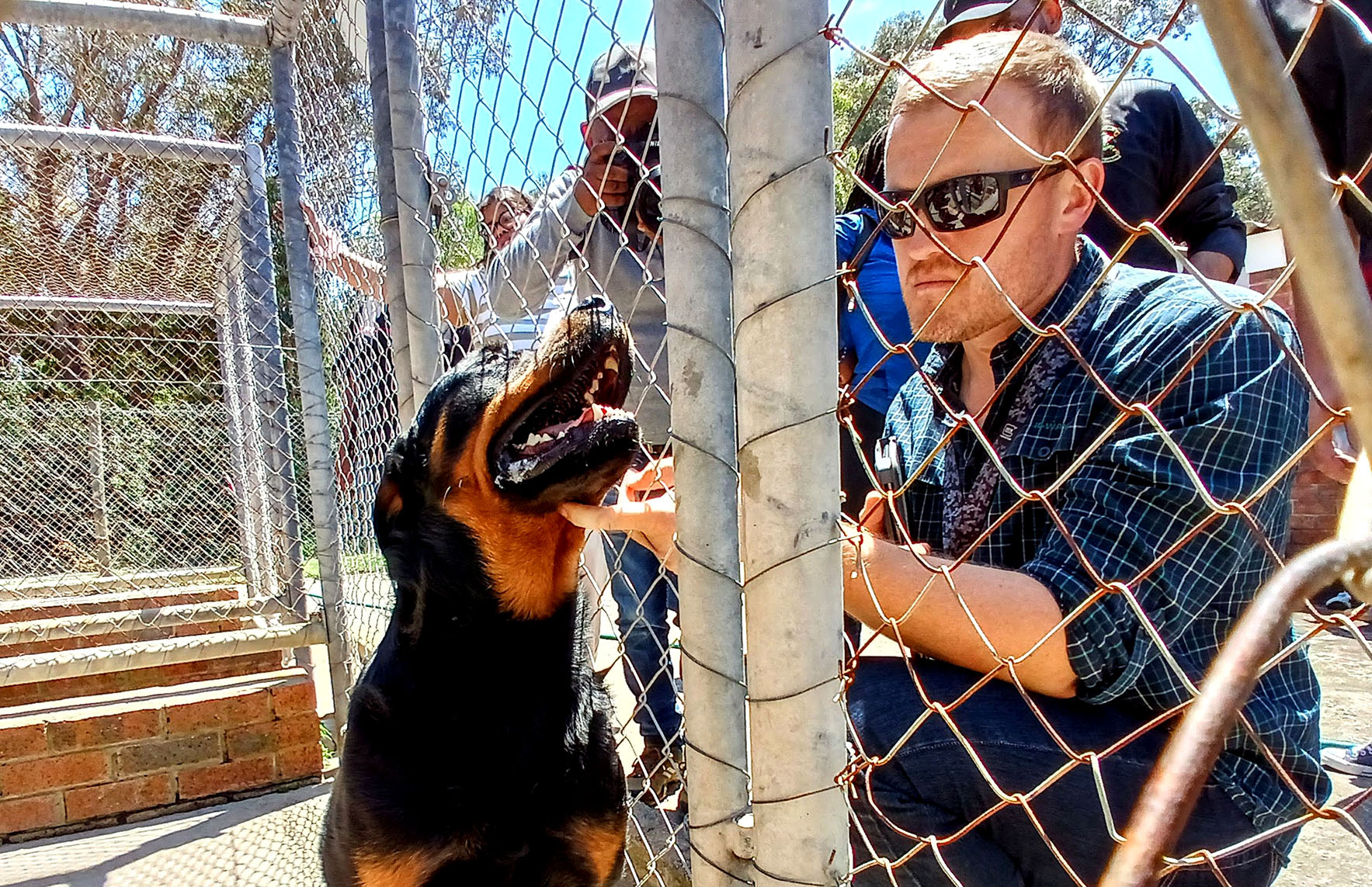
The picture at the K9 Unit was not much better. Despite members being enthusiastic and passionate about their work, and the dogs being well looked after, the unit has many challenges.
“They don’t have enough dogs, and they do not have enough members. In fact, their fixed establishment for members was brought down over the last few years, leaving them with a shortage of … members,” said Cameron.
He said a shortage of resources at the K9 Unit affected all the police units, which often need a dog to assist with specific operations. The unit had only two narcotics dogs, said Cameron, which affected operations against drugs and gang violence.
“A shortage of training is another major concern. There are members who have been with this unit for years, but still have not received the necessary training. Either they do not have dogs, or they have never been trained to work with dogs,” said Cameron.
“There are also dogs who are fully trained, but cannot be used due to paperwork and unnecessary bureaucracy.”
Cameron said the unit had only four vehicles, none of which were high-performance vehicles for rapid response, while some were not properly equipped to transport dogs.
Cassim said that over the last five years, the K9 Unit’s staff complement had been reduced from 40 members to 22.
The unit currently has 13 dogs: five patrol dogs, three for explosives, two for narcotics, and one each for search and rescue, fire investigations and protected species.
“The biggest crisis,” said Cameron, “is the leadership vacuum at a provincial and national level. The commanders on the ground are trying to make ends meet with the limited resources at their disposal.
“This leads to a recurring cycle. If you have bad leadership you usually have bad resources, which leads to bad morale. This crisis is not beyond repair, but I think we need to get rid of some people in top positions for this situation to turn around.” DM