




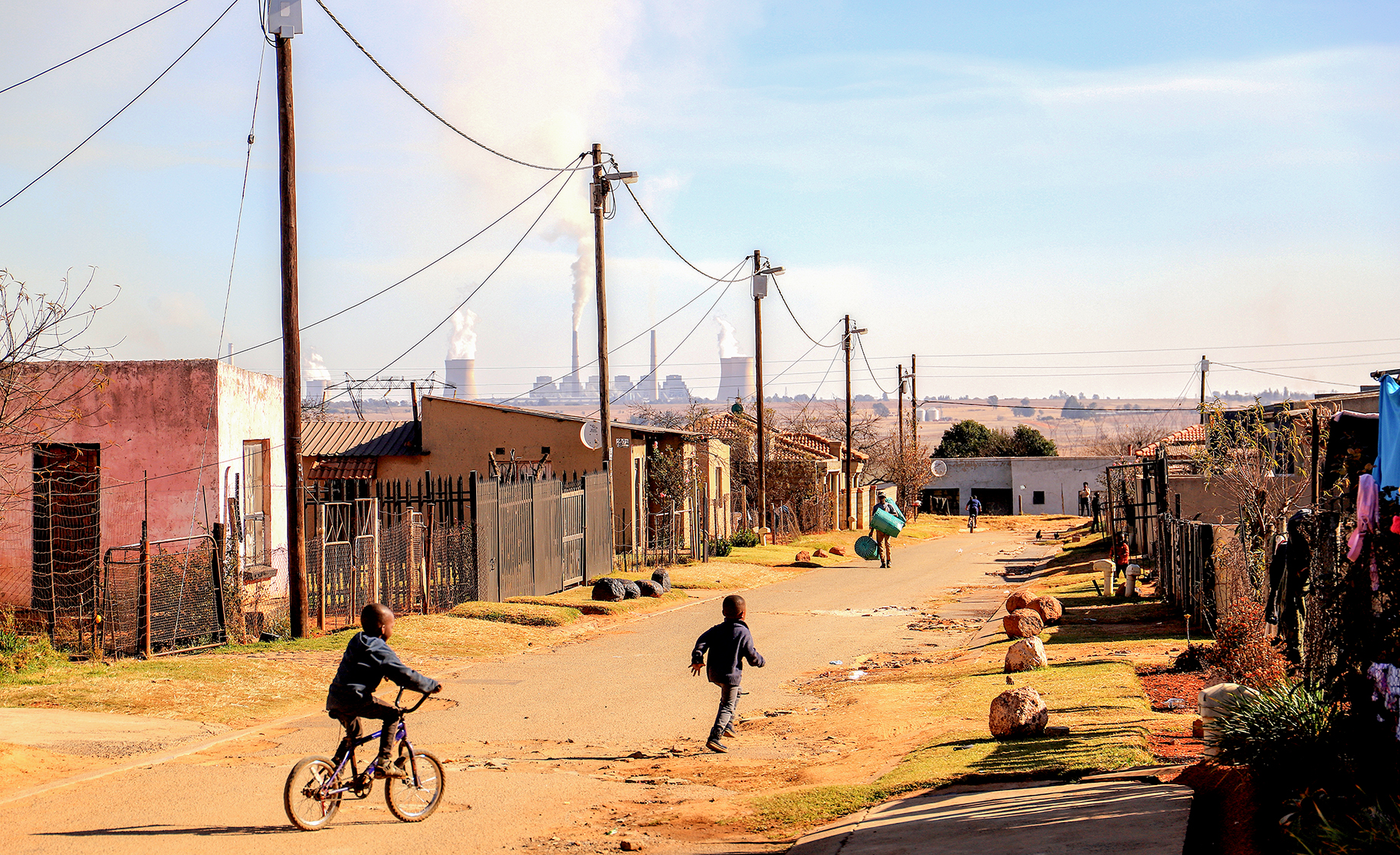
 The air in Thubelihle carries a constant yellow/ochre-tinted haze due in no small part to the Kriel Power Station and other heavy industry in the area. Despite that, life continues and children play in the street like in any other South African town. (Photo: Ethan van Diemen)
 The 30th session of the Conference of the Parties (COP30), set to begin in Belém, Brazil, from Monday, 10 November to Friday, 21 November, marks an important moment in global climate governance, 10 years after the adoption of the Paris Agreement. For South Africa, the conference is defined by moving away from negotiation into implementation, guided by the principles of solidarity, equality and sustainability.
During a one-on-one interview, South Africa’s chief negotiator, Maesela Kekana – the deputy director-general of climate change and air quality management at the Department of Forestry, Fisheries and the Environment (DFFE) – offered a frank but hopeful look at the strategies and tensions facing the South African delegation as they push for a just and fair outcome at COP30, one that balances global ambition with domestic needs.
The on-the-ground realities of climate change impacts in South Africa are immediate, tangible and severe, threatening to reverse socioeconomic development gains. South Africa is and has been feeling the effects of a changing climate through extreme weather events, extreme rainfall, flooding, food and water insecurity. The country’s priorities at COP30 must address these practical issues.
In the interview, Kekana gave insight into the country’s strategic priorities and the diplomatic battles in the lead-up to the COP. South Africa’s delegation approaches Belém focused on a package of key outcomes, centred on adaptation, finance and just transition implementation, that collectively determine what would constitute a successful COP for the country.
Kekana has been involved in COP for more than 10 years, attending the negotiations for the first time in 2009 for COP15 in Copenhagen – which set out to create a legally binding climate treaty but failed to do so. Instead, the conference resulted in the non-binding Copenhagen Accord. Eventually he rose through the ranks, becoming South Africa’s chief climate negotiator.
/file/dailymaverick/wp-content/uploads/2025/11/185811779_3982561811832119_5748084958200941452_n.jpg "Maesela Kekana. (Photo: Department of Forestry, Fisheries and the Environment / Facebook)")
“For South Africa and many other developing countries, we are highly impacted by climate change. At the same time, you look at the level of poverty, joblessness, inequality – those are identified as the overriding priorities for developing countries. Everything that you do has to fit in with those priorities,” Kekana said.
He boiled the forthcoming summit and negotiations down to “a fight about the remaining carbon space”.
“The question is how do [we] use the remaining carbon space? Do you allocate enough to developing countries to deal with these challenges and what sort of support do you give to them? The whole thing really boils down to that.”
Balancing global ambition with domestic reality
South Africa’s negotiating position has to balance increasing global climate ambition with confronting severe domestic challenges – poverty, joblessness and inequality – often exacerbated by climate change impacts. Kekana described these socioeconomic issues as “overriding priorities for all developing countries”, within which every climate action must fit.
In the lead-up to COP30 South Africa submitted its second Nationally Determined Contribution (NDC) – a high-level climate action plan detailing how each country will contribute to the global temperature goals outlined in the Paris Agreement. The NDCs detail countries’ plans to slash GHG emissions and help limit global warming to well below 2°C.
Kekana defended this NDC not as a theoretical exercise but as a realistic assessment informed by national capacity and planning. Organisations, including JustShare, have commented that the draft second NDC does not meet South Africa’s legal and international obligations, nor does it represent our fair share in the global effort to limit warming to 1.5°C.
While acknowledging the sentiment that countries “can do more”, Kekana said that any commitment must be credible and grounded in reality, rejecting purely theoretical approaches that are “grounded in zero reality” and lack a pathway to achievement.
/file/dailymaverick/wp-content/uploads/2025/11/ED_582200.jpg "Environment Minister Dion George at the G20 Environment and Climate Sustainability Working Group Technical and Ministerial Meetings in Cape Town on 13 October 2025. (Photo: Gallo Images / Misha Jordaan)")
The figures put forth in the NDC are structured to align with the country’s net zero direction of travel and are informed by existing national strategies, such as the Integrated Resource Plan and transport strategies.
In response to concerns that current global NDCs still fall far short of the 1.5°C threshold, Kekana pointed out that the NDC Synthesis Report, showing only a 10% emission reduction, is based on an incomplete picture; it relied on only 33% of parties, excluding major submissions such as those from South Africa, the EU and China at the time.
UN secretary-general António Guterres said at the opening plenary of the World Leaders Climate Action Summit on Thursday, 6 November: “The hard truth is that we have failed to ensure we remain below 1.5 degrees. Science now tells us that a temporary overshoot beyond the 1.5 limit – starting at the latest in the early 2030s – is inevitable.”
Adaptation, resilience and loss and damage
For South Africa and the African continent, adaptation remains the number-one priority. This was echoed during a national stakeholder consultation in the run-up to COP30 on 20 October. Kekana said the most immediate challenge is building resilience because climate change impacts are here now, threatening to wipe out “the little gains that you’ve made, developmental gains... in a second or in one event”.
The country will push for the finalisation of the Global Goal on Adaptation (GGA) through the Belém Work Programme. South Africa expects the framework to adopt a set of about 100 indicators to assess progress towards the UAE Framework for Climate Resilience. Crucially, South Africa insists that these indicators must include the means of implementation to effectively track the provision of support, including finance, needed to address adaptation gaps.
South Africa’s NDC, for the first time, also includes a dedicated section on loss and damage (L&D). While the institutionalisation of the Loss and Damage Fund has taken place quickly, Kekana noted that pledges made at COP28 have been slow to convert into cash.
He said South Africa’s immediate focus is to ensure the L&D fund, once operational, is new, additional, predictable, accessible and adequate to support developing countries.
South Africa also expects the Santiago Network – which will catalyse technical assistance for the implementation of relevant approaches for averting, minimising and addressing L&D at the local, national and regional level in developing countries – to move beyond its institutional phase and start delivering.
/file/dailymaverick/wp-content/uploads/2024/03/408197075.jpg "A housing development next to the Sasol’s petrochemicals plant in Sasolburg. In 2005, the government designated the region as the Vaal Triangle Airshed Priority Area, the first zone in which it would make a concerted effort to lower air pollution. (Photo: Guillem Sartorio / Bloomberg)")
/file/dailymaverick/wp-content/uploads/2023/11/iStock-543657968.jpg "Hazy: The Johannesburg skyline. (Photo: iStock)")
Kekana said that in the Santiago Network, South Africa was positioned not just as a recipient, but a contributor, through its institutions’ expertise in attribution science, which the country is trying to register to help other developing nations.
Regarding the launch of L&D funding requests, Kekana said the goalposts keep moving, but the expectation is that a call for project proposals will be out definitely by the first half of next year.
South Africa is preparing for this call by working with the insurance sector and its adaptation section.
The fight for climate finance
Climate finance is consistently identified as a huge topic at COPs, and it will be no different this time. But Kekana confirmed that South Africa’s negotiating strategy is centred on combating mechanisms that push developing countries into unjust finance.
South Africa strongly supports the New Collective Quantified Goal (NCQG), which was agreed to at COP29 to mobilise at least $300-billion annually by 2035. However, the key expectation is laid out in the Baku to Belém Finance Roadmap. South Africa expects this roadmap will clearly detail how finance will be scaled up using grants, concessional and non-debt creating instruments.
Kekana explained that this demand for non-debt instruments is a practical response to the reality that concessional loans often require government guarantees, which consumes scarce fiscal space and exacerbates indebtedness.
He said the Treasury team is engaged to propose innovative solutions, such as mechanisms to replace the need for government guarantees, thereby unlocking private sector investment at scale without “locking the government into a debt”.
A significant concern for South Africa is the lack of a dedicated space to discuss and influence the Baku to Belém Roadmap once it is released by the presidencies, potentially limiting the ability of countries to shape it into a final, beneficial text.
Implementation and decarbonisation pathways
South Africa is prioritising the operationalisation of work programmes and mechanisms that drive domestic implementation:
- Just Transition Work Programme (JTWP): South Africa expects a substantial outcome on the JTWP at COP30, including the need to adequately support its international dimension. The JTWP must adopt a “whole of economy and whole of society approach”, moving beyond the energy sector. A crucial focus is addressing the negative impact of unilateral trade measures (such as punitive trade barriers) on developing countries, ensuring these response measures do not have “spillover and negative cross-border impacts”; and
- Carbon Markets (article 6): There is criticism that carbon markets allow the Global North to export emissions to the Global South. But, Kekana said South Africa is looking to deploy carbon markets strategically to introduce necessary decarbonisation technologies into difficult abatement sectors (such as iron and steel, and cement). This, Kekana said, could be a strategic tool to ensure that these sectors are prepared to contribute emission reductions to future NDCs.
Defining a successful COP30 for South Africa
Kekana said a successful COP30 would transition from negotiation to concrete implementation. The criteria for success are ranked as follows:
- Concluding the Adaptation Framework: Finalising the Global Goal on Adaptation (GGA);
- Having a space to influence the Baku to Belém Roadmap and seeing positive outcomes on finance mechanisms for developing countries;
- Successfully concluding the modality of the Just Transition Work Programme, on which parties failed to agree last year; and
- Moving beyond the Dubai outcomes on the Mitigation Work Programme to achieve more tangible outcomes on implementation.
Kekana said the South African delegation is “upbeat” despite the immense logistical challenges facing the conference. These issues, including lack of accommodation and high costs, have resulted in the scrapping of pavilions and a reduction in delegation size, disproportionately affecting least-developed countries.
/file/dailymaverick/wp-content/uploads/2023/02/power-plant-smoke-cloud.jpeg "Reducing fossil fuel emissions from power plants would also mitigate the death toll from air pollutants such as ozone. (Photo: Oleg Savitsky / Wikimedia Commons)")
/file/dailymaverick/wp-content/uploads/Carnie-analysis-natureparks-woes-inset-2.jpg "Industrial centres such as the port of Richards Bay create jobs and foreign exchange through coal exports and other resource extraction projects, but the costs of industrial air pollution to human health are seldom measured nor adequately policed. (Photo: Tony Carnie)")
There will be no DFFE-NBI pavilion at this COP, since, Kekana said in the national consultation, that despite having the funding “[it’s] logistically not possible to host the type of pavilion we hosted before”.
This puts significant pressure on the remaining delegations, who must work intensively within the Africa Group to ensure coverage of all negotiation points.
Ultimately, South Africa’s participation is driven by a focus on “getting the messages out there” so that its voice is heard. The goal in Belém, Kekana said, was to achieve “something, hopefully, that’s just and fair” for the continent and future generations. DM
Kristin Engel is a freelance environmental journalist and a Danida Fellow participating in the Danida Fellowship Centre’s 2025 learning programme, “Reporting from the frontline of the global climate crisis in an era of fake news”. The centre is a public self-governing institution under the Ministry of Foreign Affairs of Denmark.