




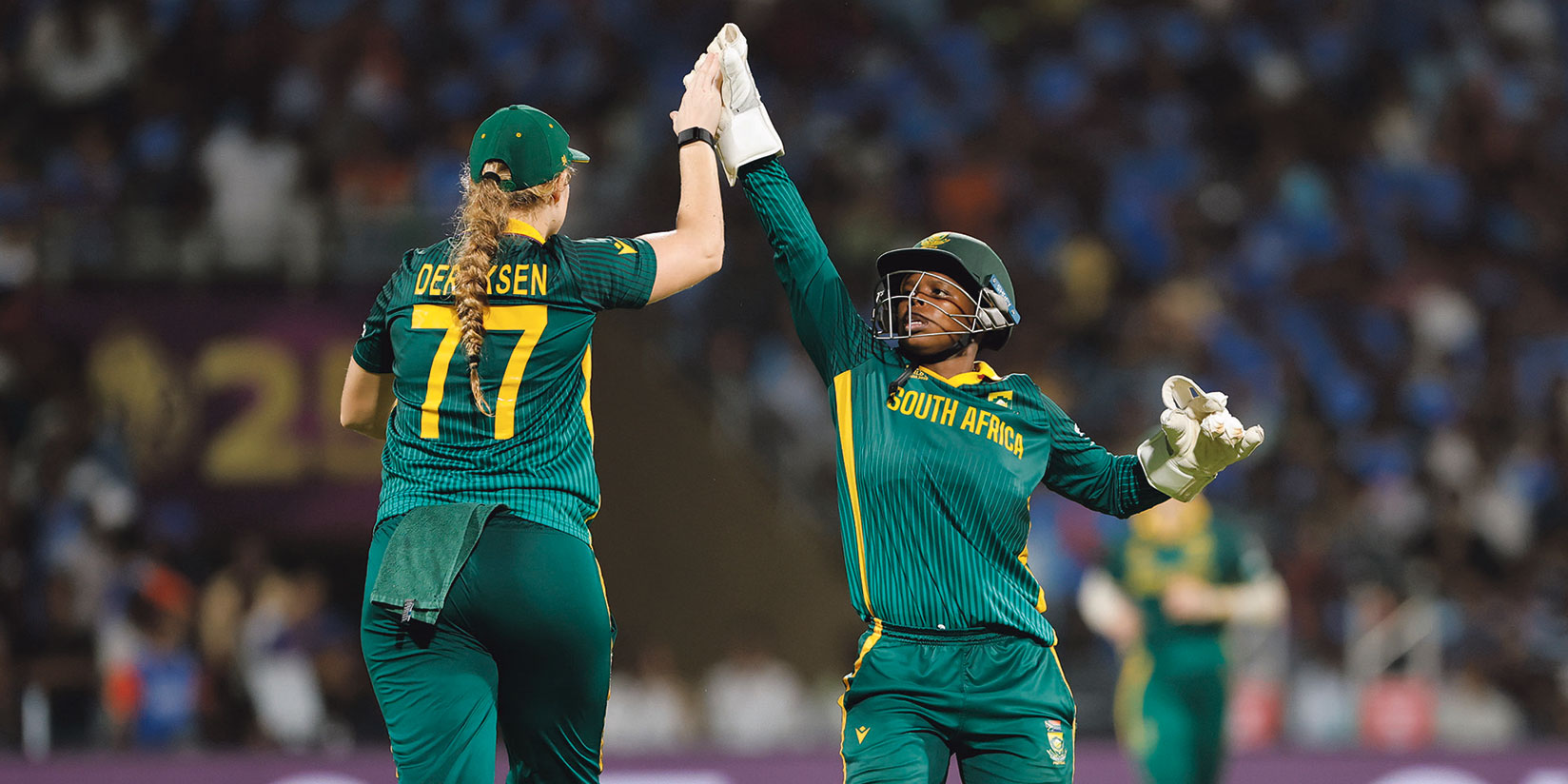
 Proteas teammates Sinalo Jafta (right) and Annerie Dercksen (left) celebrate getting the wicket of Richa Ghosh during the ICC Women’s World Cup final against India in Navi Mumbai, India, on 2 November. (Photo: Surjeet Yadav / Gallo Images)
The Proteas Women have proven three times over that they are good enough to reach the final of a global tournament. The next step will be to jump over the final hurdle. The recently completed ICC Women’s World Cup reaffirmed South Africa as one of the best cricket teams globally despite their 52-run loss to India in the final.
For 26 years of Cricket World Cup history, starting in 1997 when South Africa took part for the first time, the team failed to make it further than the semifinals. That tide has shifted rapidly since, and its flow has remained in South Africa’s direction. Since 2023, the Proteas have reached the apex of cricket tournaments on three occasions.
Read more: Proteas Women fall at the final hurdle again as India clinch maiden World Cup trophy
The first at home in 2023 – at the T20 World Cup – broke the 26-year streak, before they repeated the feat in the United Arab Emirates in 2024. Australia, New Zealand and now India – in that order – were the teams to topple the Proteas in those finals.
“After that first one in Newlands, we had domestic contracts introduced. That’s really big for our depth as a team,” Proteas captain Laura Wolvaardt said about the impact on her team of reaching the brink of glory.
“The last one [in 2024] just made us a bigger name in cricket, I guess. We’re the team that consistently is making finals now, whereas before it was maybe a one-time thing. I’m really proud that we were able to reach three in a row.
“It shows that we’re doing something right domestically and, from a squad perspective, consistency-wise. Hopefully we can keep reaching finals and one day we can win one.”
Read more: Women’s cricket has won hearts globally following enthralling World Cup in India
Putting their hands up
/file/dailymaverick/wp-content/uploads/2025/10/pic-1-4.jpg "South Africa celebrate a dismissal during a T20 match against Sri Lanka in East London in 2024. (Photo: Richard Huggard / Gallo Images)")
On South Africa’s road to the final, individual players put up their hands at the crucial moments of matches and saw the team home.
Wolvaardt did it with a big century in the semifinal along with all-rounder Marizanne Kapp’s five-wicket haul, which helped the team overcome favourites England.
In the matches against Bangladesh and India during the group stage, Nadine de Klerk demonstrated that she is turning into a world-class finisher, guiding the team to important victories.
All-rounder Chloe Tryon chipped in at every opportunity the captain needed something different with the bat or ball.
Tazmin Brits had a quiet World Cup for her high standards, but she did score an important century against New Zealand early in the tournament, which helped the team clinch an important win.
Nonkululeko Mlaba and Ayabonga Khaka were solid throughout the campaign as well.
Tough decisions
/file/dailymaverick/wp-content/uploads/2025/10/TL_2385181-scaled-1.jpg "Proteas Women head coach Mandla Mashimbyi. (Photo: Lefty Shivambu / Gallo Images)")
But for South Africa to take the next step in their progress as a unit, they need more from all their individuals.
No 3 Anneke Bosch scored only 35 runs (28 of them in one match against Bangladesh) in six innings with a number of ducks, including in the semifinal and final.
Wicketkeeper Sinalo Jafta was reliable behind the stumps, but she did not contribute enough with the bat, particularly after being entrusted to come in at number six throughout South Africa’s campaign. Jafta only managed 92 runs in seven innings at a lowly strike rate of 69.17 and an average of 15.33.
Their below-par performances added to the pressure on the on-form players.
There was also a refusal to drop players who were struggling with batting form in the tournament.
It seemed as if management believed that players were closer to a good performance despite evidence to the contrary. South Africa might need a full squad to perform to make it over the final hurdle, but they also need management courageous enough to make difficult decisions.
“To see how the team has progressed from the time that I took over is obviously a humbling experience for me,” said Proteas head coach Mandla Mashimbyi, who took over the reins in December last year.
Read more: Cohesive team environment ‘the difference in this Proteas outfit’ heading into World Cup final
“But at the same time, I’m actually kind of excited because when nobody gave us a chance, we gave ourselves a chance.”
About South Africa’s next opportunity to compete for a World Cup trophy, which will be at the T20 World Cup in England and Wales in June next year, Mashimbyi said: “You sort of look at the team and see where you need to improve, and I know what to do going forward to make sure that we leave no stone unturned going to England.
“So we’ll bring the tsunami there.”
Building more depth
The next 50-over edition of the World Cup – the most prestigious of all these tournaments – will take place in 2029. Brits and Kapp, who are 34 and 35 respectively, will almost certainly not be in the picture by that point.
There will be three T20 World Cups before then, but it’s important for South Africa to continue building squad depth for the big tournament four years away.
Young wicketkeeper Karabo Meso (18) has shown that she is able to step up with the gloves at international level. The matriculant at Steyn City High School in Midrand has those four years to secure the position of first-choice wicketkeeper.
Meso is also a prodigy with the bat, but she has not yet found her feet with it at the highest level.
Faye Tunnicliffe (26), Kayla Reyneke (20) and Alexandra Candler (22) are next in the line of players who have put in consistent performances in domestic cricket.
All-rounder Miane Smit (20), who was a travelling reserve at this ICC Women’s World Cup, has also shown signs that she belongs at the top level.
From a fast-bowling perspective, Ayanda Hlubi (21) is still raw, but she has all the potential to become a top-class talent.
With South Africa’s recent success at the World Cup, more of these talented young players will shine through and expand the Proteas playing pool.
“We had 60 million people supporting us,” Mashimbyi said about the impact of his team’s performance. “They were really happy for us because we’ve done something that has never been done before.
“I think people are going to look at cricket differently now. On the world stage, where you go and do what they did in the manner in which they did it, I think a lot of girls will be inspired to make cricket their career going forward as well.” DM
This story first appeared in our weekly Daily Maverick 168 newspaper, which is available countrywide for R35.
