




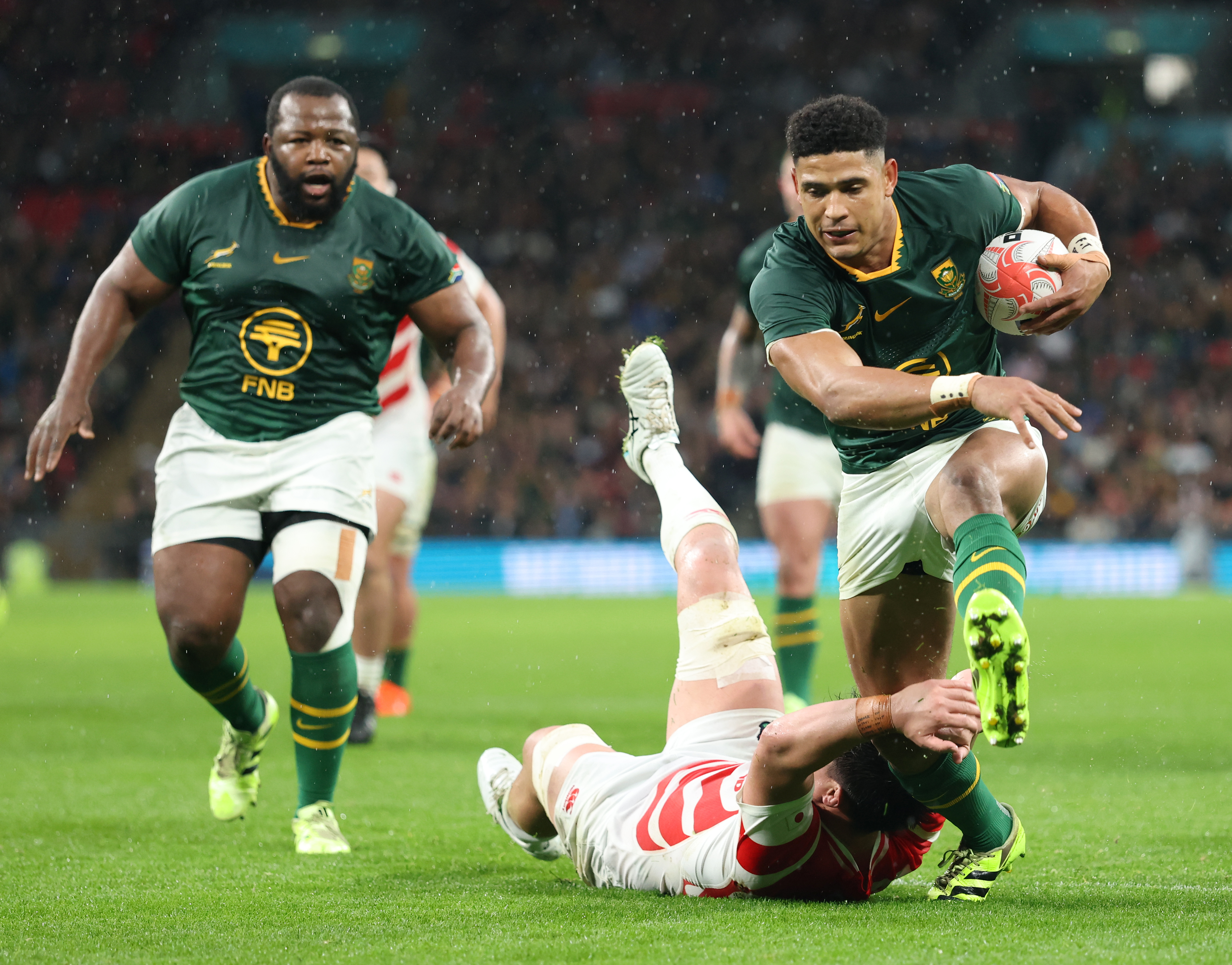
 Flyhalf Sacha Feinberg-Mngomezulu on his way to a try when the Boks played Japan in London. (Photo: Luke Walker/Getty Images)
 Madness, madness, they call it madness/ Madness, madness, they call it madness/ It’s plain to see/ That is what they mean to me
These are the lyrics of Jamaican Prince Buster’s ska hit that inspired the name for the 1980s chart-topping band Madness.
Much as I would like this frothy old man’s rant to be about the entrails of Caribbean musical influence on British pop, it isn’t. It’s about the madness gripping modern sport. Somehow, the memo that globalisation is out of economic and political fashion because of the carnage it inflicts on local employment and communities has not reached the sporting powers-that-be.
Let’s start this diatribe with the Springboks drubbing Japan last Saturday before a paltry crowd at a wet Wembley in London. Why did that meandering game take place in an arena so alien to the sport, at least 9,000km from either team’s home ground?
Especially because we are constantly told there is too much rugby, I assume it was an attempt to gouge sterling out of London Saffers – who declined, having spent a fortune just four weeks ago to see Argentina throw away home advantage in a key Rugby Championship fixture by playing the Boks at Twickenham.
And the Wembley game was played at the same time as England met the Wallabies just 15km across London at the home of rugby.
Meanwhile, Ireland were playing a theoretically tasty fixture against the All Blacks, but they decided to stage it (and lose it) way across the pond at Soldier Field, the home of the Chicago Bears football team. What could have been a cracking Dublin occasion became an inconsequential US popcorn event.
Now, it is true that 61,000 came to watch, and it was on this same field nine years ago that Ireland got their first victory over New Zealand, ending a 111-year drought, but that seductive reasoning will soon disconnect the Irish team from the people who really matter – their home fans.
Far and wide
And flipping this strange script completely, the US college football season opener this year between Kansas State and Iowa State was held at… Aviva Stadium in Dublin.
And while we are with American football, the promising Indianapolis Colts suffered a surprising defeat by the Pittsburgh Steelers on Sunday, but quoting The New York Times, “the Colts should bounce back against the Falcons next week in Berlin”.
/file/dailymaverick/wp-content/uploads/2025/11/GettyImages-2244932852.jpg "Rafael Leao of AC Milan is pressured by Manu Kone of AS Roma during their Serie A match at Giuseppe Meazza Stadium in Milan, Italy, on 2 November 2025. (Photo: Marco Luzzani / Getty Images)")
Indianapolis versus Atlanta in Berlin? The National Football League (NFL) already plays several regular-season games in London and is now targeting the Germans. Given that supporters get an average of only seven competitive home games in an NFL season, losing one of these precious events to the other side of the Atlantic must grate on the people who really matter.
The other big US sports are on to this as well. The recent Major League Baseball (MLB) season began with a Southern Californian derby series between the Los Angeles Dodgers and the San Diego Padres being played on the other side of the Pacific in Japan.
Admittedly, the Dodgers’ two biggest stars at the moment – Shohei Ohtani and Yoshinobu Yamamoto – are Japanese.
The MLB also regularly heads south to Mexico and this year it experimented with London when the Mets and Phillies played two games at West Ham’s home ground.
The National Basketball Association has regular-season games scheduled for London, Manchester, Paris and Berlin, where the Memphis Grizzlies will play Orlando Magic on 15 January.
And if you think Memphis versus Orlando in Berlin sounds out of place, then try the Australian Rugby League’s game between Newcastle Knights and North Queensland Cowboys in Las Vegas on 28 February.
Or, in ice hockey, the Nashville Predators meeting the Pittsburgh Penguins at the Avicii Arena in Stockholm in a week’s time. To quote the late Avicii: “Wake me up when it’s all over.”
Soulless
Neutral venues are just as the word suggests: neutral, soulless. Whatever happened to the core of sport? Us against you. At our place or at your place.
And soccer is being sucked into this madness as well. The big clubs have long held friendlies in far-flung places, but they are now dabbling with league games. AC Milan’s “home” match against Como in the Italian Serie A on 8 February is scheduled for Perth, of all places.
The fans are outraged. But not as much as the supporters of Barcelona and Villarreal, whose loud protests forced those clubs to cancel a planned LaLiga game at Miami’s Hard Rock Stadium in December – which meant that the Spanish soccer bosses were caught between a rock and a Hard Rock place.
/file/dailymaverick/wp-content/uploads/2025/11/GettyImages-2243885975.jpg "Ja Morant of the Memphis Grizzlies. (Photo: Ezra Shaw / Getty Images)")
England’s Premier League has resisted this… so far. But watch this space. There are 11 American-owned clubs in the top flight, close to a decision-making quorum, and those business moguls very much want to be global.
The Liverpool chairperson has been quoted as saying that he hoped to see Premier League games played in New York, Tokyo, Los Angeles, Rio and Riyadh.
Oh, of course, Riyadh.
If it’s money you want, globalise everything to Saudi Arabia; the Olympics (summer and winter), the World Cups of every sport, Wimbledon, the Tour de France, the Masters, Wolves versus Bournemouth, Sekhukhune United versus Polokwane City, Cheetahs versus Sharks. Except for cricket, where everything will be in India, including the Ashes and Tuskers versus Boland.
Take it all away. Take it far from the people who matter – the home fans.
Madness, madness, they call it madness/ Madness, madness, they call it madness/ It’s plain to see/ That is what they mean to me. DM
Mike Wills is a journalist and talk show host.
This story first appeared in our weekly Daily Maverick 168 newspaper, which is available countrywide for R35.
