



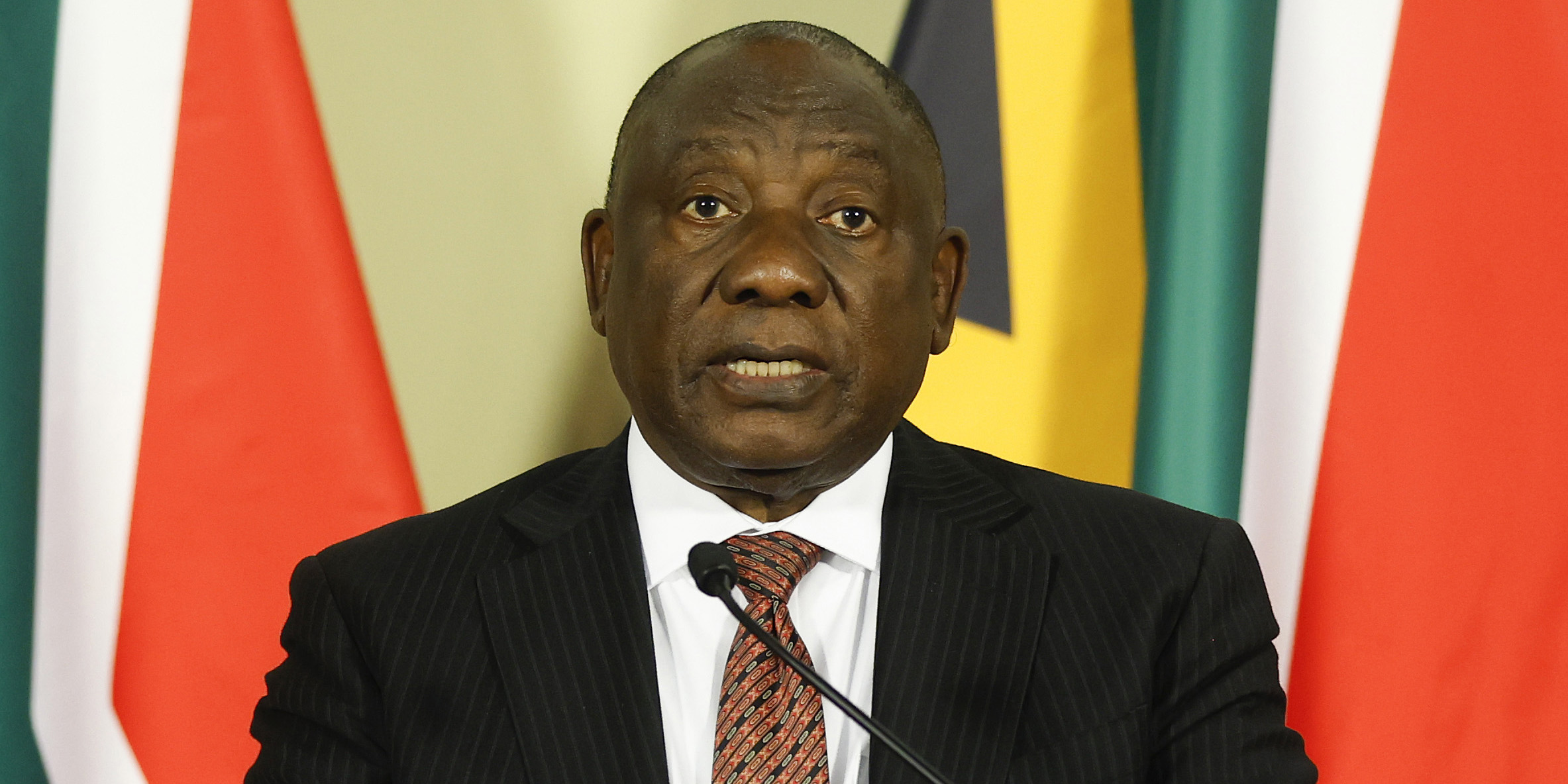
 President Cyril Ramaphosa. (Photo: Phill Magakoe / Gallo Images)
 President Cyril Ramaphosa’s decision to host a meeting of leaders of parties in the national coalition may well be a sign that he is still in charge of the government. The timing of the event, its apparent success and signs of the government making progress in improving the lives of many people may now be creating momentum behind the coalition.
On the face of it, the timing of last weekend’s workshop may seem strange. Law enforcement structures and the police are in turmoil, as evidenced by testimony at the Madlanga Commission of Inquiry of how South African Police Service (SAPS) leaders were involved in corruption and meeting criminals. This has all been broadcast to millions of people daily.
Surely Ramaphosa should be consumed with this rather than spending time with the leaders of tiny parties that may have no big roles to play in future?
But the real power of the meeting may have been its timing.
First, there was no real controversy of the moment that could distract any gathering of coalition leaders. This may sound strange, but considering the events of the past 16 months, moments like these have been few and far between. So different are the constituencies these leaders represent that controversy and disputes are never far away.
But Ramaphosa would have known disputes were unlikely to consume this meeting because the groundwork had already been laid. On 29 October, almost out of nowhere, Deputy President Paul Mashatile announced that the terms of reference of the Government of National Unity’s clearing house mechanism had now been adopted. Clearly, there had been some kind of progress in the relationships between the leaders of all 10 parties.
Then there is the Medium-Term Budget Policy Statement (MTBPS), which is due to be delivered on Wednesday, 12 November by Finance Minister Enoch Godongwana. Considering that the biggest dispute the coalition has had until now has been about the various versions of the Budget, it would make sense to resolve any potential disputes before the minister’s speech.
Even the location may have mattered. The Cradle of Humankind offers a reminder of the unique nature of South Africa. The cherry on the top, of course, was the Proteas Women starting their World Cup final against India as the meeting began.
The other genius around the timing was that, for the first time since the formation of the coalition, there are signs that the government is making some progress.
The improvements at Eskom and Transnet’s rail and port services, and the planned changes at the Passenger Rail Agency of South Africa and in higher education all suggest that, finally, this government has some momentum.
South Africa’s removal from the Financial Action Task Force grey list was also a fresh victory, showing that this government can act when ideology is not involved.
Importance of leadership
This all suggests that, in fact, there was some real thought behind the timing of this meeting, that perhaps, just perhaps, it was part of a bigger plan. It would suggest that Ramaphosa in particular is actually a lot more engaged than he sometimes seems.
The problem is that he has appeared to almost be asleep at the wheel at critical moments in the past, in particular during the processes that led to the Budget fracas this year.
If he had been more active then and held a workshop like this in the months after the election, perhaps a lot of pain and anguish would have been avoided.
That said, as many governments, countries, companies, rugby teams and even Bafana Bafana have shown, success builds success. A sense of momentum, of working together to achieve something that is making progress, can help to smooth over the rough edges in many relationships.
The meeting is another reminder of how important leadership is for a coalition government – it was clearly the work of Ramaphosa and his team. Its success is both a reminder of what Ramaphosa can do and of his almost absence over the past few months.
More leadership will be required in the near future, particularly as the local elections loom (the Electoral Commission of South Africa suggested last week that it was planning those polls for the second week of November next year).
It might be worthwhile for the coalition leaders to agree to a set calendar of such meetings and hold them regularly. This might prevent tensions from getting out of control.
Many hurdles to come
But other factors are likely to affect the coalition in the immediate future. Although it seems unlikely for the moment that there will be any disputes over the MTBPS, many of the parties involved are likely to soon demand action over the turmoil in the SAPS. They will have to demand that Ramaphosa take action.
Ramaphosa’s problem is that much of the evidence heard at the Madlanga Commission and in Parliament’s ad hoc committee is both explosive and untested.
And there is no clear solution to the problems the SAPS turmoil presents. So deeply ingrained is a culture of politicisation and corruption that there appears to be no quick action that could resolve it. It may well be that any action Ramaphosa takes could blow back on him, thus delegitimising him.
/file/dailymaverick/wp-content/uploads/2025/11/P7-mugs.jpg "Clockwise from top left: Party leaders John Steenhuisen of the DA; Patricia de Lille of Good; Gayton McKenzie of the PA; Bantu Holomisa of the UDM; Songezo Zibi of Rise Mzansi; Mzwanele Nyhontso of the PAC; and Velenkosini Hlabisa of the IFP. (Photos: Brenton Geach; OJ Koloti; Frennie Shivambu; Papi Morake; Luba Lesolle; Tebogo Letsie / Gallo Images)")
At the same time, there is constant chatter in the ANC that he may soon be leaving the government. This might be wishful thinking on the part of whoever has the most to gain from such a move, but it might well weaken Ramaphosa’s leadership in some ways.
As ever, the success of the coalition will depend on the internal dynamics of the ANC. If Ramaphosa were to leave office early, it seems obvious that Mashatile would take over.
But several of the parties in the coalition might refuse to accept his leadership. The DA in particular would find it difficult to explain to its constituency why the party would remain in the coalition with Mashatile as president of South Africa.
For this reason alone, Ramaphosa might be compelled to stay in office until the end of his term, or at least until the ANC’s leadership election two years from now.
Optimists will suggest that this coalition meeting, and the events that led up to it, might be signs of Ramaphosa being about to become more assertive, and thus the coalition will make progress. But it will require that he play an active and leading role, and that he is not derailed by events. DM
This story first appeared in our weekly Daily Maverick 168 newspaper, which is available countrywide for R35.
