




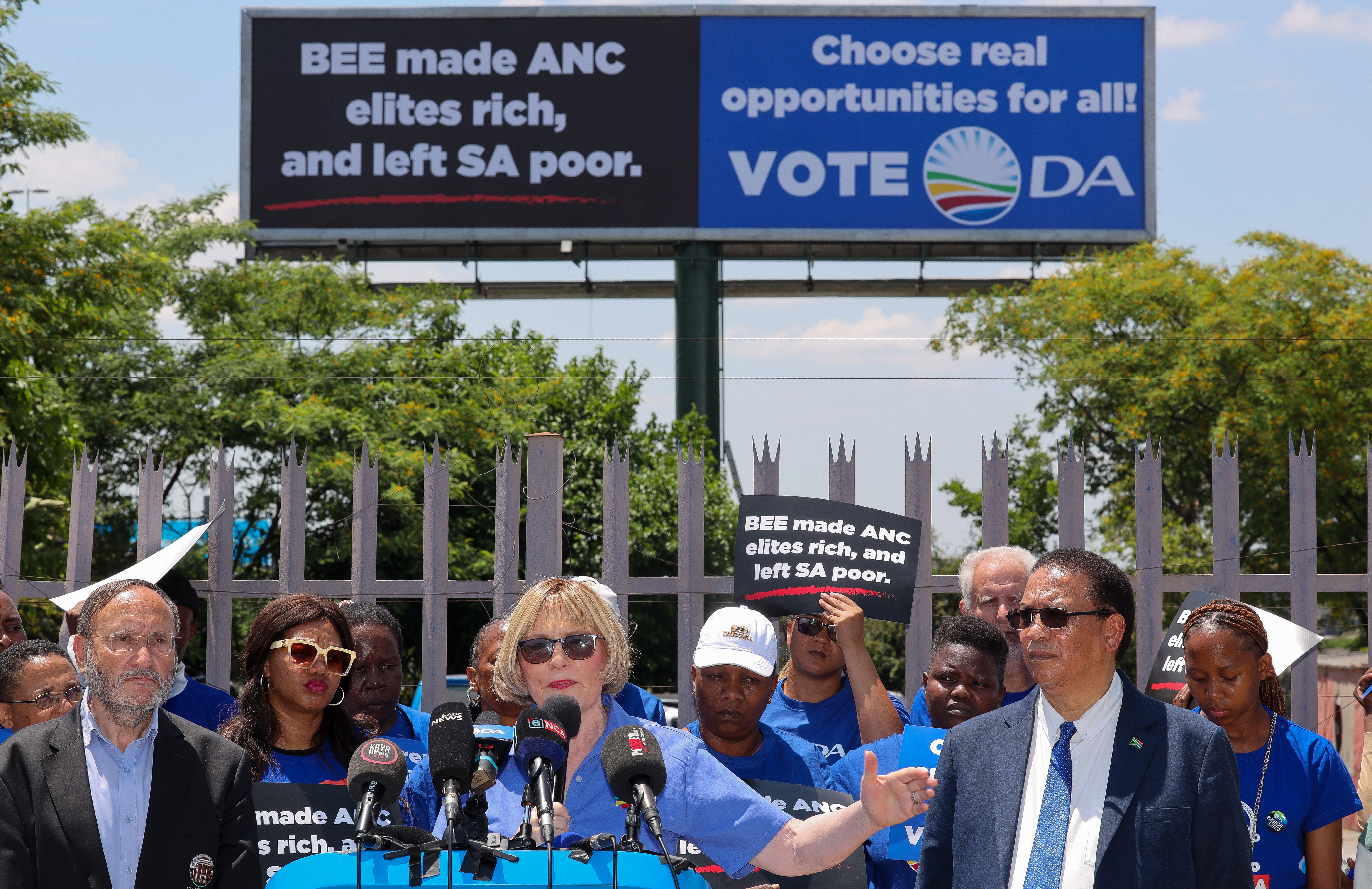
 DA Federal Council chair Helen Zille announces the Economic Inclusion for All Bill in Roodepoort, Gauteng, on 28 October 2025. (Photo: Gallo Images / Fani Mahuntsi)
“Race-based” quotas, argues the DA, have failed to achieve genuine broad-based upliftment, but have enriched only a narrow, politically connected black elite while leaving millions of South Africans unemployed and impoverished.
According to the DA, transformation should shift from corporate race-compliance frameworks such as black ownership points and management control criteria, moving towards a nonracial, needs-based approach focused on skills, job creation, investment, entrepreneurship and alignment with Sustainable Development Goals.
Expectedly, this proposal has reignited a fierce debate about the meaning of empowerment, the legacy of apartheid and the future of redress in an unequal society such as South Africa.
Among those who have entered the debate is President Cyril Ramaphosa, who has made it clear that Broad-Based Black Economic Empowerment remains “rooted and underpinned by our Constitution” and that any amendments must be tabled in Parliament.
Emphasising that the law remains intact and that the redress imperative remains central, Ramaphosa said, “if anyone wants an amendment to the BEE legislation, they must table their proposal and they must be taken for discussion in Parliament”.
The DA is not the only party advocating what essentially amounts to maintaining the status quo in which the majority African people remain excluded from the core of the economy and continue to participate only at its margins.
For example, the Freedom Front Plus has also claimed that BEE and affirmative action policies have “done nothing but promote patronage, to the detriment of the economy and the general population, which has been plunged into poverty”.
International campaigns
Another group that has been calling for an end to what it terms the government’s “racially discriminatory” policies, such as affirmative action, is AfriForum. AfriForum argues that “the government’s preoccupation with equal outcomes rather than equal opportunity has created an increasingly racialised environment”.
Not content with confining its campaign to domestic debates, this group took its message overseas, touring countries such as the US and lobbying on the false narrative of a “white genocide”.
This propaganda found resonance in some circles in the West. For example, in 2018, during her visit to South Africa, former British Prime Minister Theresa May was criticised by controversial British columnist Katie Hopkins for ignoring the alleged “slaughter” of whites in the country.
Hopkins claimed on Twitter, “The violent, ethnic cleansing of white farmers by armed, black gangs is infuriating & heartbreaking. And the world doesn’t care. Or at least the mainstream media doesn’t care.”
This misinformation campaign even reached the White House, where US President Donald Trump tweeted during his first term in office in 2018 that he had asked Secretary of State Mike Pompeo to “closely study land and farm seizures and expropriations and the large-scale killing of farmers” in South Africa. Yet, no credible evidence supported these claims.
No reliable data exists that suggests farmers are at greater risk of being murdered than the average South African. Yet the very parties at the forefront of calls to scrap BEE and affirmative action never lifted a finger to challenge or correct this false narrative. The fact that influential Western leaders such as Trump easily fell prey to such propaganda is indicative of how the West historically supported the very system that created the injustices BEE now seeks to correct.
Disinformation
Unsurprisingly, when Trump returned to the Oval Office for a second term, he wasted little time in leveraging this misinformation to advance his agenda. This time, collaborating with South African-born moguls such as Elon Musk, they used platforms like X to amplify claims of racial discrimination in South Africa.
Soon, Trump was announcing on X that “I will be cutting off all future funding to South Africa until a full investigation of this situation has been completed!” before telling journalists that “South Africa’s leadership is doing some terrible things, horrible things”. The executive order “Addressing Egregious Actions of The Republic of South Africa”. This was in direct response to President Ramaphosa’s assent to the Expropriation Bill on 23 January 2025.
Musk, aligning with Trump, condemned the law as “openly racist ownership legislation”. Trump’s executive order further mischaracterised the Expropriation Act, describing it as a “shocking disregard of its citizens’ rights” and alleging that it was designed “to enable the government of South Africa to seize ethnic minority Afrikaners’ agricultural property without compensation”.
The order also introduced provisions prioritising humanitarian relief, including “admission and resettlement through the United States Refugee Admissions Program for Afrikaners in South Africa who are victims of unjust racial discrimination”.
This intervention by Trump and Musk effectively advanced the agenda championed by South African political parties to resist and reverse transformative programmes such as land reform by escalating international tensions and misrepresenting South Africa’s policies.
This manifested in the admission of Afrikaners in the US, the showdown at the White House between Trump and Ramaphosa, and the tariffs imposed by Trump on South African goods. This historical background cannot be ignored when discussing the DA’s policy proposal since it provides crucial context for understanding the motives, implications and potential consequences of seeking to dismantle transformative policies.
Policies of redress challenged
Beyond its historical anti-transformative agenda, since the formation of the GNU, the DA has been attempting to leverage influence through its deployed cadres to challenge policies aimed at redress.
For instance, its deployees, such as Public Works Minister Dean Macpherson, have advocated for the government to reconsider its tender policy related to BEE companies. Similarly, his colleague, Communications and Digital Technologies Minister Solly Malatsi, indicated plans to issue a policy directive to Icasa to pave the way for an overhaul of BEE regulations in the ICT sector. Therefore, the current policy proposal builds on this strategy.
As things stand today, the material legacies of colonialism and apartheid remain deeply embedded in land ownership and corporate ownership, managerial power structures and access to education and finance that still skew overwhelmingly towards white South Africans.
These compatriots continue to enjoy one of the highest standards of living anywhere in the world, largely sustained by historical privileges and continued domination of white capital that is supported by black labour, often in subordinate terms.
For instance, indicators such as land ownership, unemployment and health status, such as infant mortality, reveal South Africa’s two worlds – one white and developed, the other black and underdeveloped. The 2017 land audit showed that white individuals owned 72% of farms and agricultural holdings, while Africans held only 4%. By early 2023, nearly 40% of black South Africans were unemployed, compared with just 7.5% of whites.
Campaign of subordination
The failure of the transformation agenda is not due to bad luck, but fundamentally because changing who owns and controls capital is inherently difficult when structural power remains unchallenged. The continued opposition to policies such as BEE, affirmative action and employment equity is essentially a campaign to keep black people subordinated to their white counterparts.
Beyond the fact that transformation policies such as BEE are part of the fulfilment of the constitutional commitment, in a society where race and class remain intertwined, moving to a purely nonracial needs-based model can be understood only as attempts to ignore the systemic disadvantage rooted in race. If the policy framework stops referencing race as a determinant, the material legacies of racialised power will become invisible within the model.
Removing race as a key variable reduces the tools to redress apartheid-era exclusion to blunt instruments. Without race-sensitive mechanisms, empowerment will revert to favouring those already better-positioned and replicate old hierarchies.
While the DA’s focus on outcomes such as job creation and investment may appeal to some, without accompanying transformation of ownership, management, structural access and skills, this would be merely symbolic. Therefore, without targeted policies such as BEE, the advantage conferred by centuries of white settler privilege continues unchecked.
The debate is therefore not between race-based redress and nonracial empowerment, but about how to redesign redress so that it is truly broad-based, effective, inclusive and growth-oriented. The Constitution demands nothing less. DM
Mandla J Radebe is a professor in the University of Johannesburg’s Department of Strategic Communication. He is the author of Apartheid did not die: South Africa’s unfinished revolution (Inkani Books).