



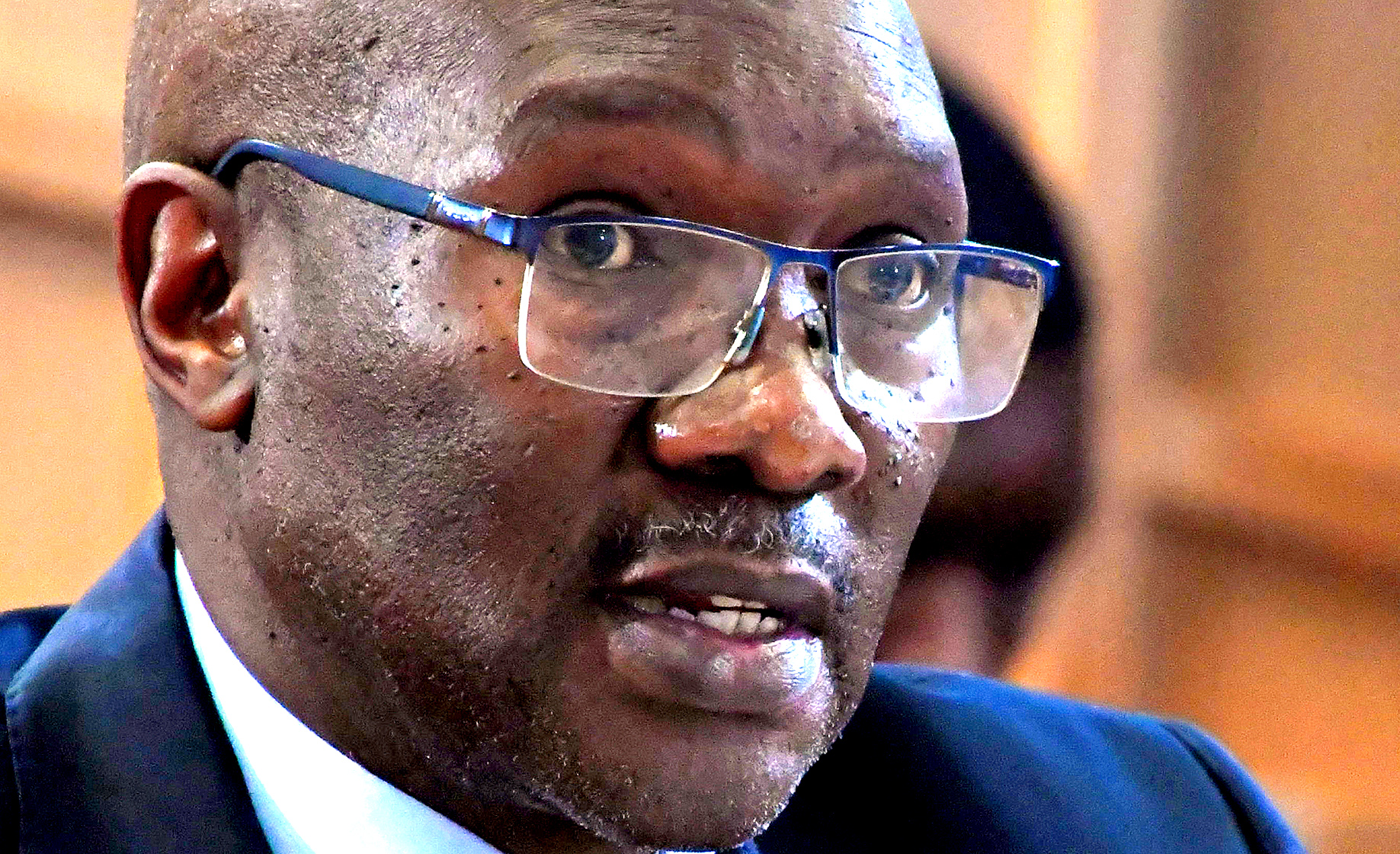
 Lieutenant-General Dumisani Khumalo testifies at the Madlanga Commission of Inquiry on 4 November 2025. (Photo: Gallo Images / Frennie Shivambu)
What happened at the Madlanga Commission?
Explosive testimony before the Madlanga Commission this week again pulled back the curtain on an alleged web of corruption binding senior police officers to a powerful criminal cartel.
In what appeared to be a move to confront this dark web, Lieutenant-General Dumisani Khumalo, the SAPS Divisional Commissioner for Crime Intelligence, told the Madlanga Commission that the Provincial Killing Task Team’s methods should be used as a national blueprint for investigating major crimes and cartel-linked operations.
The task team, he stated, set a new benchmark for investigating serious crimes. The Commission also heard that Deputy Police Commissioner Shadrack Sibiya was seen driving a vehicle registered to a man with more than 30 criminal cases on record.
Read more: Political Killings Task Team should be replicated countrywide, says Crime Intelligence boss
/file/dailymaverick/wp-content/uploads/2025/09/ED_565542.jpg "Katiso ‘KT’ Molefe. (Photo: Gallo Images / News24 / Rosetta Msimango)")
Warrant Officer Sabelo Nkosi, of the Hawks’ Tactical Operations Management Section, told the Madlanga Commission he was baffled when his team was abruptly ordered to abandon a major operation in the North West to “verify” the legality of a raid on Katiso “KT” Molefe’s home on 6 December 2024 — an operation that later proved to be entirely lawful.
He was 50km away from Molefe’s house and questioned why officers at the nearest police station were not requested to verify the information
Shocking evidence by Jabulani Isaac Mapiyeye, Chief of Police of the Ekurhuleni Metropolitan Police Department (EMPD), showed how alleged organised crime figure Vusimuzi “Cat” Matlala, through his security company, had an “unlawful” agreement with the Ekurhuleni Metropolitan Police Department to supply surveillance technology, suspect-tracking tools and tactical support in pursuing violent repeat offenders.
Read more: Vusimuzi ‘Cat’ Matlala and the ‘unlawful deal’ with Ekurhuleni metro cops
Why it matters
Explaining the unit’s effectiveness and value in combating organised crime, Khumalo cited the case of engineer Armand Swart, who was murdered in April 2024. The Political Killings Task Team (PKKT) joined the investigation on 19 November 2024 and, less than three weeks later, on 6 December, its work led to the arrest of murder accused Katiso “KT” Molefe.
While Swart’s killing may have been a case of mistaken identity, it cracked open a web of criminal links, exposing connections to an alleged organised crime cartel.
Khumalo told the commission that, based on these swift results, the team had recommended its investigative methodology be adopted as a benchmark to reshape how complex crimes are handled. He added that the PKKT model could serve as a bridge from traditional policing methods to a more integrated, intelligence-driven approach.
The testimony of Warrant Officer Sabelo Nkosi further pointed to alleged deliberate interference by the Hawks during a search and seizure operation conducted by the Provincial Killing Task Team at Katiso “KT” Molefe’s house on 6 December 2024.
Nkosi told the Madlanga Commission there was no operational briefing before the deployment — no plan on how the team would approach the scene. “We went in unprepared,” he said, adding, “we could have been moered by bullets for not being prepared. It was like walking into an ambush.”
Separately, Ekurhuleni Metropolitan Police Chief Isaac Mapiyeye again highlighted how the alleged tentacles of Vusimuzi “Cat” Matlala extend deep into institutions he can manipulate to his advantage. He revealed that the memorandum of understanding between CAT Protection and Security — Matlala’s company — and the Ekurhuleni Metropolitan Police Department (EMPD) allowed the private firm to supply surveillance technology, suspect-tracking tools and tactical support in pursuing violent repeat offenders.
Mapiyeye told the Commission that such an arrangement was unlawful, as these are core SAPS functions. “CAT Protection and Security has no legal authority to perform such tasks,” he said.
/file/dailymaverick/wp-content/uploads/2025/11/ED_585178.jpg "Deputy Minister Polly Boishelo, testifies at the Parliamentary Ad Hoc Committee inquiry into alleged corruption and political interference in the criminal justice system at Good Hope Chambers on November 04, 2025 in Cape Town(Photo: Gallo Images / Brenton Geach)")
Within Parliament, the focus of the ad hoc committee was twofold: a continuation of the Police Ministry and then the appearance of Investigating Directorate Against Corruption (Idac) head Andrea Johnson.
On Tuesday, Deputy Police Minister Polly Boshielo testified that when she saw a letter of disbandment of the Political Killings Task Team, she assumed it was “fake news” as she was not told of this by Police Minister Senzo Mchunu.
Since the damning allegations that a drug trafficking cartel has infiltrated South Africa’s law enforcement, politics and private security, Mchunu has been placed on special leave by President Cyril Ramaphosa.
This was similar to the evidence presented by the other Deputy Minister of Police, Cassel Mathale.
Boshielo also told Parliament that Acting Police Minister Firoz Cachalia had now assigned her responsibilities.
/file/dailymaverick/wp-content/uploads/2025/11/ED_585327.jpg "Minister Firoz Cachalia testifies at the Parliamentary Ad Hoc Committee inquiry into alleged corruption and political interference in the criminal justice system at Good Hope Chambers on November 05, 2025 in Cape Town, South Africa. (Photo: Gallo Images/Brenton Geach)")
Speaking of Cachalia, he testified before the ad hoc committee on Wednesday. As Caryn Dolley reported, Cachalia said the disbandment of the Political Killings Task Team (which Mchunu sent off via a letter on 31 December 2024) appeared not to have been “the right way” — and this was “unwise”.
He also said that policing capabilities were needed to dismantle and investigate corruption, which he described as “an existential threat to this country”.
Read more: No more rhetoric about tackling gangs and organised crime — the state’s new plan is the first step
/file/dailymaverick/wp-content/uploads/2025/11/ED_585359.jpg "Andrea Johnson testified that everything concerning the June 2025 arrests of former Crime Intelligence head Dumisani Khumalo and his colleagues had been above board and carried out respectfully. (Photo: Gallo Images / Brenton Geach)")
On Thursday, when Idac head Johnson testified, the existing issues within crime intelligence took a rather personal route: her husband works within the unit, which, as Caryn Dolley reported, has been repeatedly rocked by infighting and accusations of slush-funding looting. Johnson was repeatedly asked if she or her husband shared information, which she vehemently denied.
Khumalo, of course, is head of this unit.
Johnson’s testimony focused on complaints laid by National Coloured Congress leader and MP Fadiel Adams, which were eventually broken down into six matters. While four out of the six matters which Adams complained about were still under investigation, two complaints have since led to arrests.
Next week, the ad hoc is expected to hear evidence from advocate Shamila Batohi, the head of the National Prosecuting Authority on Tuesday. DM