



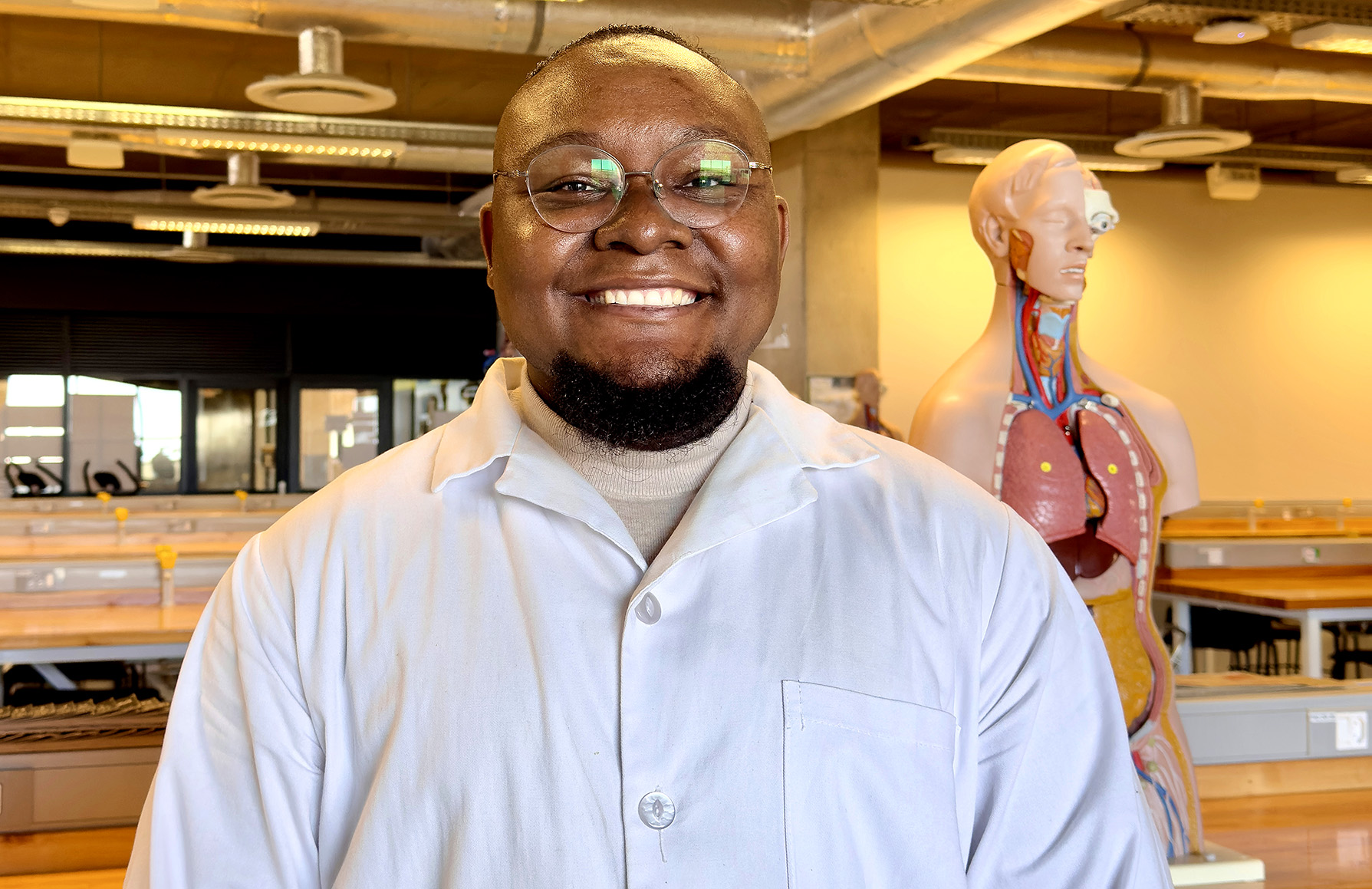
 Dr Nehemiah Latolla from Nelson Mandela University. (Photo: Supplied / Nehemiah Latolla)
 From the moment he spent time in his grandmother’s medicinal garden, Dr Nehemiah Latolla knew that he wanted to help heal people.
“But medicine was not for me. I had a sister who was studying nursing, and all the blood and guts, that was too much,” he said.
Instead, his love of chemistry took him on a different path that has now culminated in a grant to study the potential of the Eastern Cape’s indigenous plants to fight cancer.
“My granny’s medicinal garden was the first point of contact for me,” he said. “It felt natural for me to study medicinal plants and I listened to all the stories my granny told. But when I was a teenager, it wasn’t seen as cool any more to use plants for healing; instead, it was seen as folklore and witchcraft.”
His studies in organic chemistry took him to investigating the medicinal qualities of the indigenous Dawidtjieswortel (Cissampelos Capensis), a well-known indigenous plant, and to look at how medicinal plants can be used sustainably.
He also explored the potential of indigenous plants to assist in the treatment of diabetes, and for his PhD, found “promising results”.
For this research, he studied the Dawidtjieswortel and Strychnos Henningsii, also known as the Bosolienhout, Rooibitterbessie or Koffiehardepeer – a plant found elsewhere in Africa, too.
“I have always been drawn to helping others,” said Latolla, who is also a poet and a fashion designer.
He said his post-doctoral studies took him into the realm of cell work, as he wanted to study when a plant becomes toxic and at what levels it will be safe to use. This, he explained, would assist in seeing how tumours react to certain plant compounds.
Principal investigator
Latolla will serve as principal investigator on one of only eight projects selected globally.
“I am looking forward to having some time to think,” he said. “There is a wealth of knowledge out there. These secrets are passed down through the generations,” he said. Latolla added that it was crucial to him that the community worked with the researchers. “I want to co-create with the knowledge-holders,” he said.
During his research, he said, he will use a medicinal garden created by the Nelson Mandela University. “It will be community work centred on trust and relationships,” he said. He intends to use an artificial intelligence language model to enable citizen science to be preserved.
This interactive tool will safeguard community wisdom for future generations while providing practitioners and local communities with accessible insights into the scientific validation and potential applications of traditional remedies.
Holistic treatment
His studies will focus on a plant-based treatment for breast cancer. “But the indigenous knowledge is not always specific about the type of cancer a plant will be good for,” he said. He said that he hoped to spend more time with traditional practitioners of plant medicine and “figure out how to treat disease holistically”.
He said their work to evaluate traditional knowledge would begin in 2026, but he also hopes to spend more time in the field and specifically in Joubertina, where his parents are involved in missionary work.
“The first time I went to visit, one of the women there said I must come in the morning. When I arrived at around 10am, she said morning was at 6am. The next time I went, she had me dig in the garden. It was only after that, that we started talking about life,” he said. “If that taught me anything, it is that the project would need time.”
Collaboration
Dr Latolla recently represented the Nelson Mandela University at the Australia-Africa Universities Network forum and annual meeting held in Perth.
In the project, sustainable agriculturists will cultivate the plants to be used in ways that protect biodiversity, soil health, and natural resources. Laboratory studies will be conducted at Nelson Mandela University, Latolla said, with collaborative fieldwork and data sharing across partner institutions in Africa and Australia.
The project will be a collaboration between Nelson Mandela University, the University of New South Wales, Curtin University, and the University of Ghana.
Dr Priscilla Mensah, Director of Research Development, said: “Dr Latolla’s achievement reflects the calibre and ambition of Mandela University’s emerging researchers. His success in securing highly competitive international funding speaks to his scientific excellence and the strength of collaborative partnerships that place African knowledge and innovation at the centre.” DM