




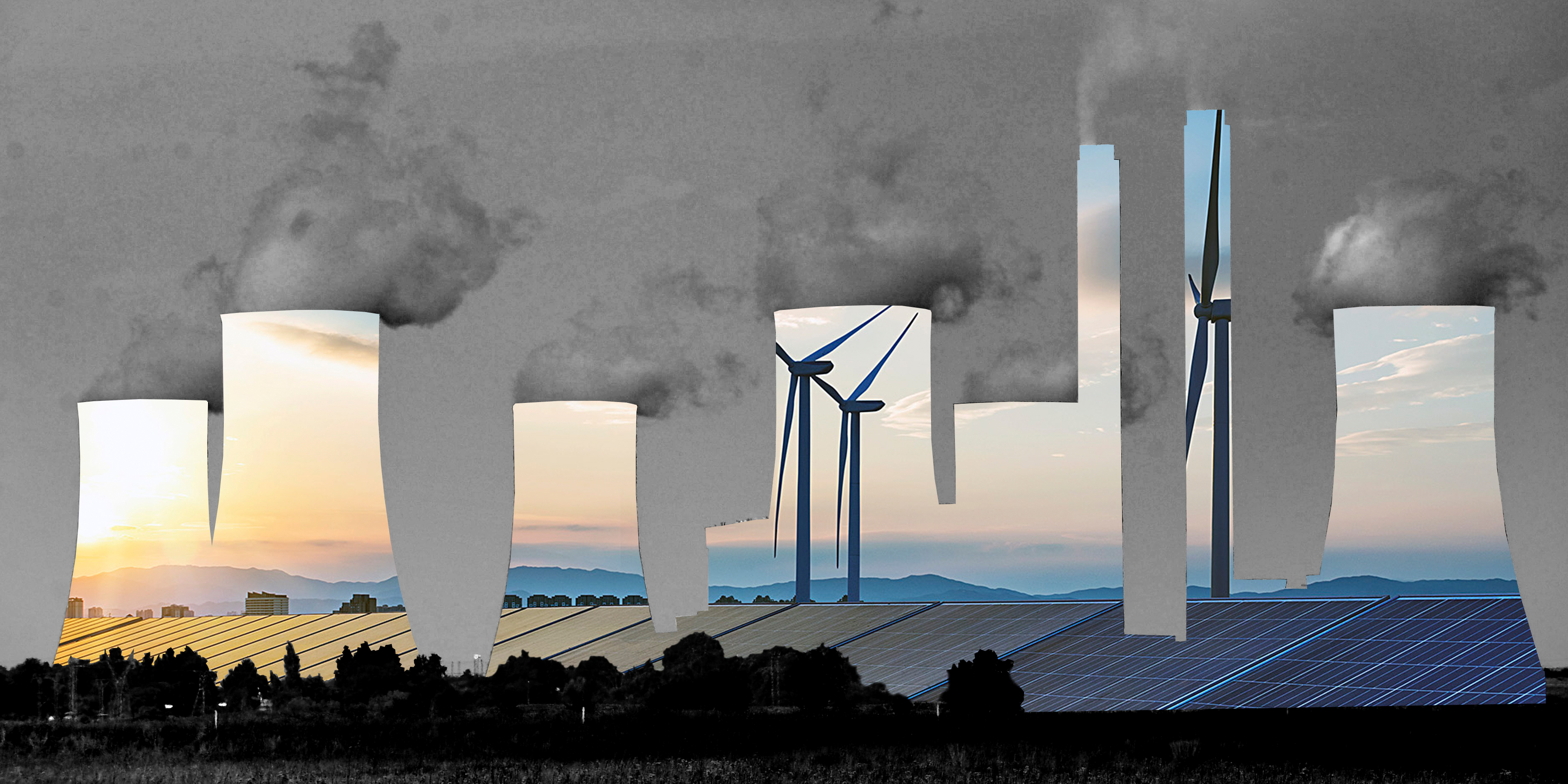
 Illustrative image: Eskom’s Lethabo coal-fired power station in Vereeniging. (Photo: Leon Sadiki / Bloomberg via Getty Images) | Wind and solar energy. (Photo: iStock)
During her speech in November 2008 to open a new building at the London School of Economics, Queen Elizabeth II famously asked a simple question about the global financial crisis that was rocking the foundations of the global financial system at the time: “Why did nobody notice it?”
It took another eight years for a satisfactory answer to emerge from mainstream economics: in 2016, the chief economist of the Bank of England, Anthony Haldane, answered the Queen’s question when he delivered the annual GLS Shackle Biennial Memorial Lecture. Drawing on complexity thinking, he criticised general equilibrium models for being hopelessly inadequate for anticipating shocks. Referring to all the mainstream models, he observed that “every one of these forecasts was not just wrong but spectacularly so”.
The reason for this spectacular failure, he argued, is because all the economists were using the same basic method – dynamic stochastic general equilibrium models: “At root, these were failures of models, methodologies and mono-cultures.” This was the answer to the Queen’s question. Four years later the Bank for International Settlements called for the development of a new generation of non-equilibrium models. South Africa’s SA-TIED initiative, working in partnership with the National Planning Commission, is developing such a model in partnership with the Development Bank of Southern Africa and the French Development Bank using a “stock-flow consistent” model called GEMMES-SA.
As argued recently in this publication, South Africa is fortunate to have a diversity of modelling capabilities for assessing our energy future. This will prevent the “mono-culture” and associated failures that Haldane warns against.
On Tuesday, 28 October, the Ministry of Electricity and Energy published the Integrated Resource Plan 2025 (IRP 2025) which is, according to the Electricity Regulation Amendment Act (Act 38 of 2024), supposed to act as a continuously updated guideline for all energy planning and ongoing implementation of generation and transmission projects over time. The IRP proposes a low-carbon energy mix through to 2050 that is based on detailed modelling work by an Eskom-based team of modellers.
On 5 November, a consortium of public sector institutions released a report titled South Africa’s Energy Sector Investment Requirements to Achieve Energy Security and Net-Zero by 2050 (the SAESIR report). As the title suggests, this report assesses the investment requirements of an energy mix that delivers at the lowest cost both energy security and a (near) net zero carbon outcome by 2050. Like the IRP, this report is also based on modelling work by a team that has been working together since 2022. The consortium comprises the Development Bank of Southern Africa (which funded the research), the National Planning Commission, the Presidential Climate Commission and the SA-TIED research partnership.
Both the IRP and the SAESIR report share the view that we need an energy pathway through to 2050 that delivers energy security for all, the most affordable energy mix, and a decarbonised economy as proposed in Chapter 5 of the National Development Plan and defined by our Nationally Determined Contribution (NDC).
Although this article does not compare the two reports in detail, it is worth mentioning that the key difference between the two documents is that the IRP is a guiding policy that commits government institutions to an energy pathway through to 2050 (including the Eskom group of companies), while the SAESIR report is entirely research-based with recommendations – it does not purport to be a policy framework. As a result, unlike the SAESIR report, the IRP is “policy adjusted” to accommodate legitimate policy priorities that cannot at this stage be fully justified by the outputs of the model that was used (e.g. a significant amount of nuclear power). Furthermore, the SAESIR includes a market sounding to assess investment appetite, and it includes two modelling-based assessments of the socioeconomic impact of the energy transition on, in particular, Mpumalanga.
Like any research that uses modelling to assess the implications of a range of probable futures, the SAESIR report describes three future scenarios that are influenced by a reading of the intersection between domestic and global trends. As far as the assumptions about global pathways are concerned, the three scenarios consist of a world aligned with the science-based target agreed in Paris in 2015, namely a maximum of 1.5°C warming; or a fragmented world that warms by 2°C to 3°C; and a business-as-usual world where warming exceeds 3°C because the world has followed Donald Trump by denying decades of climate science.
The domestic scenarios are a policy-driven green industrialisation pathway as intended by the Cabinet-approved South African Renewable Energy Masterplan as well as many other policy documents (Just Transition Framework, Low Emissions Development Strategy, National Infrastructure Plan 2050, IRP 2025, etc); a market forces pathway that is driven by prices rather than policy; and a business-as-usual pathway that is largely unaffected by both policy or prices and aligns with global policies that explicitly deny climate science.
Reading these global and domestic scenarios together, the steering committee of the project agreed that there were three probable scenarios: Scenario A: green industrialisation that correlates with the global 1.5°C “aligned” and the domestic policy-driven “green industrialisation” scenarios; Scenario B: a market forces scenario that correlates with a “fragmented” global scenario and a price-driven “market forces” domestic scenario; and Scenario C: a business-as-usual scenario that correlates with a high emissions global business-as-usual scenario and a similar domestic scenario whereby a raft of policies aligned with Chapter 5 of the National Development Plan are scrapped or not implemented.
No one can claim to know the future. However, as individuals and societies we make decisions in the present based on what we anticipate might happen in future, including at times our preferred Plan A and our fall-back plans B and even C. This is what the art of scenario building helps to achieve for entire societies. It means making assumptions about probable outcomes depending on likely scenarios and then assessing them to arrive at a preferred probable outcome.
It is not possible here to elaborate on all 18 assumptions that were made for all three scenarios, but it is not hard to imagine a few of the most important ones: How much carbon do we want to save by 2050? How quickly should we shut down the old coal-fired power stations? Will the cost of renewables and batteries continue to drop and how quickly (so-called learning rates)? How much more electricity will we need every year to 2050 based on assumptions about economic growth? At what interest rate can we borrow the money that is needed? (so-called cost of capital) And how big is the capital market?
Unsurprisingly, models differ for obvious reasons: modelling groups do not always share the same assumptions about possible futures. In a democracy, we debate these differences. In many undemocratic environments, the powerful dictate the preferred future.
To answer the above questions, the SAESIR report has assumed that the carbon budget through to 2050 for Scenario A is 2.0 gigatonnes of CO2 equivalent (GtCO2) (in order to align with South Africa’s NDC), 3.0 GtCO2 for Scenario B, and no limits for Scenario C. As far as coal decommissioning is concerned, the report assumes the pathway recommended in IRP 2019 for scenarios A and B, and a delayed decommissioning for Scenario C. However, the preference is for “mothballing” (not close, but keep operational but without an output) rather than full decommissioning in order to keep coal power in reserve (for what is called “ramping”) in case the other options do not materialise in time. With regard to technology learning rates, optimistic assumptions inform Scenario A (i.e. costs of renewables will drop quickly), moderate optimism informs Scenario B and pessimistic assumptions inform Scenario C. As for demand for electricity, both the SAESIR and IRP reports accept the projections generated by University of Cape Town, namely that demand will grow from 250,000GWh in 2023 to more than 400,000GWh in 2050.
As far as financing is concerned, it is assumed that the bulk of the capital will be sourced from the private sector. Even if state-owned companies build publicly owned infrastructures, they will – as in the past – invariably need to borrow money via loans and bonds from the private investors (banks, institutional investors) and public investors (GEPF and development finance institutions). What matters, therefore, is the cost of capital. For Scenario A it is assumed that investing in fossil fuels will cost 10% more than renewables, and 5% more under Scenario B, with no advantage for renewables under Scenario C. Furthermore, the availability of climate finance will be greater under Scenario A than the other scenarios.
Besides the above five key assumptions, the others relate to adherence to air quality standards, the impact of the Carbon Border Adjustment Mechanism, extent of carbon taxes, how high the Energy Availability Factor of the ageing fleet of coal plants will be, the viability of Carbon Capture and Storage (CCS), the price of fossil fuels (coal, gas), the extent of rooftop solar, the extent of private generation for third-party customers via the market, rate of grid expansion, amount of load shedding and how much electricity can be bought from southern African neighbours.
To cut a long story short, the model results are:
Energy Mix for Scenarios A, B and C (GW)

Under Scenario A, renewables (wind and solar) plus backup (batteries and gas) plus hydro increases to 73GW by 2030 and to 228GW by 2050. Coal reduces from the current 48GW to 14GW by 2030 and to 10GW by 2050 (if CCS is viable by then). Under Scenario B, renewables plus backup plus hydro increases to 45 GW by 2030 and to 161 GW by 2050. Coal reduces to 34 GW by 2030 and 10 (plus CCS) by 2050 in Scenario B. For Scenario C, renewables plus backup plus hydro increases to 42GW by 2030 and to 143GW by 2050. Coal reduces to 34 by 2030 in Scenario C, and to 11 (without CCS) by 2050.
It is noteworthy that the modelling work, based in particular on the cost estimates of different technologies, did not result in the selection of additional nuclear power due to uncertainties about cost and implementation horizons. However, the SAESIR report does acknowledge that if future innovations result in reduced costs of nuclear, it should be considered as an option in future. Furthermore, many sensitivities were run to test the implications of key assumptions not materialising, for example the challenge of building large amounts of gas infrastructures within the next five years.
Based on authoritative international price estimates and related learning rates, it was possible to estimate the capital and operating costs of the energy mix for the three scenarios. The generation capex is for the energy mix described above. Added to this are the investments required for operations and the Transmission Development Plan.
Investments Required (in billions of rands)

The total capex requirement through to 2050 to achieve Scenario A for both generation and transmission is just more than R2-trillion, which is slightly less than the IRP 2025 estimate of R2.2-trillion. The capex for Scenarios B and C is estimated to be R1.5-trillion and R1.6-trillion, respectively. However, to fund the entire system cost through to 2050 it is necessary to also include operating costs. The result is a total system cost for Scenario A of R3.5-trillion, R3.6-trillion for Scenario B and R4.1-trillion for Scenario C. The reason that scenarios B and C are more costly is because of their significantly higher operating costs resulting from the fact that more needs to be spent on buying coal to feed coal-fired power stations that remain operational. In short, the least-cost scenario is also the more sustainable development pathway to net zero.
A word on backup: so-called variable renewable energy does fluctuate with the availability of sun and wind. It therefore needs to be backed up. However, there are two kinds of backup requirements: instantaneously for three to nine hours, or for three to four days. For the former, batteries are ideal, while for the latter, you need substantial gas infrastructures (both open cycle and combined cycle) to provide the bulk of the energy needed on those rare occasions when both sun and wind resources are inadequate. In other words, this might mean building a lot of gas infrastructure, but using very little gas annually. This is normal across all renewables-based energy systems around the world. The challenge, however, is that we do not have our own proven gas reserves on scale (although Namibia does), and to buy a gas turbine can take up to five years because of global demand. Rapid deployment of large-scale gas infrastructure in the near term is, therefore, unlikely to happen.
So, this brings us to the question about who is going to invest in our energy transition. Obviously, climate finance is going to play a major role. However, as soon as this is mentioned, South Africans immediately assume this will come from outside South Africa. This is a myth. Only 10% of the R1.5-trillion Just Energy Transition Investment Plan, for example, will be funded by foreign investors. Can the remainder come from domestic investors? The short answer is yes.
The Presidential Climate Commission recently released its authoritative report entitled The South African Climate Finance Landscape 2025. Based on quantitative analysis, this report found that R188.3-billion was invested in 2022-23 in climate-related investments within South Africa, more than 70% of which were energy-related; 60% of the total invested came from domestic investors (R108.3-billion). Of this, R93.9-billion came from private domestic investors, and only R17.9-billion came from public domestic investors. Of the 40% invested by international investors, only R14.4-billion came from private international investors, while international public investors invested R59-billion. The two biggest institutional investors were domestic banks (R36.6-billion) and international (publicly owned) development finance institutions (R48-billion). Not much was sourced from South Africa’s deep pools of institutional investment capital (pension and insurance funds), i.e. only R12.5-billion. That said, these institutional investors do tend to be a major source of funding for the banks, so maybe this is not such an accurate statement.
The SAESIR report includes a “market sounding’. This refers to a survey of South African public and private investors to ascertain whether investors think there is R100-billion per annum to invest in the energy transition through to 2050. The answer – which is a subjective judgement rather than an objective quantitative certainty – is a strong yes, which is good news. And this is confirmed by the quantitative finding of the PCC report (R93.9-billion). However, these investors may be confident that R100-billion per annum was available over the next five years, but uncertain that this is true beyond 2030. This is not because of a shortage of funding, but rather governance-related matters such as weak project preparation capabilities and capacity, lack of coordination between state institutions, policy and regulatory uncertainty, and poor understanding of energy investment opportunities within the wider financial sector. For example, if policy conflicts prevent a fully independent transmission system operator getting established in five years, including ownership of the transmission assets as envisaged by the Electricity Regulation Amendment Act, this will significantly diminish the appetite for investing in the transmission grid.
In short, the SAESIR report is confident that the South African public and private investors can carry the bulk of the investments required to achieve energy security and (nearly) net zero by 2050. The remainder will be readily accessible from foreign sources.
However, much depends on whether the government puts in place rules of the game that favour South African companies to both finance and deliver the R3.5-trillion worth of new infrastructures. If these rules favour international investors and contractors (as is the case now with respect to the request for qualifications for bidders to build out the transmission system), the energy transition will fail to catalyse the accelerated industrialisation needed to drastically reduce unemployment and poverty. This cannot just mean partnerships with South African financiers who have no incentive in reinvesting in expanding productive capabilities and capacities in the manufacturing and construction sectors in the long run. Most of their lucrative profits from these partnerships will spin around in the domestic and international financial circuits. Partnerships must be formed with companies with actual productive capabilities and capacities that can expand through reinvestments of profits over the long run.
Finally, the SAESIR report includes an analysis of the impact of the energy transition on Mpumalanga using a combination of CGE modelling and micro-economic analysis. There are an estimated 106,887 direct and indirect Mpumalanga workers in the coal value chain, representing 87% of South Africa’s total coal-related employment. Two-thirds are semiskilled. Their future livelihoods will depend on retraining and income support. About 3,700 workers are 55 years or older, and qualify for early retirement. Nearly 8,000 are unskilled and will require income support costing R4-billion over five years, or just more than 1% of the total social protection budget. This group is the biggest challenge. Existing institutions such as Setas and UIF can provide the bulk of the funding needed for income support and retraining of the semiskilled group (the largest group). There is, however, a gap of R2.6-billion which will need to be funded from the fiscus and/or by climate finance. Besides these welfare interventions, the industrial potential of Mpumalanga must not be ignored. It has a long tradition of semiskilled industrial workers plus a substantial energy and road infrastructure that can together be redeployed to support a regional green industrial strategy.
The recently launched JET Skills Advisory Forum under the auspices of the Human Resource Development Council will need to address the economy-wide challenge of skills development for the energy transition, with special reference to Mpumalanga. The SAESIR report’s recommendations for Mpumalanga will help frame the forum’s approach.
In conclusion, the SAESIR report provides a detailed and carefully researched contribution to the democratic debate South Africans must now have about our collective energy future. No one can claim to know the future. Nor can anyone claim there is one right way. Let’s make sure we avoid making decisions with long-term impacts that may not be optimal. The last thing we need is for load shedding to return which prompts our head of state to ask the energy planners: “Why did nobody notice it?”
Dr Zeph Nhleko is chief economist of the Development Bank of Southern Africa. Professor Mark Swilling holds the SARCHi Chair in Urban Innovation at the Centre for Sustainability Transitions, Stellenbosch University, and is a commissioner on the National Planning Commission. He writes in his academic capacity. Both Nhleko and Swilling were members of the steering committee that provided strategic guidance for the team that compiled the SAESIR report.