




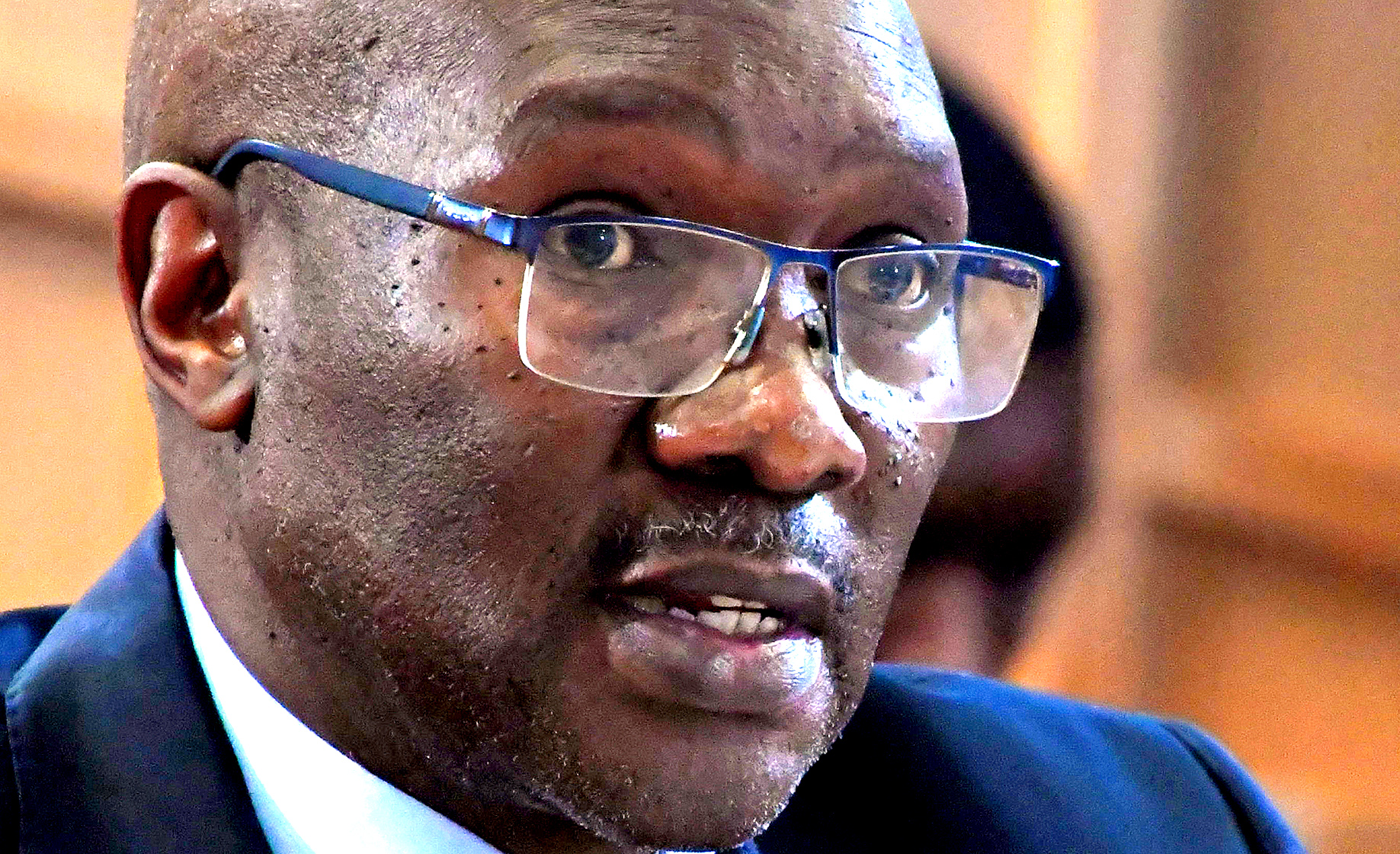
 Lieutenant-General Dumisani Khumalo testifies at the Madlanga Commission of Inquiry on 4 November 2025. (Photo: Gallo Images / Frennie Shivambu)
 On Tuesday, 4 November, Lieutenant General Dumisani Khumalo, SAPS Divisional Commissioner for Crime Intelligence, told the Madlanga Commission that policymakers should adopt the Provincial Killing Task Team’s (PKTT) methodologies as a national benchmark for investigating serious crimes, including those linked to cartels.
Khumalo resumed his testimony on Tuesday after falling ill and pausing his testimony on 1 October 2025.
Most of his evidence centred on interference by the Hawks in PKTT cases and cartel members recruiting SAPS members. But a key point he raised was the effectiveness of the PKTT and the value it brought to tackling organised crime.
He highlighted the case of engineer Armand Swart, who was murdered on 17 April 2024. The PKTT became involved in the case on 19 November 2024, and on 6 December 2024, it led to the arrest of businessman Katiso “KT” Molefe.
/file/dailymaverick/wp-content/uploads/2025/09/ED_565542.jpg "Katiso ‘KT’ Molefe. (Photo: Gallo Images / News24 / Rosetta Msimango)")
Swart was killed in what was believed to be a case of mistaken identity after the company he worked for, Q Tech, reported corruption related to Transnet contracts. Molefe is alleged to be the mastermind behind the murder.
Based on the PKTT’s quick results, Khumalo told the commission: “In all our recommendations to policymakers, we recommend that this methodology is used as a benchmark to try and change the way we investigate crime.
“We believe this model of PKTT can be used as a transition from the traditional way of investigating to this one, which is suitable for the problems that we are facing as a country at this moment.”
The Madlanga Commission is hearing evidence on alleged criminality, political interference and corruption within law enforcement, resulting from explosive claims by KZN police commissioner Nhlanhla Mkhwanazi, who accused sidelined police minister Senzo Mchunu and deputy national commissioner Shadrack Sibiya of colluding with or acting in concert with organised crime.
/file/dailymaverick/wp-content/uploads/2025/09/ED_557542.jpg "The Madlanga Commission heard claims that Vusimusi ‘Cat’ Matlala had police leadership on his payroll. (Photo: Luba Lesolie / Gallo Images)")
Khumalo, who was moved from Crime Intelligence after he was criminally charged in July over an alleged irregular appointment, also told the commission that the “Big Five” cartel was connected to various syndicates. Of the Big Five, he named only two, Vusimuzi “Cat” Matlala and Molefe, but the commission has also heard that the late Pretoria taxi boss Jothan “Mswazi” Msibi was also a member.
PKTT model could revitalise investigations
Khumalo highlighted the Swart case while praising the PKTT. He said the PKTT uncovered that an AK-47 seized from suspects in that case was linked to several other high-profile cases, a link which hadn’t previously been established.
Read more: Armand Swart killing suspect, KT Molefe’s nephew, on the run since 2024
“After discussions with other stakeholders and Lieutenant General Nhlanhla Mkhwanazi in November 2024, a decision was taken to assign 10 experts from the PKTT to join the Gauteng Counterintelligence Operations Unit (GCIops). This included experts in the field of ballistics, digital forensic analysis, call data analysis and crime scene investigators who dealt with reconstructing crime scenes,” he said.
/file/dailymaverick/wp-content/uploads/2025/11/ED_585146.jpg "Lieutenant General Khumalo told the commission that he saw the PKTT model as the blueprint for transforming policing, a shift from outdated, reactive investigations to a system designed for the country’s current criminal landscape. (Photo: Gallo Images / Frennie Shivambu)")
Khumalo told the commission that cartel figures often hid in plain sight, setting up private security companies to stockpile weapons under a legal façade.
The PKTT not only had the necessary forensic experts at its disposal, but it was able to use them for a quick turnaround in investigations. The commission has heard that police ballistics face a severe backlog and often take months to make findings, while the PKTT could produce results within days.
Read more: SAPS ballistics backlog imperils criminal cases and undermines trust in police
Khumalo said the PKTT’s probe ripped the lid off how deeply organised criminals had embedded themselves in the justice system. Replicating such dedicated teams could do the same in other parts of the country. The PKTT was involved in several investigations across provinces, but was primarily based in KwaZulu-Natal.
Khumalo said that, as part of efforts to replicate the PKTT’s success, all provinces were at one stage directed to deploy a minimum of six SAPS officers to work side by side with the task team and absorb its investigative approach.
Khumalo described how trainees attended classes at night and joined PKTT teams in the field by day, a hands-on approach that initially worked.
“It was a successful attempt, but once they returned to their provinces, the system broke down. Those expected to enforce the new methods simply didn’t understand them and fell back into old habits,” he said.
He pointed to the Western Cape as a rare exception, where provincial commissioner Thembisile Patekile took part in the training himself.
“That made a difference,” Khumalo said. “When leadership understands the model, implementation follows.”
/file/dailymaverick/wp-content/uploads/2025/10/ED_573386.jpg "Western Cape Police Commissioner Thembisile Patekile. (Photo: Gallo Images / Die Burger / Jaco Marais)")
Khumalo further told the commission that he saw the PKTT model as the blueprint for transforming policing, a shift from outdated, reactive investigations to a system designed for the country’s current criminal landscape.
Recommendations to formalise the model, he said, had already been handed to the police minister, the national commissioner and members of the interministerial committee overseeing the unit.
The PKTT has also faced allegations that it received a disproportionately high budget relative to the number of cases it was investigating, as well as claims of heavy-handedness in dealing with suspects, claims its leaders have denied.
Alleged police middleman
During his testimony, Khumalo also added detail to allegations that deputy commissioner Sibiya received kickbacks from criminals. He said Sergeant Fannie Nkosi, a detective in Sibiya’s office, served as the go-between for Sibiya and murder accused “KT” Molefe.
/file/dailymaverick/wp-content/uploads/2025/10/ED_582163-1.jpg "Suspended Deputy National Commissioner of Crime Detection Shadrack Sibiya arrives at the parliamentary ad hoc committee inquiry into alleged corruption and political interference in the criminal justice system on 13 October 2025. (Photo: Gallo Images / Brenton Geach).")
The commission has also heard that Nkosi was an alleged intermediary in a kickback chain that funnelled money from Matlala to both Sibiya and himself.
Read more: Witness C details ‘Cat’ Matlala’s claims to have bribed minister, top cops
Nkosi’s alleged links to the cartel were underscored on Tuesday when CCTV footage played before the commission showed him stepping out of a state-owned vehicle at Molefe’s Sandhurst home. Within 10 minutes, he reappeared, carrying a white bag and walking back to the car alongside Molefe.
Khumalo told the commission that the state vehicle assigned to Sibiya, which Nkosi was using, should have been equipped with a tracker. It wasn’t, and investigators are now looking into whether the device was intentionally removed to conceal its movements.
The commission heard that Nkosi was also caught with a bank card, allegedly belonging to Matlala. Khumalo said investigators had since traced Sibiya’s alleged links to criminal syndicates through Nkosi, his trusted detective.
Khumalo continues his testimony on Wednesday. DM