




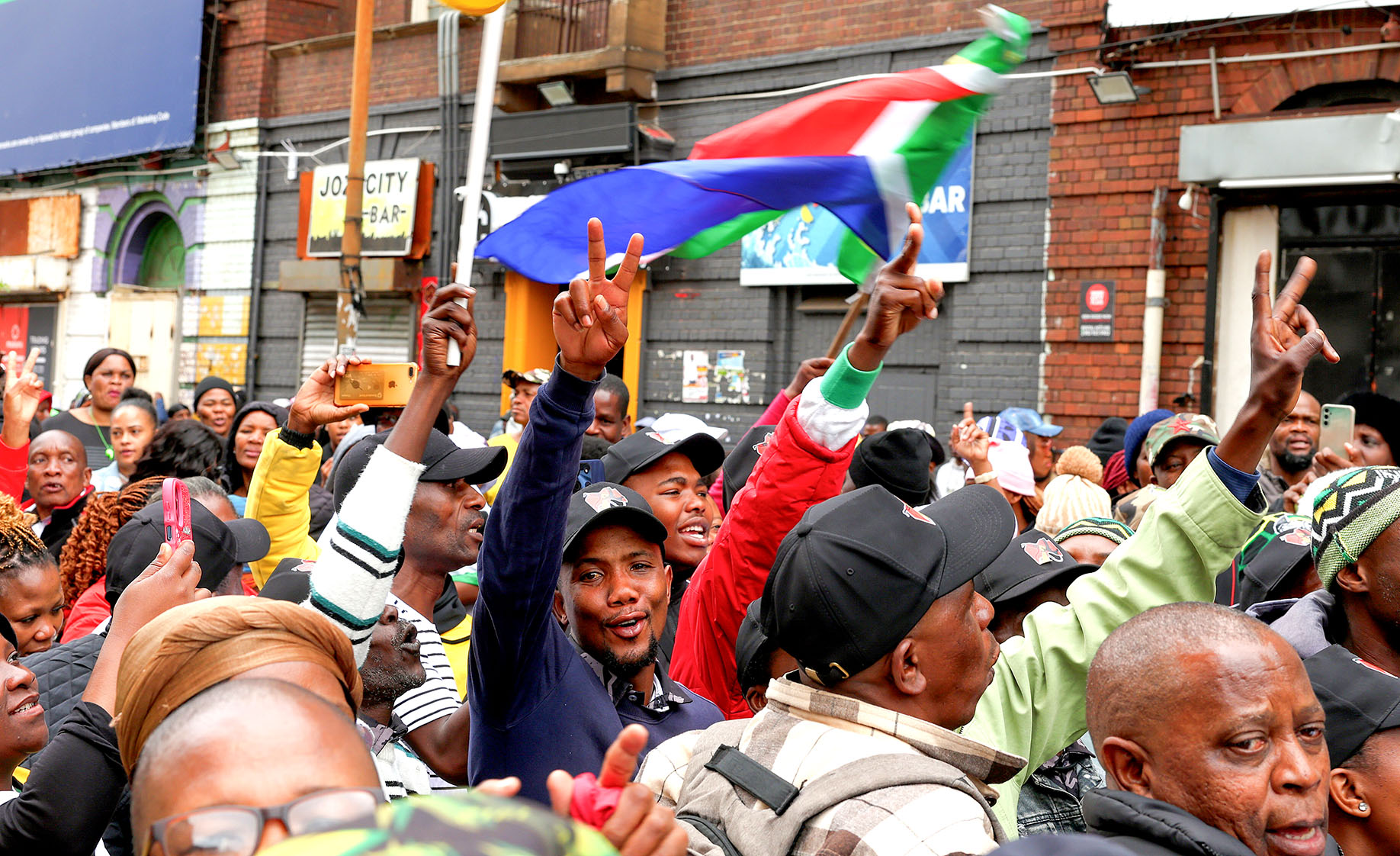
 Protesters march on 3 November in De Villiers Street, Johannesburg, from where informal traders were evicted last month. (Photo: Gallo Images / Luba Lesolle)
 The Gauteng Division of the High Court in Johannesburg has ordered the City of Johannesburg to verify, register and allocate spaces to qualifying inner-city traders within two weeks after the traders took the municipality to court for allegedly arbitrarily evicting them at the beginning of October.
In his ruling, Judge Brad Wanless said the process must commence on 4 November and be completed by no later than 18 November 2025. This means the city has a fortnight to verify and register the traders and allocate them stands.
Read more: ‘My children will starve’ — evicted informal traders prepare for court battle against City of Joburg
“The first respondent, the City of Johannesburg, is to conduct an expedited verification/registration/reregistration and allocation process as contemplated by the Informal Trading ByLaws promulgated in the Provincial Gazette dated 14 March 2012,” Judge Wanless ruled.
The ruling followed an urgent application brought by the Socio-Economic Rights Institute of South Africa (Seri) on behalf of the South African Informal Traders Forum (SAITF).
On 2 October, the city of Johannesburg removed informal traders from their long-standing trading spots on De Villiers Street in Johannesburg’s inner city. The operation was extended to other inner-city areas, and extended to Soweto and Alexandra.
The informal traders took the city to court on an urgent basis last week. They argued in court papers that their removal was arbitrary and violated their trading rights, and that the city had failed to issue them proper permits since 2012.
Since their removal by the city and the Johannesburg Metropolitan Police Department (JMPD), they have been unable to trade, which has affected their livelihoods and ability to support their families.
/file/dailymaverick/wp-content/uploads/2025/10/IMG_20251008_105255.jpg "Johannesburg Metro Police Department vehicles stationed near De Villiers Street in Joburg's CBD, from where informal traders were evicted on 2 October. (Photo: Bheki Simelane)")
/file/dailymaverick/wp-content/uploads/2025/11/ED_585132.jpg "Protesters in De Villiers Street on 3 November. (Photo: Gallo Images / Luba Lesolle)")
Insufficient trading space
The city told the court it had 200 spaces to allocate, while there were about 500 affected informal traders.
“We know … that some of them are already ineligible for various reasons,” said attorney Leslie Mkhabela, representing the city. “We believe that the number will go down exponentially.”
The city has previously emphasised that trading should be reserved for South Africans, but after Monday’s judgment, it said foreigners with valid visas or asylum-seeker permits also qualified.
“This decision by the court highlights the necessity of establishing a structured and compliant framework for informal traders, ensuring a balanced strategy that fosters economic growth while upholding order and respecting the rights of both residents and businesses,” said the city on Monday.
Traders will not be allowed to return to trade until they are allocated stands in designated areas. No trading will be allowed on De Villiers Street, where popular thrift stands had been operating for decades.
“The city demarcates markets,” said Mkhabela. “You do not just pick a spot because you like it. De Villers Street is not one of the streets which will be allocated for trading.”
Last week, a city representative said 40 informal traders had been verified, but on Monday, the city said it was an ongoing process, which made it impossible to know the exact number of verified traders.
/file/dailymaverick/wp-content/uploads/2025/10/ED_583611.jpg "Joburg Mayor Dada Morero hands over an informal trading permit at Noord Street Market, Johannesburg, on 24 October. (Photo: Sharon Seretlo / Gallo Images)")
Traders claim victory
Seri legal director Nkosinathi Sithole said the ruling was a win for the law, although not an overwhelming success.
“But by agreement, we got what the traders were looking for, which is to be regularised. And that is a victory for the traders and the organisation because had it not been for this litigation, we would have found ourselves in a position where the traders are forgotten, as was the city’s intention,” said Sithole.
He said a 2013 Constitutional Court judgment had interdicted the city from evicting informal traders, but the city had defied that judgment and removed the traders.
Read more: Informal traders evicted from Joburg thrift haven as city embarks on crackdown
Sithole said Seri and SAITF were never opposed to the city enforcing the law as long as this was done legally.
“Mere threats that they will not regularise informal traders that are not South African by origin are not going to fly,” he said.
“The informal traders who we represent are here legally. They have passports, they have asylum-seekers [permits] and therefore those traders will be regularised, failing which we will come back to this court.”
He dismissed claims that Seri was opposing all the city’s measures to tackle inner-city challenges, which, the city has claimed, include hijacked buildings.
“If that was true, we would not have agreed to the city regularising the traders as has been ordered in this court,” said Sithole.
“Come the 18th of November, if nothing has not been done, we will be back in this court to say that the city has failed to comply with the order of this court.”
‘The city was wrong’
“For us, it’s simple. All we wanted was the city to do what they were supposed to do,” said SAITF chair Brian Phaaloh in reaction to the judgment.
“We didn’t think in the first place that [the city] needed to be compelled by the court to do what they needed to do. They were wrong by removing those people without verifying their trading statuses.”
He said the city knew that some of the traders were operating legally and had been verified in May.
“We believe that the city will abide by the order, but the city previously said it does not have enough trading space. Now they have been ordered to give space to those who qualify, and we are happy and confident that we will be victorious in the end when it comes to this case.”
Tense confrontations
The case began on Friday, and the hearings were characterised by intense confrontations between the informal traders and anti-migrant groups, including Operation Dudula.
Insults were traded openly while police and security did their best to maintain calm.
/file/dailymaverick/wp-content/uploads/2025/11/ED_585137.jpg "Protesters and police in De Villiers Street on 3 November. (Photo: Gallo Images / Luba Lesolle)")
Matron Mhlanga, one of the leaders of SAITF, was confronted by a crowd of elderly women wearing Operation Dudula gear. They accused her of standing with foreign nationals.
“Their actions are proof that for them the issue was never about lawful trading but getting rid of foreign nationals,” said Mhlanga.
A number of people in EFF regalia were also at court in support of the traders, and were criticised by the anti-foreigner groups. DM