



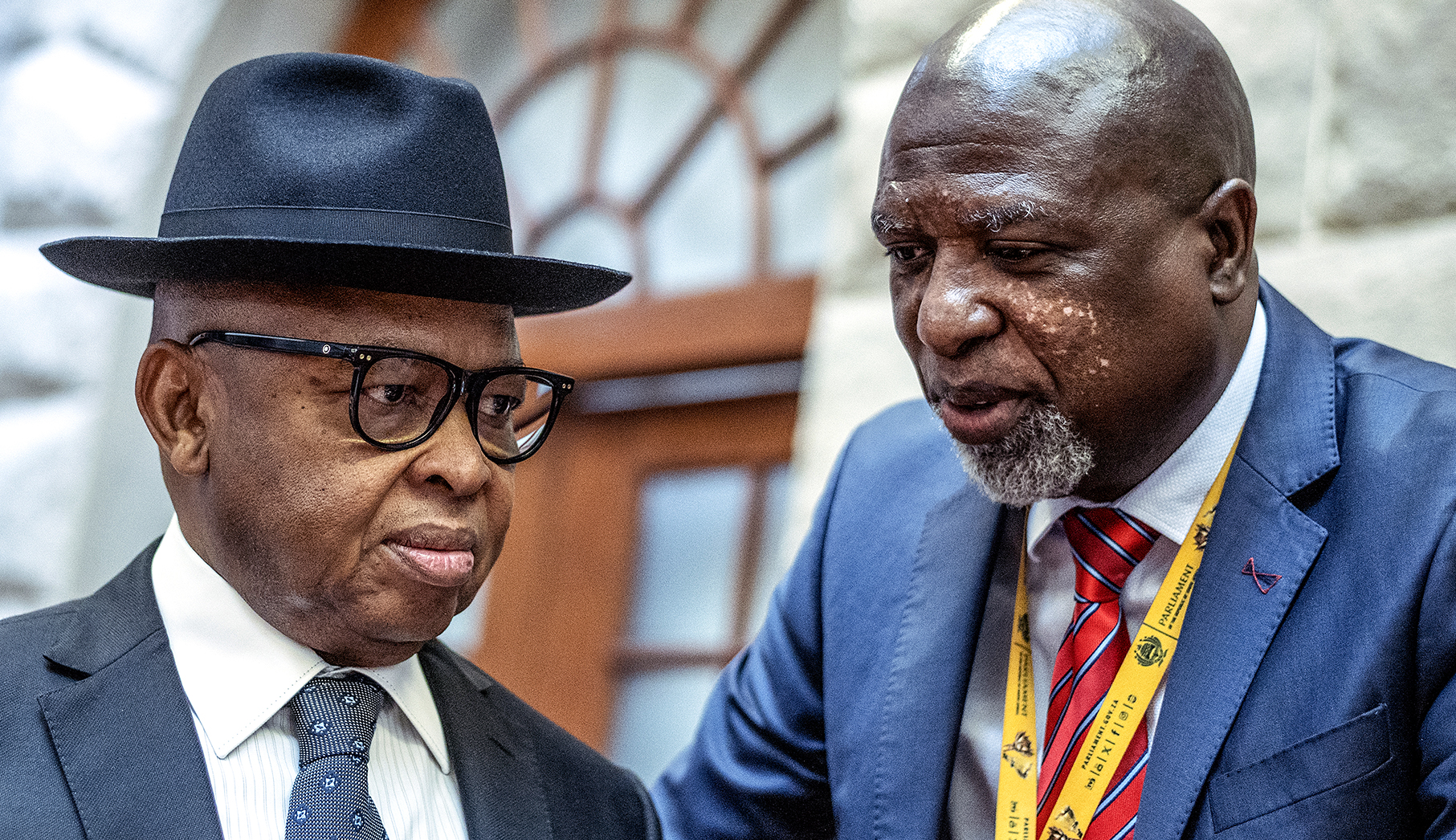
 Deputy Police Minister Cassel Mathale (left) and chairperson of the parliamentary ad hoc committee inquiry into alleged corruption and political interference in the criminal justice system, Soviet Lekganyane, at Good Hope Chambers in Cape Town on 28 October 2025. (Photo: Gallo Images / Brenton Geach)
 When Deputy Police Minister Cassel Mathale saw the news of the disbandment of the Political Killings Task Team (PKTT), he thought it was “fake”.
This was his testimony at the parliamentary ad hoc committee hearing meant to unpack allegations that a drug trafficking cartel had infiltrated South Africa’s law enforcement, politics and police. These allegations were first made by KwaZulu-Natal police commissioner Lieutenant General Nhlanhla Mkhwanazi in July 2025.
/file/dailymaverick/wp-content/uploads/2025/10/ED_584424.jpg "‘I thought it’s fake,’ Deputy Police Minister Cassel Mathale told Parliament about his reaction to social media posts about the disbandment of the Political Killings Task Team. (Photo: Gallo Images / Brenton Geach)")
His allegations have led to two investigations: the Madlanga Commission and the parliamentary ad hoc committee hearing.
“I don’t know what was going through his mind when he wrote that letter,” said Mathale about now sidelined Police Minister Senzo Mchunu’s decision to disband the PKTT, which sits at the centre of ongoing inquiries into alleged criminal interference in the police.
On Tuesday, 28 October, Mathale – who has served as deputy police minister since 2019 – appeared before MPs to explain his role, if any, in the unfolding saga.
When asked about whether he knew beforehand about the disbandment letter, Mathale said he did not.
Mathale’s boss, Mchunu, previously told Parliament the decision was taken on 31 December 2024, while he was contemplating his thus-far six-month tenure as police minister.
Mathale said he first picked up the issue on social media.
“I thought it’s fake,” he said, but would later understand the disbandment was a reality.
In her testimony at the Madlanga Commission, Director of Public Prosecutions in KwaZulu-Natal Elaine Harrison said she also thought the news was fake, having come across the announcement of the disbandment via social media reports, rather than official documentation.
Mathale’s appearance came after two weeks of testimony by his former and current bosses: Bheki Cele and Senzo Mchunu.
/file/dailymaverick/wp-content/uploads/2025/10/ED_584425.jpg "Deputy Police Minister Cassel Mathale at the parliamentary ad hoc committee inquiry into alleged corruption and political interference in the criminal justice system at Good Hope Chambers in Cape Town on 28 October 2025. (Photo: Gallo Images / Brenton Geach)")
During his testimony, Mchunu lambasted Mkhwanazi over claims that alleged Big Five cartel member Vusimuzi “Cat” Matlala was funding his political ambitions and those of alleged ANC information peddler Brown Mogotsi.
When committee evidence leader, advocate Norman Arendse SC, asked Mathale about the letter’s timing, which Mchunu sent out on New Year’s Eve, Mathale said: “31 December is 31 December and it’s New Year’s Eve. Personally, I observe [it]”.
Arendse then asked Mathale if he had not raised it days later at the African National Congress’s birthday celebrations in Cape Town. Mathale and Mchunu are both ANC members and would probably have been at the party’s birthday celebrations.
“No, at the gathering, the minister was not present,” said Mathale. He said neither did he know whether this had been discussed with President Cyril Ramaphosa.
Mathale repeated this claim several times when under questioning by MPs.
According to EWN, Mchunu told Parliament that he partook in ANC birthday celebrations in George, but departed for Eshowe on the evening of 8 January for a funeral.
The ANC’s 2025 birthday celebrations held in Cape Town have previously been discussed before the committee. Deputy national police commissioner Shadrack Sibiya revealed he met Mogotsi at a hotel in Camps Bay during this period, while he was on a work trip.
In his testimony, Mchunu denied suggestions that he had asked Mogotsi and Matlala, who is facing attempted murder and money laundering charges, to arrange a dinner in Cape Town. The ad hoc inquiry has heard allegations that Matlala was linked to funding Mchunu’s political ambitions.
Reader question
What happens if someone is caught lying to this committee or is dishonest?
As committee chairperson, Soviet Lekganyane said before he administered Mathale’s oath, someone who lied to Parliament could be found guilty of an offence.
Lekganyane read: “And please be aware that in terms of section 172 of the Powers, Privileges and Immunities of Parliament and Provincial Legislatures Act, a person who wilfully furnishes the house or a committee of Parliament with information which is false or misleading, commits an offence and is liable to a fine or imprisonment for a period not exceeding two years.
When asked if he thought the decision by Mchunu to disband the PKTT was correct, Mathale said, “I think with retrospect, that decision could have been made differently.”
Previously, national police commissioner Fannie Masemola told the Madlanga Commission that it was encroachment for Mchunu to disband the task team; a responsibility that Masemola said lay with his office.
Later, Mathale confirmed that he supported the task team’s closure. He repeated Mchunu’s claim that the PKTT would have been dissolved, and a new organogram, including a resuscitated Murder and Robbery Unit, would have been created, into which task team members would probably have been absorbed.
No delegated responsibilities
Earlier in the day, Mathale claimed that despite his appointment as deputy minister in July 2024, he and fellow deputy police minister Polly Boshielo did not have delegated responsibilities.
Mathale put this down to Mchunu’s inexperience in policing and his need to find his feet in the role.
Mathale said that in comparison, when Cele had been appointed as police minister in 2019, he had been delegated several responsibilities, including overseeing the SAPS Administration division, the Civilian Secretariat for the Police (CSPS), the Independent Police Investigative Directorate (Ipid), and the Private Security Industry Regulation Authority (PSIRA).
Mathale put it down to Cele’s understanding of the responsibilities within the police, having previously been the country’s national police commissioner.
Naturally, MPs raised eyebrows.
Read more: Parliament’s Mkhwanazi ad hoc committee hearings — the players you need to know
Sibonelo Nomvalo from the uMkhonto Wesizwe (MK) party put it plainly: “Now, if you are to be honest with us or with South Africans, do we need deputy ministers?”
Nomvalo said under the circumstances, Mathale had spent 12 months in office with no delegated functions because “that indirectly means that you add no value to the minister’s work if, after 12 months, he has not given any function to you through a performance agreement. So he’s simply saying, ‘you guys are not adding any value to my work’.”
MK party MP Vusi Shongwe said: “I’m worried and concerned… The fact that it’s been a year and you guys don’t have delegated work. Doesn’t that worry you – already we are wasting our taxpayers’ money somehow?”
Mathale replied: “Look, I will be the happiest to have my responsibilities clearly defined, but I also appreciate where we are, where we come from, and we are not just sitting idle waiting to be given responsibilities… We are working as a team, we do things.”
Mathale repeatedly blamed the delay in having responsibilities assigned to him on the unfolding policing crisis, despite his having served under Mchunu for a year before Mkhwanazi went public with his allegations.
The DA’s Glynnis Breytenbach said Mathale was “sliding like a hot knife through butter. You saw nothing, you heard nothing, you did nothing. You know, so I’m wondering what it is that you came to do here today.”
She asked Mathale if acting Police Minister Firoz Cachalia had delegated “any authority, function, work, anything at all to his two deputies”.
“No, no,” responded Mathale.
However, he said the matter of his responsibilities had been discussed in the past two weeks before Cachalia had accompanied President Cyril Ramaphosa on a work trip to Southeast Asia.
Since Cachalia’s return, the pair had seen each other before Mathale appeared before the committee, but Cachalia would, within his power, delegate responsibilities. DM