




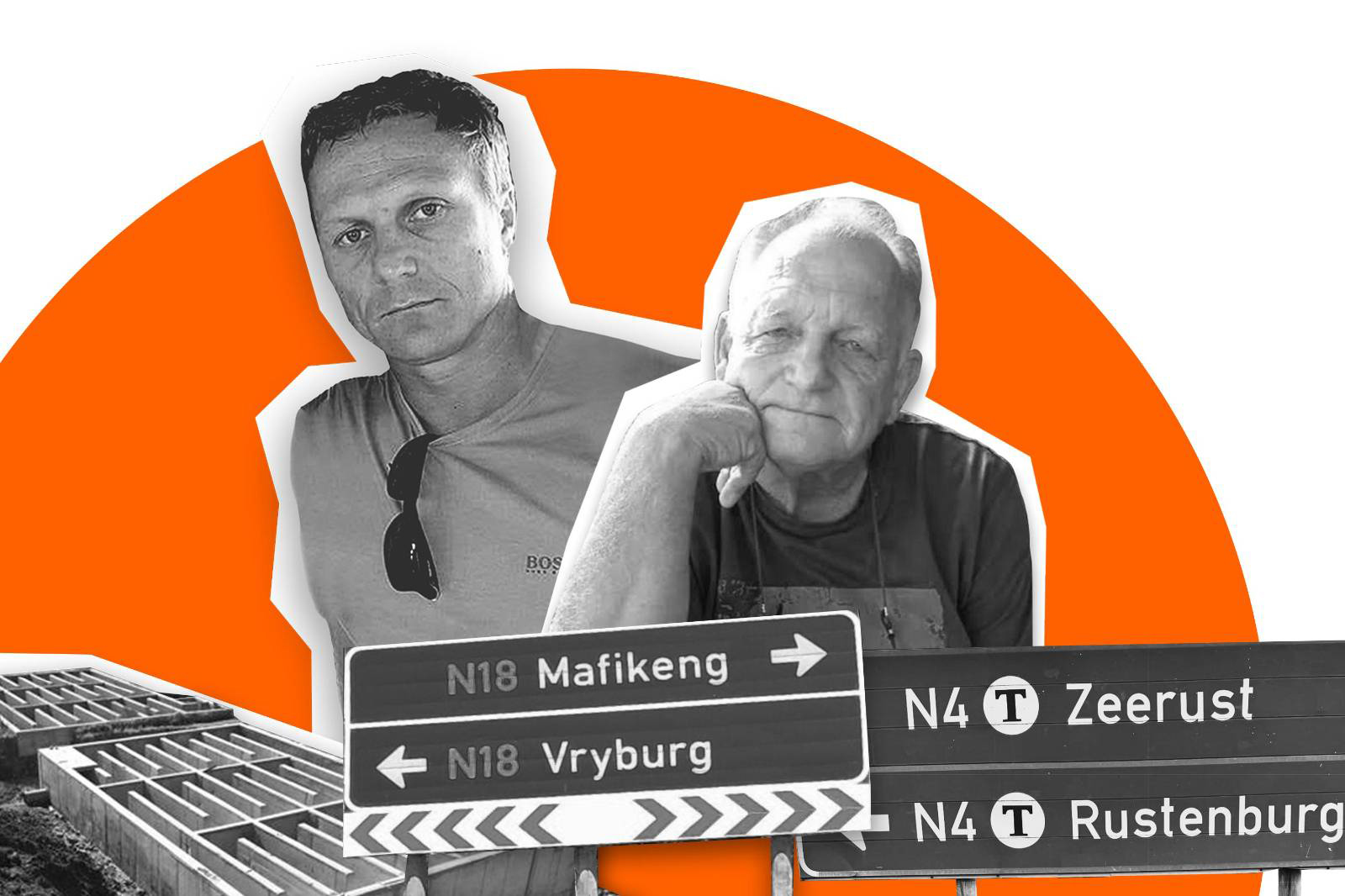
 Illustrative image | Father and son duo, Dolf Schoeman (right) and Rudolf Schoeman (left) left a trail of destruction by failing to fix water and sewage treatment plants in small towns across North West. (Photos: Facebook / TikTok / Department of Water and Sanitation)
 Recap: In 2019, CMS Water Engineering won a R291-million contract to refurbish the Rooiwal wastewater treatment plant in Tshwane alongside infamous tenderpreneur Edwin Sodi. The project failed and was suspected of playing a part in the outbreak of cholera in 2023, which killed 47 people.
But sources in the water industry said this shouldn’t have come as a shock: by the time CMS landed the Rooiwal contract, it was already notorious in North West. In Part 2 of our investigation, we explore the underhanded tactics that allegedly helped CMS rise to the top of the dirty water industry and the towns that paid the price for its ambition.
Every good scandal needs an origin story – and CMS Water Engineering is no different.
It starts in 1984, in the gold mining town of Orkney, when Rudolf Schoeman Snr – who goes by “Dolf” – started a business repairing machinery and equipment for water and wastewater (sewage) treatment plants.
Initially, the company was little more than a one-man show, living off small contracts from North West municipalities. By 2000, it had grown to eight employees, but still, its ambitions were modest.
“Oom Dolf wasn’t a luxury guy,” a long-time employee told us in 2023.
“[He] only got a touch screen phone a year ago; we’d always have to go buy him the Pep stuff,” another employee added.
But in 2012, Dolf’s son Rudolf – then a 30-year-old lawyer with outsized ambitions – asked if he could join the family business.
Read more: Deadly Water — The life and death of a tenderpreneur (Part 1)
“At first I thought that he was a little bit unorthodox in the way that he did things. He liked to party… And he was a loud guy,” the second employee told us. “But then, after adjusting to the loudness and the flashiness, I actually thought that he was a good businessman. He thought of stuff out of the box.C
The employee, who, like others, would only speak to us if we hid their identity, told us that Rudolf could also be volatile. If he arrived at the office in Orkney and no one was available to wash his car – a black Dodge RAM bakkie or his F-type Jaguar – he would scream, only half-jokingly, “So after everything I’ve done for you this is how you treat me? Jy voel fokol vir my! [You feel f**k all for me!]”
Rudolf Schoeman died amid shards of glass in 2023 before we began our investigation, and Dolf Schoeman did not respond to our questions. Instead, we’ve pieced together a picture of the company’s spectacular growth and subsequent implosion based on interviews with insiders, internal documents and court records.

Deadly Water is also available as a podcast. Listen to Episode 1 and Episode 2 now.
Small favours
By 2014, CMS Water had built up an impressive turnover of R68-million a year. But Rudolf wanted more, and it’s at this point that the little company from North West allegedly became a vehicle for something more sinister.
“The bribery started small: R3,000 here or R5,000 there… It was, ‘But dad, if you pay this guy just a small amount, he will always look after you’,” the first employee told us.
But as the contracts got bigger, so too, the employee alleged, did the payments: “If you gave in a payment certificate for R1.3-million, then that other person … will want 10% of that and they would just give it… The biggest amount that I drove with was R3-million.”
The payments that former employees describe didn’t leave a paper trail, at least not in the records we’ve seen. Instead, what we found was evidence of Rudolf’s generosity towards officials from the water boards and municipalities where CMS had, or hoped to land, contracts.
This included a two-night stay at Sun City for an official at JB Marks Local Municipality, where CMS would later secure a R23-million contract to build a new pump station, as well as R3,000 worth of bricks for an “Oom David”.
Both Dolf and Rudolf were close to David Dikoko, the non-executive chairman of Sedibeng Water, a sprawling water board that supplied chunks of North West, Free State and Northern Cape.
In 2015, CMS landed a R65-million contract to repair the wastewater treatment plant in Wolmaransstad, 80km down the road from Orkney. CMS would later tell forensic investigators that it was approached by the project manager and asked to pay a 10% bribe.
The Schoemans told investigators they refused, but agreed to pay R5.1-million to a local company – picked by the municipality – that would source pumps for the project. The pumps were never delivered.
CMS had been bitten in Wolmaransstad, but Sedibeng Water would become a lucrative hunting ground: in the space of six years, CMS landed nine contracts worth R396-million.
“When I was a mayor, the person that I knew was his father,” Dikoko told us during a meeting in Sandton last year. “So Rudolf was just a small boy and grew from that.”
Among the records, we found proof of payment of R3,000 to SmartStone in Potchefstroom on behalf of “Oom David”. When we asked Dikoko about the payment, he explained that he asked Rudolf for help sourcing brick paving for his home.
“Instead of sending me the [details], he said … ‘I will buy you the [bricks] and send them to you, you will reimburse me.’ … That’s how it was done.”
Dikoko told us he repaid Rudolf in cash. Asked if he declared the transaction to Sedibeng Water, he said: “There’s nothing to declare because it’s not a gift. It was just a small thing.”
Now, it’s not like R3,000 worth of bricks bought CMS R396-million worth of contracts from Sedibeng Water, and as the non-executive chair, Dikoko’s role was to provide oversight, not to award tenders.
But Rudolf seemed to believe that keeping powerful people onside had benefits.
A house in the suburbs
Two former employees told us that, in 2018, CMS Water began renovating a house belonging to an official in the Ngaka Modiri Molema District Municipality.
Cornel Dreyer, a councillor with the Democratic Alliance, told us he had seen CMS Water vehicles parked outside the house in question and had seen CMS delivering construction materials on several occasions.
Another former employee, who had allegedly installed air conditioners at the house, said they were told CMS Water’s involvement in the home improvement project was to open doors within the district municipality.
We asked the official who owned the house whether he had paid CMS for the alleged renovations. He ignored our questions.
The municipality was equally uninterested. Essentially, they told us, this is “a private matter”. They simply had “no reason” to investigate the alleged upgrades to a senior employee’s home.
In 2019, roughly a year after the alleged home makeover began, CMS Water secured three contracts from the municipality to refurbish the Zeerust and Sannieshof wastewater treatment plants.
Total value? R209-million.
CMS goes global
By 2017, CMS had almost doubled its revenue to R128-million, with big contracts in places like Parys, Kroonstad and Mahikeng. But Rudolf still wanted more, so in 2017, he unveiled a new civil engineering division: CMS Global Solutions.
“He got a partner who came in with a moerse bang … and then Rudolf’s whole way of doing business changed when the partner came in,” the second employee told us.
CMS Global was not, in fact, a division of CMS Water Engineering, but an independent company owned 50% by Rudolf and 50% by a new business partner, Elias “Eric” du Plessis.
This presented a problem: CMS Water’s long track record had secured it a coveted Grade 8 PE rating from the Construction Industry Development Board (CIDB), meaning it qualified to bid for the government’s most expensive tenders.
- The CIDB grading system goes from 1 to 9 based on the contracts a company has successfully completed in the past five years. Companies with a grade 1 can bid for construction projects of up to R500,000, whereas there is no limit on the size of the tenders for which a company with a grade 9 can compete. CMS Water Engineering had a grade 8, meaning it could bid for contracts of up to R200-million. However, because it was black-owned, it was given a status of “potentially emerging (PE)”, meaning that it could bid for contracts one grade higher, allowing CMS to compete for tenders alongside companies like WBHO and Aveng.
In addition to this, Clint Adonis, who was married to Rudolf’s sister Ilze, had been a 60% shareholder of CMS Water since 2009, meaning that under BBBEE laws, CMS Water was considered majority black-owned.
CMS Global, with no track record and two white owners, had neither of these advantages. And so a plan was hatched: CMS Water would secure tenders for civil engineering work – using its track record and BBBEE status – then quietly pass most of the work and money to CMS Global.
Jan Brink, a private investigator who was later hired by CMS Global’s liquidators to look into the relationship between the two CMSes, told the liquidators in a 45-page report: “There was no written agreement … When payments were received from a client, a small percentage, that was usually 10%, was kept back by CMS Water and the remainder of the invoice was then paid over to CMS Global.”
Included in Brink’s report is an unsigned Memorandum of Agreement spelling out that CMS Water would only be entitled to keep between 1% and 2.5% of any payment received from its clients, while the balance would be paid to CMS Global “sonder versuim [without delay]”.
At another point in the report, Brink wrote: “The projects were tendered by utilising CMS Water, as agreed by Rudolf, but CMS Global attended to the contracts ... it was agreed that the funds of CMS Global would be channelled through CMS Water.”
As the second former employee put it: “That was huge amounts of money to run through a company that you started literally a month or two ago. And it was a way of building up [CMS] Global and making it CIDB-ready.”
To fudge the line between the two CMSes, CMS Global used a near-identical logo and Du Plessis signed his emails “Director, Civils”.
“Eric and Rudolf presented as a front to people, it was only inside that we knew the split,” they added.
Fronting?
At face value, this looks like fronting, which is a crime in terms of the BBBEE Act and comes with a 10-year jail sentence and/or 10-year ban on receiving government contracts – although, as we’ll see, Du Plessis denies this, puts any blame on Rudolf and says he was merely a subcontractor.
In the long run, the arrangement would also cannibalise CMS Water, but it had both short- and long-term benefits for Rudolf.
In the short term, he would get a larger slice of the profits: at CMS Water, he was only a 20% shareholder, alongside his father (20%) and his brother-in-law (60%). At CMS Global, he would now be a 50% shareholder.
In the long term, Rudolf allegedly planned to jump ship: “Rudolf and his dad didn’t see eye to eye on a lot of stuff … Rudolf’s dangerous way of doing stuff and pushing stuff to the limit, he and his dad fought about stuff like that a lot… Rudolf’s plan was always to leave CMS [Water] and just go to [CMS] Global with Eric,” the second former employee told us.
R600-million
Between September 2017 and April 2020, this is how CMS Water operated: on paper, the company was growing – in 2019, it recorded R146-million in revenue – but the tidy profits the company used to make shrank as more contracts were siphoned off to CMS Global.
In total, more than R600-million worth of critical infrastructure projects were passed to Rudolf’s other company:
- In 2017, the Rooigrond (R62-million) and Kroonstad (R10-million) wastewater treatment plants;
- In 2018, the Bospoort water treatment plant (R85-million), the Sediba irrigation system (R15-million) and the Vierfontein pipeline (R4-million);
- In 2019, the Sannieshof (R50-million) and Zeerust (R129-million) wastewater treatment plants, reticulation in Mkhwanazi (R35-million), and a substation in Alrode (R77-million); and
- In 2020, the Sterkfontein water treatment plant (R112-million), drying beds in Khutsong (R14-million), and a pipeline and pump station for Ntambanana (R67-million).

Half of these projects were never completed, so it’s hard to know how much would have eventually landed in CMS Global’s bank account. But according to the payment reconciliations contained in court papers, CMS Water received R208-million from its clients on these projects and passed R174-million (84%) to CMS Global.
A special kind of subcontractor
For reasons we’ll get into later, the secret agreement didn’t last. And by the time we spoke to Du Plessis, he was keen to distance himself from Rudolf, CMS Water and any responsibility for the trail of destruction it left behind.
He told us that he approached Dolf because he knew CMS was subcontracting all its civil engineering work and asked if it wanted to bring that in-house.
CMS Global was merely “the primary civils subcontractor of choice”, he told us in a letter. He didn’t see the arrangement as fronting, but added that whatever promises were made as part of the tender, that was on Rudolf and CMS Water.
“No contract was subcontracted to [CMS] Global in its entirety … Global’s mandate was to do the civil construction work when required by CMS Water (Rudolf) to do so … Rudolf would evaluate the bill of quantities of a specific project and assign the scope of works to be performed,” he wrote.
That unsigned agreement, which had promised CMS Global up to 99% of CMS Water’s income, only applied to “the civils portion of contracts, not a percentage of the total contract value”, he added.
“CMS Global would be entitled to the value of work performed as allocated by CMS Water, minus the administration charge,” he told us.
Out of the R600-million in contracts that he worked on, Du Plessis estimates that only 50% would ultimately have flowed to CMS Global.
The luxury life
Rightly or wrongly, some former employees blame Du Plessis for the eventual collapse of CMS Water.
“The biggest problem [was] when we became a civil company,” a third employee told us. “When we concentrated on mechanical and electrical, it was 100%. The moment when we became civil, when Eric du Plessis came in, that's when –”
“– when the luxury life came in,” the first employee added.
Rudolf had always lived his life in excess. According to former employees, he was always decked out in designer clothes, from Versace and Polo shirts, to Alexander McQueen sneakers that cost R10,000 to a Romain Jerome Titanic-DNA watch worth R300,000. Even the candles that he bought for the CMS office in the industrial part of Orkney came from Ralph Lauren at R1,500 a pop.
“If Eric and Rudolf stood next to each other, you would say Eric was a boer and Rudolf was a city boy,” the second employee told us.
But now, their joint company, CMS Global – flush with cash from CMS Water – began splashing out as well.
In January 2019, CMS Global bought a Cessna plane for R3-million; in May, a 40ft yacht called “Happy Ours” for R1.7-million. The yacht, we’ve been told, was intended for Jeffreys Bay, where Rudolf had a holiday house, but turned out to be too big for the mooring. Instead, the yacht stayed in the V&A Waterfront, and Cape Town became a regular haunt.

Du Plessis denies that he was responsible for introducing a lavish streak to CMS and maintains that the plane and the yacht were sound business decisions: “The plane was purchased as a business tool to ferry project management to and from [KwaZulu-Natal]” while the yacht, he claimed, was a fixer-upper that was ultimately sold by the business rescue practitioners at a hefty profit.
“The lifestyle followed by Rudolf being in and out of rehabilitation facilities, his impulsive and negative approach to situations and lavish taste for the expensive was more of a concern,” he told us.
Yet one doesn’t need to travel far to see how the agreement with CMS Global contributed to the company’s downfall.
In 2018, CMS Water was awarded an R85-million tender to upgrade the Bospoort water treatment plant, on the outskirts of Rustenburg. It was one of the first projects that would be diverted to CMS Global, and it was a disaster.
It would also set the standard for what would happen at Rooiwal: allegations of tender-rigging, court battles and abandoned projects. DM
This is the first instalment of Deadly Water Part 2. The second instalment of Part 2 will follow soon.
Want to hear the story told by the journalists who did the digging? Listen to our Deadly Water podcast. Or sign up to our newsletter and get each Deadly Water article and podcast delivered to your inbox.