



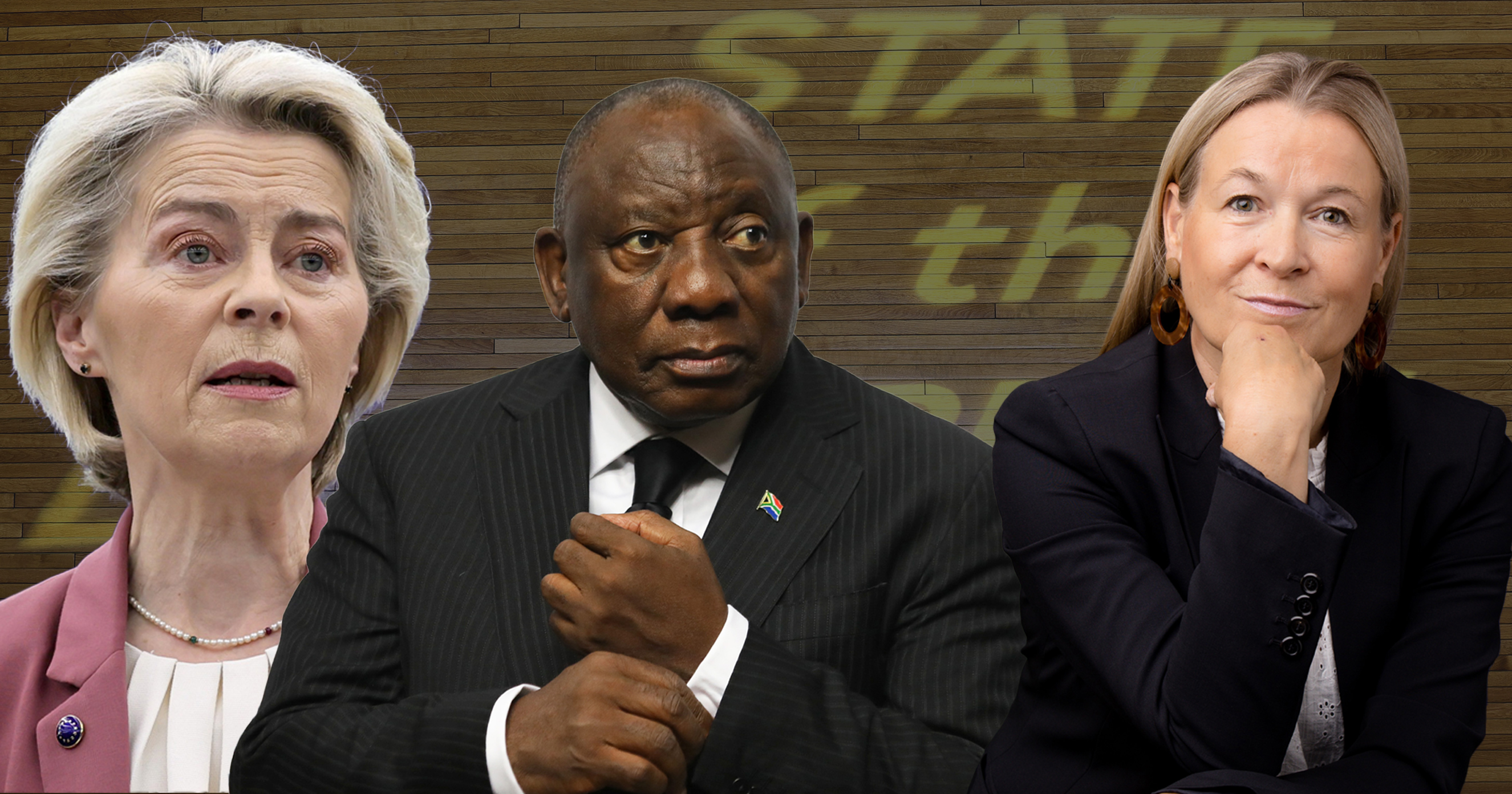
 Illustrative image: A State of the Union projection. (Photo: Ronald Wittek / EPA) | European Commission President Ursula von der Leyen. (Photo: Ronald Wittek / EPA) | President Cyril Ramaphosa. (Photo: Dwayne Senior/Bloomberg via Getty Images) | EU ambassador Sandra Kramer. (Photo: Supplied)
 As South Africa continues to wrestle with the US over tariffs and other issues, its relationship with its biggest economic partner, the European Union, by contrast, goes from strength to strength.
At the SA-EU summit in Cape Town in March this year the EU announced a €4.7-billion Global Gateway investment package with South Africa: mainly to boost connectivity, local vaccine production and biomanufacturing capabilities and, above all, to produce clean energy.
This month, when President Cyril Ramaphosa attended the EU’s Global Gateway Forum in Brussels, European Commission president Ursula von der Leyen announced a new set of investments from EU member states into South Africa under the Global Gateway, which boosted the pledged EU investment from €4.7-billion to almost €12.billion.
The largest part will go into South Africa’s Just Energy Transition, which is shifting the country from its huge dependence on fossil fuels, mainly coal, to renewables, while preserving the livelihoods of coal miners and communities.
EU ambassador to South Africa Sandra Kramer explained that the now almost Є12-billion “Team Europe” Global Gateway package comprised:
- Advancing the Just Energy Transition (€8.7-billion), with investments in green hydrogen projects, local critical raw material processing, and renewable energy (solar, wind) projects;
- Ensuring a Just Transition (€1.2-billion), through: Dedicated to social measures such as reskilling workers, creating new jobs, research and innovation, and climate adaptation projects such as water security;
- Connectivity, green logistics and infrastructure (€1.3-billion), with investments in modern, sustainable rail, port and road infrastructure, renewable-powered logistics and digital connectivity; and
- Building South Africa’s production of vaccines and other pharmaceuticals (€292-million), with investments in innovative research projects, training and capacity building on biotechnology, pharmaceutical infrastructure and vaccine roll-out.
“This Team Europe Investment Package is already delivering concrete results. Let me name a few,” Kramer told Daily Maverick.
“An important one is a new commitment to the Coega Green Ammonia Project. We are confident that local production will meet increasing global and domestic demand in the agricultural, chemical or mining sectors. It will also support South Africa’s ambition to become a global shipping hub as green ammonia becomes a choice for clean maritime fuel.
“There is also a new commitment to strengthen local biomanufacturing capabilities to produce vaccines and other pharmaceuticals in South Africa for the African continent, building on our partnerships with entities such as Afrigen, Biovac or the Council for Scientific and Industrial Research.”
/file/dailymaverick/wp-content/uploads/2022/03/ED_318514.jpg "The Biovac facility in Pinelands, Cape Town. (Photo: ER Lombard / Gallo Images")
Clean energy and vaccines
Global Gateway is the European Union’s investment programme launched in 2021 to boost “smart, clean and secure” links in digital, energy and transport sectors and to strengthen health, education and research systems across the world through equal partnerships. Von der Leyen announced at the Global Gateway Forum that the EU had already raised more than €306-billion, exceeding its original target of €300-billion by 2027.
South Africa’s Just Energy Transition will get €9.9-billion of the total of €11.492-billion of Global Gateway investments.
Von der Leyen told Ramaphosa at the EU-South Africa summit in March: “We know that others are withdrawing. We on the contrary are doubling down with our support. We are here to stay.”
/file/dailymaverick/wp-content/uploads/2025/10/GettyImages-2239622087.jpg "US President Donald Trump. (Photo: Anna Moneymaker / Getty Images)")
The EU and South Africa have also reached an agreement in principle for a Clean Trade and Investment Partnership (CTIP). Kramer told Daily Maverick that “partnering with South Africa to negotiate the first CTIP was a clear strategic choice for the EU”.
The CTIP will facilitate the scaling up of public and private financing in South Africa in strategic clean supply chains such as green hydrogen, renewable energy and critical raw materials. “The CTIP would support South Africa’s efforts to create an attractive investment environment and improve regulatory cooperation,” Kramer said. South Africa and EU leaders expect to sign the CTIP on the margins of the G20 Summit in November.
As an example of what the CTIP is about, after the March summit, a joint statement by the EU and South Africa said the partnership was expected to deliver solutions to enable Sasol to export sustainable fuel, especially aviation fuel, to the EU. While Sasol is free to export sustainable aviation fuel to the EU, EU rules prevent it from certifying those exports as green because of their high carbon content.
Kramer said consultations on this issue were ongoing with a view to supporting Sasol’s decarbonisation efforts.
Read more: Green ambitions: SA targets EU market with clean aviation fuel and electric vehicle exports
And she said technical discussions were also continuing between the two sides to facilitate South Africa’s export of electric vehicles and hybrid vehicles to the EU market, while supporting battery manufacturing in South Africa and the EU.
/file/dailymaverick/wp-content/uploads/2025/05/pic-8.jpg "Sasol’s Secunda coal-to-liquids plant in Mpumalanga. (Photo: Waldo Swiegers / Bloomberg via Getty Images)")
She also noted that the EU and South Africa were negotiating a memorandum of understanding to develop the minerals value chain through local beneficiation, also expected to be signed in the margins of the G20 Summit.
SA’s G20 presidency ‘already a success’
Daily Maverick asked Kramer whether the EU was increasing its support to South Africa to compensate for withdrawal of US support and if the EU thought the South Africa’s presidency of the G20 would succeed despite the sharp US criticism of it, including its theme of solidarity, equality and sustainability.
“We believe that South Africa’s G20 Presidency already is a success,” she replied. “South Africa has brought African interests to the forefront of the global agenda and is successfully hosting the first ever G20 on the continent. South Africa’s presidency must be commended for doing an excellent job in organising the G20 in a context of geopolitical uncertainty, and for bridging gaps and finding consensus.
“We have no doubt that, as we approach the G20 Summit, the South Africa presidency will host a successful summit that will make South Africa and the African continent proud.
Read more: SA pushes debt sustainability, green financing and disaster response before G20 summit
“The European Union’s commitment to South Africa’s G20 presidency – and in particular the themes of solidarity, equality and sustainability – is an expression of the long-standing convergence of values and interests and adherence to key principles of mutual trust, respect and benefit, irrespective of a changing geopolitical context.”
These values and principles included multilateralism, human rights and democracy, decarbonisation, competitiveness, economic growth and job creation.
Moreover, the EU and South Africa are working on a concrete deliverable for the G20 summit: a campaign to mobilise investments in clean energy across the entire Africa continent.
Von der Leyen and Ramaphosa launched this campaign last November and will conclude it at the G20 Summit in Johannesburg.
The objective of the “Scaling Up Renewables in Africa” campaign is to bring investments in concrete projects that support electrification, modernise power grids, and expand access to renewable energy across the continent.
“We are expecting many pledges, from governments and from the private sector. Because there is a strong business case for investing in renewables in Africa. We are working closely together to make the pledging event a success,” Kramer noted.
/file/dailymaverick/wp-content/uploads/2025/04/Introduction.jpg "President Cyril Ramaphosa has committed South Africa’s G20 presidency to strive to build consensus on the many challenging global issues the summit is addressing. (Photo: EPA-EFE / Kim Ludbrook)")
South Africa’s Ukraine position
Daily Maverick asked Kramer why the EU’s earlier criticism of South Africa’s refusal to condemn Russia’s invasion of Ukraine seemed largely to have dissipated recently.
“The European Union’s position is clear,” she replied. “There can be no impunity for what constitutes a gross violation of international law, in this case the unprovoked and unjustified invasion by Russia, a permanent member of the UN Security Council, of Ukraine.”
But she added: “We appreciate South Africa’s wish to play a constructive role and even offer its mediation offices. We both support a just, comprehensive and lasting peace in Ukraine, as we also do in the occupied Palestinian territories, Sudan, South Sudan and Democratic Republic of Congo.
“South Africa and the European Union share an unshakable commitment to the respect for the UN Charter, in particular its principles of peaceful resolution of disputes and territorial sovereignty of any state.”
Among the agreements reached at their bilateral summit in Cape Town last March, the EU and South Africa are discussing the opening of a peace, defence and security dialogue to facilitate a shared understanding of evolving threats for more effective conflict prevention and crisis response.
/file/dailymaverick/wp-content/uploads/2025/03/Executive-Mayor-Matika-1.jpg "Ukrainian President Volodymyr Zelensky speaks to President Cyril Ramaphosa in June 2023 during Zelensky’s welcome to Ukraine of the African Leaders Peace Mission to Ukraine and Russia. (Photo: Kopano Tlape / GCIS)")
Trade disputes
The South Africa-EU relationship, like all relationships, does have some problems. One of them is the EU’s Carbon Border Adjustment Mechanism (CBAM), which aims to apply a levy on the carbon content of certain imports into the EU from 1 January 2026. The EU’s intention is to ensure that its own producers are not disadvantaged when they are taxed on their carbon output.
The EU insists CBAM is an environmental measure but South Africa and some other trading partners see it as trade protectionism.
Kramer said the EU would soon adopt a simplification package of CBAM to benefit stakeholders in the EU and non-EU countries.
“The package aims to simplify EU rules and reduce administrative burden, including for third-country operators, while maintaining maximum effectiveness in preventing carbon leakage. It is expected that the legislation will be formally adopted by the end of the year. “
She added that the EU had stepped up its engagements with South African industry and government to explain CBAM.
Read more: EU carbon border tax poses existential threat to SA’s aluminium exports — experts
Another long-standing trade irritation has been the measures – such as cold storage – which the EU has demanded to control two pests on South African citrus exports to the EU – citrus black spot and false coddling moth.
Kramer noted that South Africa had referred these measures to the World Trade Organization (WTO) dispute settlement mechanism, but the EU was confident that its control measures were in full compliance with its obligations under WTO law.
She noted that despite the control measures, South Africa’s exports to the EU had increased from €496.6-million (R9.940-million) in 2020 to €592.2 million (R11.854 million) in 2024, according to UN Comtrade data.
“The EU is by far the top destination for South African citrus,” she said.
/file/dailymaverick/wp-content/uploads/2022/08/ED_309688.jpg "A large quantity of South African citrus fruit destined for the EU. (Photo: Darren Stewart / Gallo Images)")
Trade between South Africa and the EU is governed by the EU-SADC Economic Partnership Agreement (SADC EPA), a free trade agreement which the EU launched with South Africa, Botswana, Namibia, Lesotho, Eswatini and Mozambique in 2016, further opening the markets of both sides to each other. The EPA has been credited with boosting manufacturing in South Africa by expanding the access of its manufactured and processed products to the EU.
“Every year, there is almost €50-billion in trade between us. And 98% of South Africa’s exports to the EU are already duty- and quota-free.” DM