



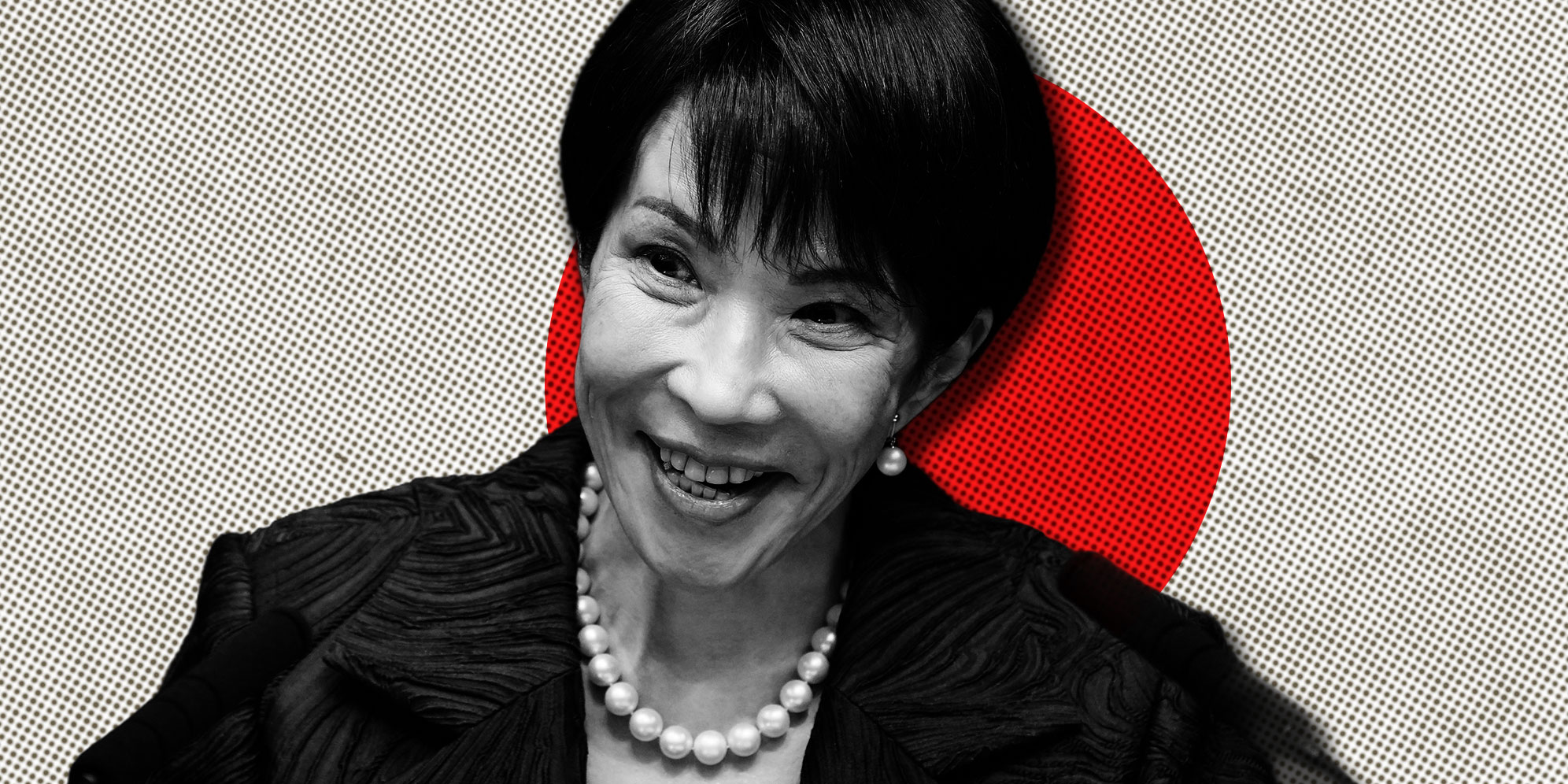
 Japan's first female prime minister, Sanae Takaichi speaks during a press conference in Tokyo, Japan, on 21 October. (Photo: Eugene Hoshiko / Pool /EPA)
 Some 1,500 years ago, the Japanese nation had been ruled by several powerful women emperors, including the Empress Suiko, known for spreading and supporting Buddhism in Japan. And nearly 1,000 years ago, the world’s first real novel, “The Tale of Genji”, was written by Lady Murasaki Shikibu. But in the meantime, certainly in most Western eyes, it is the norm to think of Japan as a place where women know their place and carefully follow the dictates of men. But that is not fully accurate.
While there are still very few Japanese women running major corporations and influential institutions, they have been elected in increasing numbers to the Diet, the national assembly, and to key prefectural governorships, among other offices. And in Japanese domestic circumstances, it’s still the norm for male salaried employees to hand over the entirety of their pay packets to their spouses and be given their pocket money for the month in return.
Women ensure family expenses get paid (traditionally, even paying the monthly tabs at clubs used for business entertainment by their spouses) and ensure savings for future expenses are made. Classic Japanese novels and films such as “The Makioka Sisters” and “Ikiru” focus on how women hold power within that smaller universe, but ultimately chivvy “their” men into doing the necessary. Still, Japanese women do remain underrepresented in those upper levels of major Japanese corporations and the government’s bureaucracy.
/file/dailymaverick/wp-content/uploads/2025/10/13462023.jpg "Japan's Prime Minister, Sanae Takaichi, during the 28th Asean-Japan Summit, part of the Association of Southeast Asian Nations Summit (Asean), at the Kuala Lumpur Convention Centre in Kuala Lumpur, Malaysia, 26 October 2025. (Photo: EPA / CHALINEE THIRASUPA / POOL)")
This past week, Sanae Takaichi (surname last as per Western convention) became Japan’s top politician when she was confirmed as the country’s newest prime minister after securing the leadership of the Liberal Democratic Party (LDP), or Jiminto, but in coalition with the smaller Japan Innovation Party, or Ishinto. The new prime minister had been a significant player within her party for decades, serving in a variety of Cabinet appointments and intra-party positions, but she had vied for the top job in several intra-party battles before finally succeeding.
In her new government, she has formed a coalition government, but not with her party’s more usual partner, the Komeito, or Clean Government Party. The former is a lay Buddhist-affiliated political party with positions on defence spending, for example, that differ from those of the new prime minister. The LDP was in complete power for many of the years since its formation in 1955, and in recent years it routinely formed an alliance with the Komeito. This time around, however, Ishinto seemed more simpatico on key issues such as defence spending and government reform.
Takaichi’s personal background is rather different from most of the politicians who have been Japanese prime ministers since the ascendancy of her party in the post-World War 2 era. (Pre-World War 2, a prime minister would have come from a notable or noble family, although the generals that controlled the army and navy had exercised a compelling influence over the country’s circumstances, to less than salutary outcomes in the long run.)
Born in 1961, Takaichi comes from the smallish city of Nara in central Japan. Her family was a dual-income one — her father worked for an automotive firm affiliated with Toyota, and her mother was in the Nara Prefectural Police.
/file/dailymaverick/wp-content/uploads/2023/06/GettyImages-1258841553.jpg "A visitor takes a selfie photograph with a deer in Nara, Japan, on Monday, 19 June 2023. (Photo: Soichiro Koriyama / Bloomberg via Getty Images)")
Early career
In the face of parental disagreement, she did not attend either the exclusive Keio or Waseda private universities to which she had been admitted; instead, she attended Kobe University, closer to her family, but where she paid her own way from the earnings of part-time jobs.
With her BA in hand, she then attended the prestigious Matsushita Institute of Government and Management, which, in turn, sponsored her for a two-year stint in the US as a congressional fellow in the office of then Democratic congresswoman Pat Schroeder.
Returning to Japan, Takaichi worked as a legislative analyst (drawing on her personal knowledge of US politics). She then made a major career shift (still something relatively unusual in Japan) to a series of broadcasting positions at various television networks. Perhaps her most unusual attribute as a future prime minister was the time she spent as the drummer in a rock band while in university. That is not the usual training of a Japanese politician in the making.
The new prime minister first successfully ran for office in 1993, then cycled through several smaller parties until she joined the LDP, thereafter gaining increasingly senior positions in successive LDP governments. During those years, she was a proponent of controversial positions like preventing married women from keeping separate surnames after marriage.
She also courted serious tongue-clucking on the part of many Japanese when she suggested TV broadcasters could have their licences revoked if they aired programmes the government considered to be politically biased. Her critics labelled this as tantamount to an effort to repress free speech.
She visited the Yasukuni Shrine in Tokyo with its memorial to the Japanese war dead that includes the ashes of individuals judged to have been war criminals. Her critics add that she has appeared in photographs and public appearances with individuals from neo-Nazi-ish political movements.
On the other hand, demonstrating a real populist touch, from her Cabinet position at the time, she supervised the popular issuance of needed cash payments to citizens during the Covid crisis.
/file/dailymaverick/wp-content/uploads/2022/12/GettyImages-1408453408.jpg "People walk past lit paper lanterns during the Mitama Matsuri summer festival at the Yasukuni Shrine on 13 July 2022. About 30,000 lanterns are displayed during the four-day traditional festival. (Photo: Tomohiro Ohsumi / Getty Images)")
Appointment as prime minister
In 2025, following her defeat of Shinjirō Koizumi (himself the son of a popular former prime minister) in the battle to lead their party, Japanese stock market indices jumped upwards. Then, on 21 October, she defeated the Constitutional Democratic Party’s leader, Yoshihiko Noda, in the vote in parliament, whereupon Emperor Naruhito formally appointed her as prime minister in a ceremony at the Tokyo Imperial Palace.
/file/dailymaverick/wp-content/uploads/2023/02/GettyImages-1247396255.jpg "Emperor Naruhito and his wife Empress Masako greet visitors during his birthday celebration at the Imperial Palace on 23 February 2023. (Photo : Rodrigo Reyes Marin /Pool /Getty Images)")
Takaichi has thus become the first woman and the first person from Nara Prefecture (the ancestral wellspring of Japan’s culture, society and its first capital) to hold this post. She is also the country’s first prime minister born in the 1960s. And don’t forget that early career as a rock musician.
Interestingly, while there have been female heads of government in Britain, Germany, India, Indonesia, Pakistan, Mexico, Bangladesh, Sri Lanka, Malawi, Italy, Israel, and some Scandinavian nations, Japan — with its presumed deeply rooted male supremacy — now has a female head of government. This is before Russia, China, the US, Brazil, Turkey, the Arab world and most of Africa, including South Africa.
In forming her new Cabinet, the prime minister’s selections for the defence, foreign affairs and economic security portfolios are not the usual line-ups and musical chairs familiar to the Japanese. Her picks of Defense Minister Shinjirō Koizumi, Foreign Affairs Minister Toshimitsu Motegi, and Economic Security Minister Kimi Onoda all bring a mix of experience and vitality to the new administration, despite the challenges it is going to face. This trio also have real experience with the US, including studying at universities there.
Her pick of Koizumi was partially to prevent a deeper rift within the party, but he has more than 15 years of experience in the Diet (the parliament). Crucially, he has significant ties to the US as Japan continues sorting out its responses to US President Donald Trump’s constant, transactional demands, including the push for Japan to bear more of its self-defence costs in a complex Northeast Asia. Koizumi attended Columbia University and worked as a researcher at the Center for Strategic and International Studies, an influential think tank in Washington.
/file/dailymaverick/wp-content/uploads/2025/10/13359468.jpg "Shinjiro Koizumi (Photo: Issei Kato / Pool / EPA)")
As The Japan Times noted, “The Trump administration has urged allies including Japan to spend as much as 5% of gross domestic product on defense — a daunting figure for a country that has had trouble scrounging up funding to hit a 2% target by fiscal 2027. Koizumi emphasized Tuesday following his appointment that an amount shouldn’t be a ‘starting point’ for talks with the U.S. and that Japan itself ‘must determine and build the defense capabilities it needs.’ ”
The paper added, “Amid growing military challenges from China, North Korea and Russia, Takaichi has ordered revisions to the country’s three key security documents, opening the door for further dramatic shifts in Japan’s defense policy and a hike in its budget — a task in which Koizumi will undoubtedly play a crucial role.”
‘Trump whisperer’
Meanwhile, as Japan’s most senior foreign affairs official, Motegi has been nicknamed a “Trump whisperer” for his previous work on trade negotiations with the US.
Motegi told a news conference that in addition to his foreign policy portfolio, he was now in charge of tariff talks with the US. As part of the July US-Japan deal, Japan has pledged to invest $550-billion in the US by 2028, in exchange for the US lowering tariffs on Japanese cars and other goods. Japanese analysts believe Motegi was selected for this job — beyond his deep political experience — by virtue of being a Harvard University graduate.
The new minister commented, “Compared with my previous stint as foreign minister, the international environment surrounding Japan, including on the security front, has become significantly more severe and complex,” pointing to Chinese military moves, Russia’s invasion of Ukraine, Middle East conflicts and North Korea’s nuclear programme.
Motegi added, “At the same time, I feel the international community's expectations for Japanese diplomacy are greater than ever before.” He said Japan would seek to “leverage the various frameworks we have established to reinforce our diplomatic and security cooperation networks with Australia, India, South Korea, the Philippines, European nations and others”.
These views may get some quick stress tests during Trump’s East Asia swing, which includes meetings with the new prime minister as well as the Association of Southeast Asian Nations (Asean) gathering and the leaders' summit of the Asia-Pacific Economic Cooperation (Apec) forum.
/file/dailymaverick/wp-content/uploads/2025/10/13447993.jpg "Toshimitsu Motegi arrives at the prime minister's official residence in Tokyo, on 21 October. (Photo: Franck Robichon / EPA)")
Economic challenges
Meanwhile, Japan’s new economic security minister, Onoda, is going to face the challenges of sharpening Japan’s economic security strategy in the face of Trump’s protectionism as well as China’s use of the full panoply of tools in its economic toolbox to reshape the international order to its benefit. Just 42 (rather young for a Cabinet official), Onoda was born in Chicago to a Japanese mother and an American father. She has renounced her US citizenship.
In her first-day remarks, beyond stressing efforts to expand partnerships to like-minded partners beyond the US, she said she hoped to build supply chain resilience to help secure semiconductors, rare earths and other critical materials, and technologies to help power Japan’s economy.
As she said, “Regarding economic security, we are truly facing a situation where various threats through economic means are intensifying under the most severe and complex security environment since the postwar period,” and she pledged to see through policies that “ensure Japan's autonomy, superiority and indispensability”.
Key priorities
During the first press conference of her premiership, Takaichi outlined that her key priorities included tackling rising inflation, as well as working to suspend the provisional petrol tax rate.
She also spoke of other plans, such as creating a backup capital region, overhauling the country's social security system, revising the Constitution, and creating a majority government to bring stability while listening to opposition parties regarding national policies, and raising the national tax-free income threshold, ideas which are in line with her new ties with the Japan Innovation Party.
She is planning a major economic stimulus package aiming for a “responsible proactive fiscal policy” with three main thrusts: countering inflation, supporting investment in growth industries and improving national security. Other proposals include expanding local government grants for small and medium businesses and additional investments in technology such as artificial intelligence and semiconductors.
/file/dailymaverick/wp-content/uploads/2025/10/13462156.jpg "Japan's Prime Minister, Sanae Takaichi, attends a bilateral meeting on the sidelines of the Association of Southeast Asian Nations (Asean) Summit at the Kuala Lumpur Convention Centre in Kuala Lumpur, Malaysia, 26 October 2025. The 47th Asean Summit and Related summits are being held in the Malaysian capital from 26 to 28 October 2025. (Photo: EPA / HOW HWEE YOUNG / POOL)")
Hard-line conservative
Foreign observers often describe Takaichi as a hard-line conservative with Japanese nationalist views. She has been known to cite former British prime minister Margaret Thatcher as a role model. She is also a member of the Nippon Kaigi, an organisation calling for a reinterpretation of Japanese history along more nationalist lines.
Taro Kono, an influential LDP parliamentarian, has said that Takaichi is on the far right of the political spectrum within their mutual party. Meanwhile, various foreign newspapers and periodicals have called her an “ultraconservative".
This week will include Trump’s first interactions with Japan’s new prime minister. Significantly, observers note Trump’s mental view of Japan remains rooted in its earlier reputation of the 1980s and early 1990s. As The Washington Post reported, “‘First they take all our money with their consumer goods, then they put it back in buying all of Manhattan,’ Trump told Playboy magazine in 1990. ‘So either way, we lose.’ His solution, then and now: tariffs.
“But Japan today is not the go-go speculative booming Japan of Trump’s memory. Today, Japan is number four. Trump will arrive in Tokyo on Monday, his first trip of this term. He and Japan’s newly elected prime minister, Sanae Takaichi, are expected to discuss the U.S.-Japan trade agreement, under which Japan agreed to 15 percent tariffs on all its exports to the United States and promised to invest $550 billion into the country.
“But Trump’s trade policies are stuck in the era of competition four decades ago, analysts say. ‘He’s never really let go of that perception of Japan as a peer challenger … even as Japan isn’t exactly a peer competitor with the United States anymore,’ said Paul Nadeau, an expert in international trade policy atTemple University’s Japan campus. ‘He never got past it.’ “
/file/dailymaverick/wp-content/uploads/2025/10/13413170-1.jpg "US President President Donald Trump. (Photo: Francis Chung / Pool / EPA)")
It will be fascinating to see if the two leaders’ interactions — over trade, globalisation, security cooperation and Japanese defence spending, among other issues — generate mutual understanding and progress. Or, instead, will they largely talk past each other, as Trump almost inevitably falls back into his earlier views about Japan — and his highly personal way of attacking opponents and allies alike. But the new prime minister may be a tougher match than some of the leaders he has encountered elsewhere. DM