




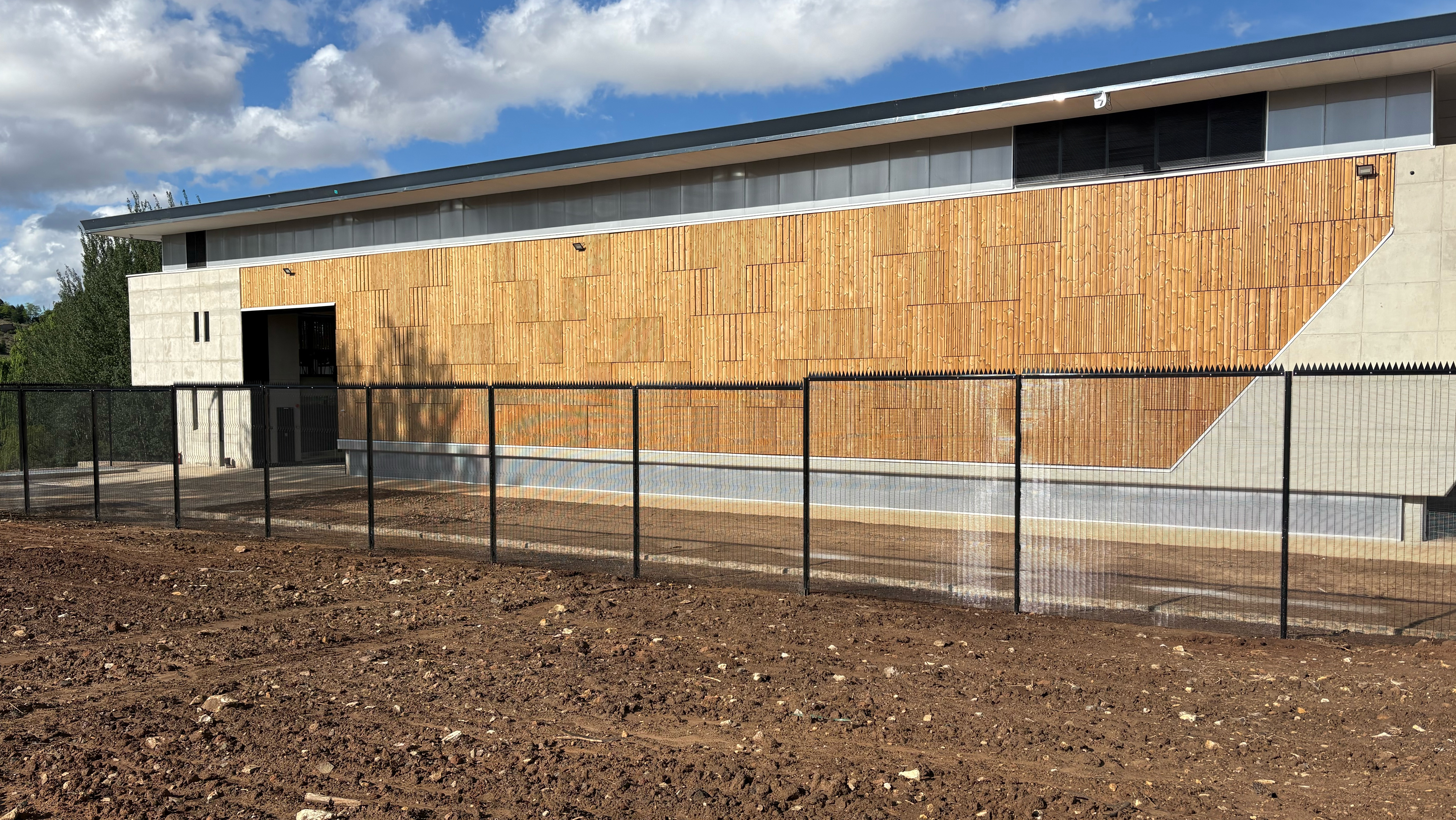
 The newly built Boston hydropower plant near Clarens in the Free State exists as a result of the Lesotho Highlands Water Project. (Photo: Ed Stoddard)
 The water rushing through the canal originated way up in the Lesotho mountains and its final destination – if you live in Gauteng – should be your shower or sink.
But on this leg of its journey outside the picturesque Free State town of Clarens, the water is playing a different role: generating hydropower. “This is an unintended consequence of the Lesotho Highlands Water Project [LHWP]. They were not thinking about this when it was started,” Anton-Louis Olivier, CEO of Serengeti Energy, said as he stood alongside the canal.
Olivier was referring to the independent power producer projects that have been unleashed in South Africa in recent years through the loosening and lifting of regulations. This has spawned initiatives enabled by the LHWP, such as the recently opened Boston hydroelectric plant near Clarens, which was built by Serengeti.
JSE-listed Growthpoint Properties has acquired a 30% stake in the R390-million plant and has exclusive access to all of the 30GWh of renewable electricity that will be generated by the plant annually via a 195GWh power purchase agreement with licensed energy trader Etana Energy.
The project is a microcosm of the renewable energy initiatives that liberalisation has spurred – and how the sector is able to grasp the opportunities presented by infrastructure crafted primarily for another purpose.
When the LHWP was launched in the late 1980s, the main aim was to provide reliable water supply to South Africa’s industrial hub.
But it’s also tailor-made to generate hydropower: the flow varies but is constant, and along the way it is peppered with locations suitable for the dam walls, weirs and vertical drops needed to generate energy from H₂O.
In 1999, the Muela hydropower plant in Lesotho began generating electricity for the mountain kingdom. But using the flow from the LHWP to unlock hydropower potential for South African consumers was long bottled up by Eskom’s monopoly and other regulatory hurdles.
The sector is now uncorked and the current of liberalisation has allowed the private sector to tap into the LHWP.
The water comes from the massive Katse Dam in Lesotho, and its key discharge point near Clarens is into the Ash River, transforming a previously inconsequential stream into a humming torrent.
“This is the sweet spot between the Lesotho Highlands and Gauteng,” Olivier told Daily Maverick as he guided journalists inside the plant.
Read more: Can lessons from Eskom be used to tackle SA’s water crisis with determination and strategy?
Read more: Africa’s potential for renewable energy unmatched globally — Ramokgopa
A river runs through it
/file/dailymaverick/wp-content/uploads/2025/10/IMG_2171-2.jpg "The Ash River flows out of the Boston Hydropower Plant en route to Gauteng water customers. (Photo: Ed Stoddard)")
At the bottom of the rectangular structure – adorned with fashionable wood panelling concealing the industrial skeleton within – a blue pipe funnels the flow of the Ash into a massive cylinder-shaped turbine.
A hulking red generator completes the picture. And the water that churns through continues on its merry way to serve the thirsty needs of Gauteng. Hydropower is nonconsumptive – the water used for electricity generation is not consumed.
Ed’s take
It’s revealing to see a property company such as Growthpoint inserting itself into the renewable energy space, but it makes sense – and presumably cents. The group has invested more than R1-billion in solar energy locally, an investment that helped to keep the lights on for its tenants when Eskom was failing, while also reducing the carbon emissions on their books. All sectors of the economy are scrambling to decarbonise and reduce their exposure to Eskom’s sky-high rates. For a property group with clients that span the economy, it’s a no-brainer.
It was this correspondent’s first proper visit to a hydro plant, and one of the things that struck me was that the facility is unmanned. Once it is up and operational, the water does all the work. Obviously, for security reasons, the plant is surrounded by an imposing fence – where there is power generation, there is copper. But the operation effectively runs itself, so long as the water is moving.
These things also last. The Boston plant has an operational lifetime of more than 40 years and some of the first hydro plants built in the 1880s are still producing power.
This correspondent has fly-fished in the Ash River for trout in the past and I was also pleased to spot a cormorant – a sign that fish are present – in the weir above the dam.
There are half a dozen hydro plants on the Ash River now – a state of affairs that was not possible before the liberalisation of the sector, which was politically triggered by Eskom’s epic failures.
For a property company such as Growthpoint, the project allows it to provide cheap, reliable renewable power to its tenants – corporate clients in 10 Sandton office buildings – allowing these companies in turn to reduce their “Scope 2” emissions.
Growthpoint has a fleet of 80 rooftop plants across its portfolio, providing 61MW of capacity, and a wind project is in the works.
“It not only benefits the immediate occupants of Growthpoint’s properties but also helps to create a brighter and more sustainable future for South Africa,” Growthpoint CEO Estienne de Klerk said.
This is the nuts and bolts of private-sector renewable power agreements – they align with broader goals as companies scramble to slash their emissions, with the ultimate target of “net zero” to contain rapidly rising temperatures linked to fossil fuel usage.
Across South Africa’s private sector – from mining to retail to banking to property – renewable power projects are sprouting like mushrooms after a rain.
The hydro contribution to South Africa’s overall power mix is still a drop in the bucket. But globally hydropower is the leader on the renewables front, accounting for about 15% of electricity generation worldwide.
Unlike wind or solar, hydro is consistent, so long as the water keeps flowing.
That is not always the case, and in this region, Kariba Dam stands out starkly. The latest El Niño-inspired drought left it high and dry, dealing a crippling power blow to Zambia and Zimbabwe.
But Katse Dam and its sister Mohale Dam in Lesotho are respectively about 97% and 89% full currently, and a La Niña summer beckons with its promise of rain.
The water pouring from Katse is now lighting up offices in Sandton. But the prospect of it reaching your tap consistently if you live in Johannesburg is a different matter because of the shambolic state of Johannesburg Water.
The LHWP doesn’t always reach its end goal even as it generates renewable power. Both are the products of “unintended consequences”. DM
This story first appeared in our weekly Daily Maverick 168 newspaper, which is available countrywide for R35.