




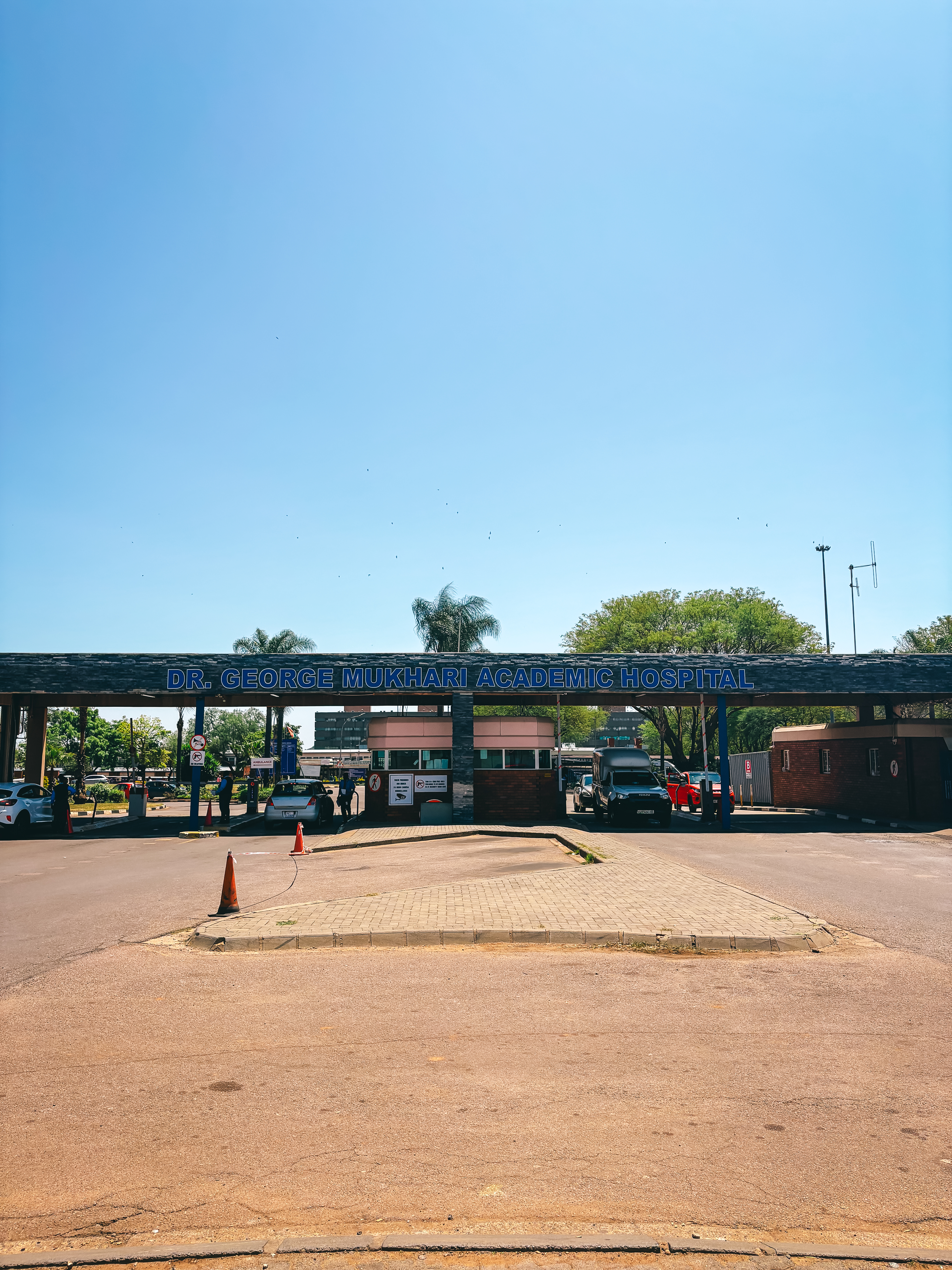
 Dr George Mukhari Academic Hospital. Photographer: Kieth Khumalo
 Not too long ago, the province of Gauteng was famous for its groundbreaking medical milestones, such as the HIV/Aids research and antiretroviral treatment programmes carried out by the Chris Hani Baragwanath Hospital in Soweto in the 1990s and 2000s.
Meanwhile, Charlotte Maxeke Johannesburg Academic Hospital gave birth to breakthroughs in cardiac and renal care. And perhaps the country’s most famous medical miracle – the first heart transplant in 1967 – also has connections to Gauteng. Before achieving international fame in Cape Town, Dr. Chris Barnard engaged with Johannesburg’s medical community through professional meetings and collaborations within South Africa’s surgical circles. His postgraduate training in cardiothoracic surgery at the University of Minnesota in the United States later paved the way for the world’s first human heart transplant.
In recent years, the Gauteng Department of Health has been hard at work to restore this rich legacy in the healthcare sector. This ambition is at the heart of the department’s 2020-2025 strategy, which comprises six key priorities, namely improving patient experiences, enhancing clinical services, promoting health education, strengthening governance and leadership, and fostering job creation and economic growth.
/file/dailymaverick/wp-content/uploads/2025/10/IMG_9048.jpg "IMG_9048")
/file/dailymaverick/wp-content/uploads/2025/10/IMG_9056.jpg "IMG_9056")
Despite budgetary constraints and a litany of governance challenges, the department has consistently made strides towards achieving these objectives.
Before taking a look at some of the long-term trends, here are some of the more recent improvements that signal a vital shift in the way the Gauteng Department of Health provides services to the 50,000 patients who visit its 504 health facilities daily.
Despite an average maintenance budget of around R2.2 million per year for each facility, the department has managed to address some of its main priorities, including upgrades to mental health and neonatal programmes, improving occupational health and safety measures, tackling water shortages and replacing vital equipment, such as the HVAC system at Tembisa Hospital, two old chillers at Chris Hani Baragwanath and laundry machines at Dr George Mukhari. The department has also replaced and repaired kitchen equipment at Masakhane Provincial laundry and a boiler at Edenvale hospital.
/file/dailymaverick/wp-content/uploads/2025/10/IMG_9093.jpg "Welcome Centre at Dr George Mukhari Hospital. A commitment to strengthening infrastructure and improving patient experiences. Photographer: Kieth Khumalo")
Mental health improvements
It goes without saying that the province’s mental health programme has enjoyed the highest priority in the wake of the Life Esidemeni scandal, which highlighted severe shortcomings in the department’s mental health services.
In order to remedy this failure, we have completed phase one of the refurbishment of Bertha Gxowa mental hospital, consisting of a thirty-bed facility. The second phase of this project will also comprise a 30-bed facility and will be completed next year. The department has also completed a 12-bed mental ward at Bheki Mlangeni hospital as well as the Weskoppies mental hospital.
/file/dailymaverick/wp-content/uploads/2025/10/WhatsApp-Image-2025-10-24-at-16.58.47.jpeg "A newly refurbished patient ward, demonstrating the department's focus on upgrading healthcare facilities. The refurbishment of Bertha Gxowa mental hospital includes a completed thirty-bed facility in Phase One. Photographer: Kieth Khumalo")
Other ongoing projects include mental health facilities at the East Rand, South Rand and Tshwane District hospitals. In the fourth quarter of this financial year, the Sterkfontein Ward 18 capital project will kick off.
Following fires at Tembisa and Charlotte Maxeke earlier this year, the department has boosted occupational health and safety measures at all its facilities.
Fire detection systems, sprinklers and fire extinguishers have been implemented at Chris Hani Baragwanath; Steve Biko; Charlotte Maxeke; George Mukhari, among others. To date, five hospitals are above 90% compliance; 16 are above 80% and 16 above 70%.
A two-phase action plan will refurbish damaged locations at Tembisa hospital, starting at the end of this financial year.
Of course, none of these achievements will have the desired outcome if the province’s municipalities cannot fix dire service delivery issues. Perhaps the most crucial of these is water infrastructure especially since water shortages are expected to become even more critical in the coming decades in Gauteng and the Western Cape, as the populations in these provinces explode.
Maintenance-related disruptions left some Gauteng health facilities’ taps running dry in July this year, with water storage facilities in some hospitals only able to supply them for two to four days at a time.
/file/dailymaverick/wp-content/uploads/2025/10/WhatsApp-Image-2025-10-24-at-16.58.47-1.jpeg "WhatsApp Image 2025-10-24 at 16.58.47 (1)")
/file/dailymaverick/wp-content/uploads/2025/10/IMAGE-4-GDH.png "IMAGE 4 GDH")
Two months before that, a huge burst on Rand Water’s F39 pipeline near Soweto triggered a water shortage in several hospitals and clinics, including Chris Hani Baragwanath Hospital and clinics in Mogale City.
In the wake of these service challenges, the department has commissioned feasibility studies to propose water solutions at five facilities, namely: Chris Hani Baragwanath, Charlotte Maxeke, Dr George Mukhari, Steve Biko and Helen Joseph Hospital. These reports will form the basis of a business case that will be submitted to the Gauteng Provincial Treasury in order to motivate for a funding allocation in 2026/27.
The outcome of this process will play a huge role in the department’s ability to meet its targets, which have steadily registered improvements.
In 2022 and 2023, the department recorded significant improvements, including an increase in 24-hour community health centres, expanding screening for priority non-communicable diseases and a decline in HIV positive clients among the 15- to 24-years age group.
/file/dailymaverick/wp-content/uploads/2025/10/WhatsApp-Image-2025-10-24-at-16.58.48.jpeg "Part of the ongoing infrastructure upgrades and maintenance efforts within the Gauteng Department of Health. Photographer: Kieth Khumalo")
Still, there is a long way to go.
For example, the 2020/21 Gauteng City Region Observatory Quality of Life Survey found that 93% of respondents had not struggled to access healthcare during the year of the report. However, it points out that the remaining 7% is a concern as this group is likely to be poor and have poor to very poor health status. This group is also likely to have a higher incidence of anxiety and depression.
The survey also recorded a growing level of dissatisfaction with public healthcare services, noting that this trend “is deeply concerning, as it is likely to be a reflection, at least in part, of poor service delivery, potentially exacerbated by the pressures of Covid-19.” The report points out that “regular negative experiences with healthcare services will negatively impact appropriate care-seeking behaviours.”
Still, amid the many unflattering headlines, Gauteng’s public and private medical institutions have continued to deliver world-class results.
In 2017, surgeons at the Wits Donald Gordon Medical Centre performed what is believed to be the world’s first living-donor liver transplant from a mother living with HIV to an HIV-negative child with end-stage liver disease.
The procedure was ethically groundbreaking: the mother had HIV (on ART and suppressed viral load), and the child was HIV-negative. The decision weighed the risk of HIV transmission versus imminent death from liver failure.
The surgical team believed there was no detectable HIV transmission to the child after more than a year of follow-up.
/file/dailymaverick/wp-content/uploads/2025/10/WhatsApp-Image-2025-10-24-at-16.58.46.jpeg "The exterior of Bertha Gxowa Hospital, a facility receiving refurbishment of its mental hospital as part of a priority upgrade. Photographer: Kieth Khumalo")
This opens new possibilities in donor-organ pools, including living donors with HIV, especially important in South Africa where both organ donor shortage and HIV prevalence are significant.
In the public sphere, the Gauteng Department of Health has implemented initiatives to clear backlogs and provide hundreds of surgeries in 12-hour campaigns. On July 18 this year, medical teams across 29 public hospitals performed over 800 surgeries in just 12 hours as part of the Mandela Day Surgical Marathons.
The department has also introduced for the first time in South Africa a “Treatment Time Guarantee” framework – setting maximum waiting times for various surgical interventions in Gauteng.
Digitisation of hospital records and “smart-hospital” transformation is also under way across Gauteng, converting millions of paper files into digital systems, improving access and efficiencies.
No doubt this is just the beginning of a long healthcare road ahead. It will take relentless work to restore faith in the public healthcare system. The success of the turnaround will depend on a wide variety of factors, not least of which are budgetary capacity and governance. Perhaps most important will be the 18,000 public servants who are the heartbeat of the Gauteng Department of Health. DM
Author: Gershwin Wanneburg