




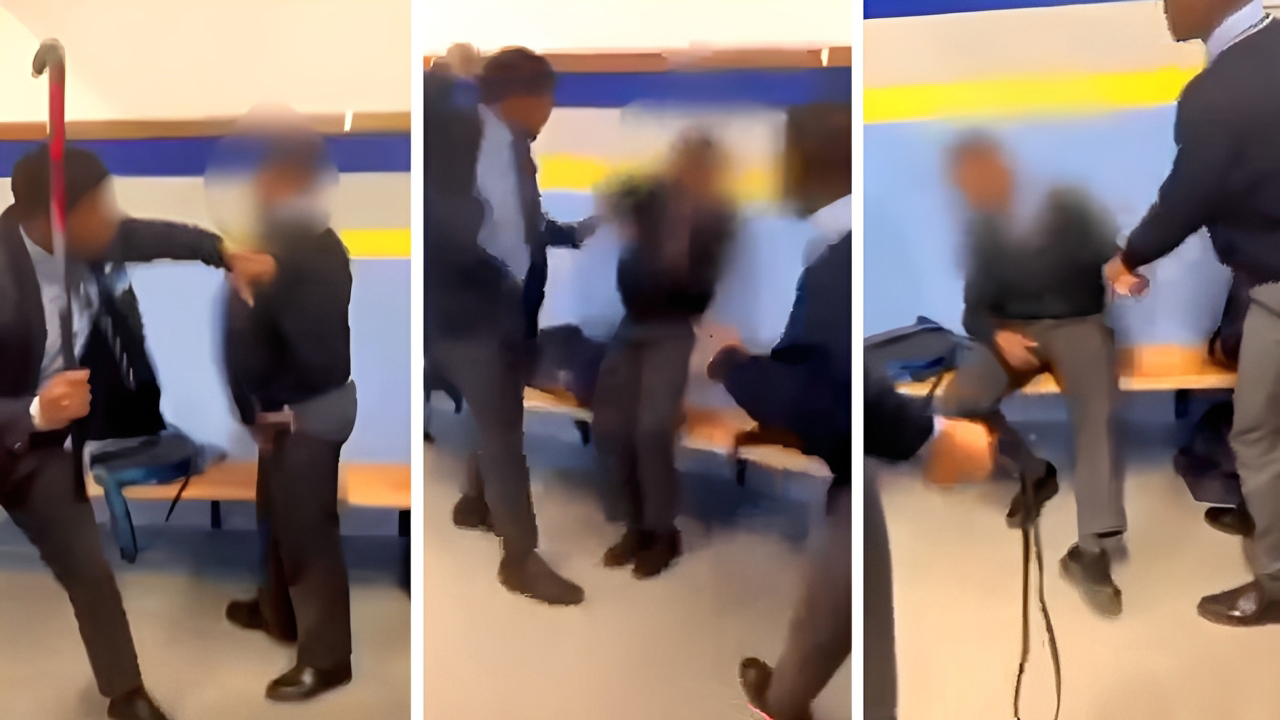
 A distressing video surfaced on social media showing a Grade 10 Milnerton High School learner being physically and verbally attacked by a group of fellow pupils, many of whom are reportedly members of the school’s first-team rugby squad. (Screengrabs: vocalperson / X)
 On Thursday, 23 October 2025, eight learners from Milnerton High School appeared at the Cape Town Magistrates’ Court on charges of assault with intent to cause grievous bodily harm.
The boys, aged between 17 and 18, allegedly struck a 16-year-old cancer survivor, a boy who had recently completed chemotherapy, with objects including a hockey stick, a hosepipe, and a belt.
/file/dailymaverick/wp-content/uploads/2025/10/IMG_7717.jpeg "The mother of a Grade 10 learner who was struck with objects, including a hockey stick, arrives at Milnerton High School. The assaulted boy is a cancer survivor who had recently completed chemotherapy. (Photo: Siyabonga Goni)")
A distressing video surfaced on social media showing a Grade 10 learner being physically and verbally attacked by a group of eight pupils, several reportedly members of the school’s first-team rugby squad. The footage shows some learners standing by and recording the assault without intervening, while others are heard encouraging the attackers.
National Prosecuting Authority spokesperson Eric Ntabazalila confirmed that the State did not oppose bail because the accused all had fixed addresses and had no pending cases against them.
“Six of them appeared in front of the magistrate, and the other two appeared at court 19 as they are juveniles… The court set bail at R2,000 for each accused with conditions that they must not contact the complainants and witnesses directly or indirectly. If they see the complainants, they must walk in a different direction, they are prohibited from entering the school yard or the school until the case is finalised, they must submit their cellphones and pins (five cellphones and pins were handed over in court),” said Ntabazalila.
One minor has been assessed and released on warning. The other minor will be assessed tomorrow, but has been released into the care of his parents.
The case has been postponed until 20 January 2026 to allow the accused to write exams. “The accused will study at home and the Western Cape Education Department (WCED) has provided an alternative venue for them to write exams – Metro North District Office,” said Ntabazalila.
/file/dailymaverick/wp-content/uploads/2025/10/IMG_7709.jpeg "Police monitor the main gate of Milnerton High School after a Grade 10 learner was bullied, leading to a protest. (Photo: Siyabonga Goni)")
WCED director of communications Bronagh Hammond said, “We are waiting for the official report from the school, but they had notified us on Friday that there was an assault at the school involving learners, and they initiated an investigation. They then proceeded to have a school governing body meeting on Tuesday, and a decision was made to precautionarily suspend eight learners, who will now face a disciplinary hearing.
“Based on the outcome of the disciplinary hearing, an outcome to determine sanction will be recommended. It must be noted that it is only the head of a provincial education department who [can] expel a learner,” said Hammond.
Chairperson of the parliamentary basic education committee Khomotjo Joy Maimela said that despite the school taking action to suspend those involved in the bullying, the school took some time to report the matter.
Maimela said this was a serious criminal matter and that there was a culture of violence at the school.
“They said that they provided psychosocial support. We learnt that they didn’t actually provide any psychosocial support.” The “support that they think they provided” had been inadequate under the circumstances.
“There are certain gaps that we’ve actually established in how the school and the department have reacted to this issue,” Maimela said.
Deputy secretary of Equal Education Nontsikelelo Dlulani told Daily Maverick that the school and WCED should ensure that the eight learners faced punishment.
“The WCED and the Milnerton High School should provide psychosocial support for the learner and any other support that he needs to deal with the trauma, because bullying is not just bullying and pain and being beaten up, it also comes with so much generational trauma because of the stigma around bullying,” said Dlulani.
Hammond said that the school would hold a disciplinary hearing and, based on that outcome, determine a sanction or a recommendation to the WCED head of department (HOD).
“If a recommendation is received, the recommendation of expulsion is carefully considered by the HOD, and he will determine whether to uphold or dismiss the expulsion recommendation,” she said.
Speaking to the media outside the school, Hammond said the learner who had been assaulted would receive support as he was set to write exams.
She said the department had contacted the parent and “had spoken to the learner today. They were hoping that the learner would come in today for counselling, but he wasn’t present today, but I believe he received counselling on Monday.”
Hammond said that “a lot came out in terms of other incidents that are popping up that certainly need to be investigated”.
She said videos doing the rounds were concerning “because there are quite a few videos that have been circulating and it seems that many of those cases were not reported to the school”.
“We’ve also committed to assisting the school in terms of putting programmes in place to address bullying and other forms of assault and abuse, which is extremely important at this stage," Hammond said.
What does the law say?
Despite five separate pieces of legislation aimed at preventing and addressing bullying among minors in and out of school, educational institutions, parents and teachers in South Africa continue to struggle with the complex and pervasive nature of bullying.
The South African Constitution guarantees rights to equality, dignity and freedom from violence, especially for children protected under Section 28, which prioritises their protection from maltreatment and their best interests.
The South African Schools Act 84 of 1996 (SASA) mandates public schools to establish codes of conduct addressing bullying, creating safe, disciplined environments. Schools must enforce these policies with disciplinary actions, including suspension or expulsion, ensuring learners’ dignity and equality.
The Children’s Act 38 of 2005 protects children from abuse, including bullying, allowing victims to seek legal redress. It emphasises restorative justice, focusing on rehabilitating bullies, and holds schools and the state accountable for protection failures.
The Protection from Harassment Act 71 of 2011 offers victims protection orders against bullies to prevent ongoing harassment, providing civil remedies within school settings.
The Cyber Crime Act 19 of 2020 criminalises online bullying by prosecuting those who send abusive or threatening digital messages.
The Child Justice Act 75 of 2008 addresses juvenile offenders using restorative justice, promoting rehabilitation, diversion and reintegration over punishment.
The Milnerton High School Code of Conduct explicitly addresses bullying and cyberbullying, stating that the issue will be addressed with zero tolerance. The school implements policies designed to proactively educate learners, employ clear reporting mechanisms and enforce stringent disciplinary actions for offenders.
The code outlines extensive support and counselling mechanisms available to learners who are involved in disciplinary proceedings or those who are affected by issues such as bullying or other conflicts within the school, underscoring the commitment to ensuring the safety and wellbeing of learners. School staff are further instructed to consider whether misbehaviour, even in normally well-behaved learners, might be linked to the child suffering significant harm, potentially requiring referral to the education district office.
Bullying’s toll on self-worth and emotional health
Jessica Allschwang, an adolescent coach and director of Aligned Intentions, explained the deep impact bullying had on mental health and self-esteem.
“It is one of those things that really degrades your sense of self-worth, because you start to question whether or not you deserve it, whether those things about you that the bullies target are true,” she said.
This erosion of confidence often leads to feelings of shame, anger, and a desire to blame others. “Often that anger gets (transferred) on to someone else who is smaller or more vulnerable... it’s an attempt to take back power and control.”
Allschwang also highlighted the effects bullying had on brain development and academic outcomes. She referred to research showing that bullying can lead to significant structural and chemical changes in the brain. These changes contribute to increased anxiety, depression, poor emotional regulation, social anxiety and difficulty concentrating, all of which harm learning.
Allschwang said that although many schools had anti-bullying campaigns, there was a need for more effective support systems.
“Do they really have support systems for their students? Are there processes implemented to make sure it doesn’t happen? This systemic change is essential to breaking the cycle and protecting adolescent mental health,” she said. DM