



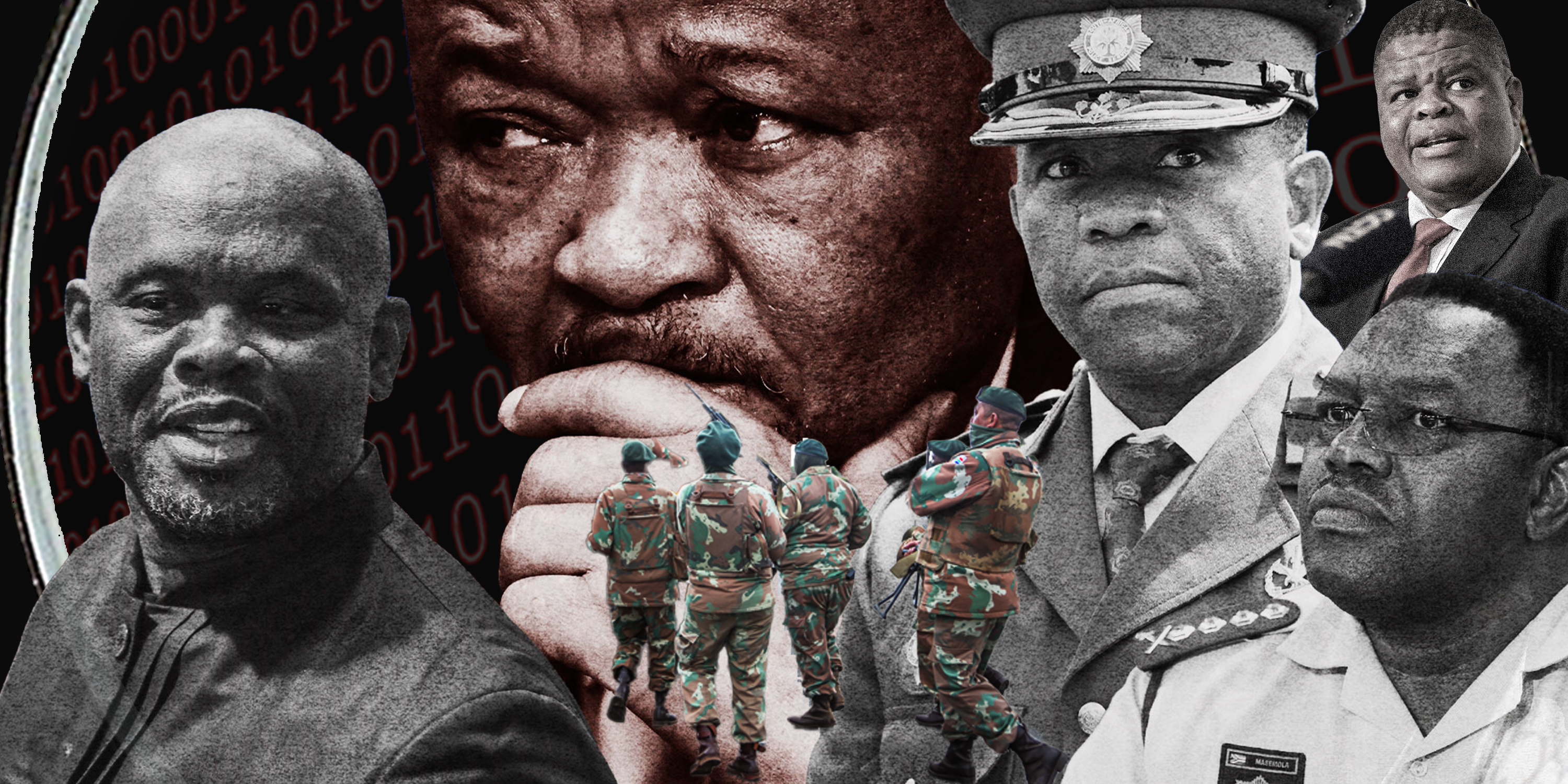
 Illustrative Image: Suspended Deputy Police Commissioner Shadrack Sibiya. (Photo: Phill Magakoe / Gallo Images) | Suspended Police Minister Senzo Mchunu. (Photo: Frennie Shivambu / Gallo Images) | KwaZulu-Natal Police Commissioner Lieutenant General Nhlanhla Mkhwanazi. (Photo: Frennie Shivambu / Gallo Images) | National Commissioner General Fannie Masemola. (Photo: Jaco Marais / Gallo Images / Die Burger) | David Mahlobo. (Photo: Luba Lesolle Gallo Images) | Members of the SANDF. (Photo: Sharon Seretlo / Gallo Images)
In some awful ways, the state of our intelligence and security institutions is a direct reflection of the state of the ANC.
Only a party that has become the symbol of corruption could create a situation in which the entire country hears testimony about how a State Security Agency (SSA) employee could be ordered to draw millions of rands in cash and give it to the SSA minister — only for that minister, David Mahlobo, to end up back in the government of a President who has promised “renewal”.
This kind of attitude has seeped into the very fabric of our security institutions.
The Madlanga Commission and the parliamentary ad hoc committee investigating the allegations made by Lieutenant General Nhlanhla Mkhwanazi have heard riveting testimony of how suspended Police Minister Senzo Mchunu was in contact with known violent criminals.
/file/dailymaverick/wp-content/uploads/2025/10/ED_573669.jpg "Judge Mbuyiseli Madlanga on Day One of the Madlanga Commission hearings in Pretoria on 17 September. (Photo: Deaan Vivier / Gallo Images / Beeld)")
The culture of the police has become so rotten that the suspended Mpumalanga provincial police commissioner, Lieutenant General Daphney Manamela, felt that she could demand gifts from police stations she visited. (Imagine being a police officer, earning a pittance for putting your life on the line, and being asked to pay for a “gift” for a person who earns so much more than you.)
So deep is the rot in our security institutions that SANDF Major General Edward Mulaudzi had no qualms about ordering a military truck to drive 1,200km to come to his home to remove two tree stumps.
Read more: SA’s ongoing capture — Mkhwanazi’s accusations and countering charges merge with past state sabotage
Professor William Gumede has argued, in the Sunday Times, that SA’s entire intelligence apparatus — all of our intelligence agencies — should be shut down.
He is entirely correct. It seems impossible that they can be reformed with almost any of the current leaders in place.
As Gumede argues, perhaps it’s time for an outsider, someone who is not a South African, to play a leading role in recreating these agencies.
There is not much precedent for a democratic country closing an entire intelligence agency and starting again (this tends to happen only at the end of wars or during a transition from oppression to democracy — as when apartheid ended, or during the integration of East and West Germany).
In Colombia, the president decided that the rot in the intelligence agency was so deep that it had to be shut down.
Given that we are approaching a period when our politics will no longer be dominated by the ANC, we need to consider what our security apparatus should look like. This includes the intelligence agencies, the SA Police Service (SAPS) and the SA National Defence Force.
Breaking the political links
The first, and obvious point, is that the link between politics and appointments to the security apparatus must be broken.
National Police Commissioner Fannie Masemola’s testimony that it would have been “career-limiting” to disagree with Mchunu’s illegal instruction to close the Political Killings Task Team illustrates this perfectly.
We need a situation where officials in all of our security institutions are not dependent on politicians for their jobs. In return, politicians will not be able to rely on these officials for dirty dealings.
Many countries have faced this problem, and many have found solutions.
When different parties come into office in older democracies, there is often very little that changes in their security institutions.
These countries have found a way to ensure that officials who are trusted and appointed on merit are in charge of their security structures.
These two elements, merit and integrity, should be paramount when assessing who should lead these institutions.
Read more: Why the twin inquiries into police corruption is our new #Guptaleaks moment
At present, given the zero-sum nature of our politicians, it is unlikely that any appointees they make to security institutions will have merit and integrity.
This suggests that new appointing structures are needed, structures that insulate the office-holders and ensure that they cannot act undemocratically.
Because of the nature of the liberation struggle, many of those who headed South Africa’s security institutions had long histories with the ANC.
Bheki Cele and Jackie Selebi became national police commissioners essentially because of their previous roles in that party.
/file/dailymaverick/wp-content/uploads/2024/02/ED_492804.jpg "Former police minister Bheki Cele. (Photo: Darren Stewart / Gallo Images)")
It should be relatively easy to demand that in future, people in these positions have no political history, and thus no political adherence. In short, they should be apolitical to the point where the leader of the EFF and the leader of the Freedom Front Plus feel the same way about them.
A chance for reform
Because of the nature of this moment, where it is obvious that we are about to undergo major political change, there is now a window to also assess what threats these institutions must be designed to face.
The rise of violent crime, non-state actors who threaten to destabilise South Africa through the trafficking of drugs and weapons, and cyberattacks should be among them.
These are all threats that our current security apparatus is failing to defend us against. And thus, a proper redesign, with totally new leadership, might well lead to more effective services.
However, many people have a keen interest in keeping our security institutions as politicised as they are currently.
The leaders of the ANC, MK and EFF all have links to people in these institutions (the ANC is obvious, MK through Jacob Zuma, and the EFF through Julius Malema’s relationship with SAPS Major General Feroz Khan).
/file/dailymaverick/wp-content/uploads/2024/10/LIGHT-BLUE-26.jpg "Feroz Khan. (Photo: Supplied)")
It is likely that members of other parties also have links to high-ranking personnel in our security apparatus.
This means that there may be very few voices demanding real change.
But, considering how our politics is changing, this may be the moment for those who want security services that serve all of us to raise their voices as loudly as they can. DM