




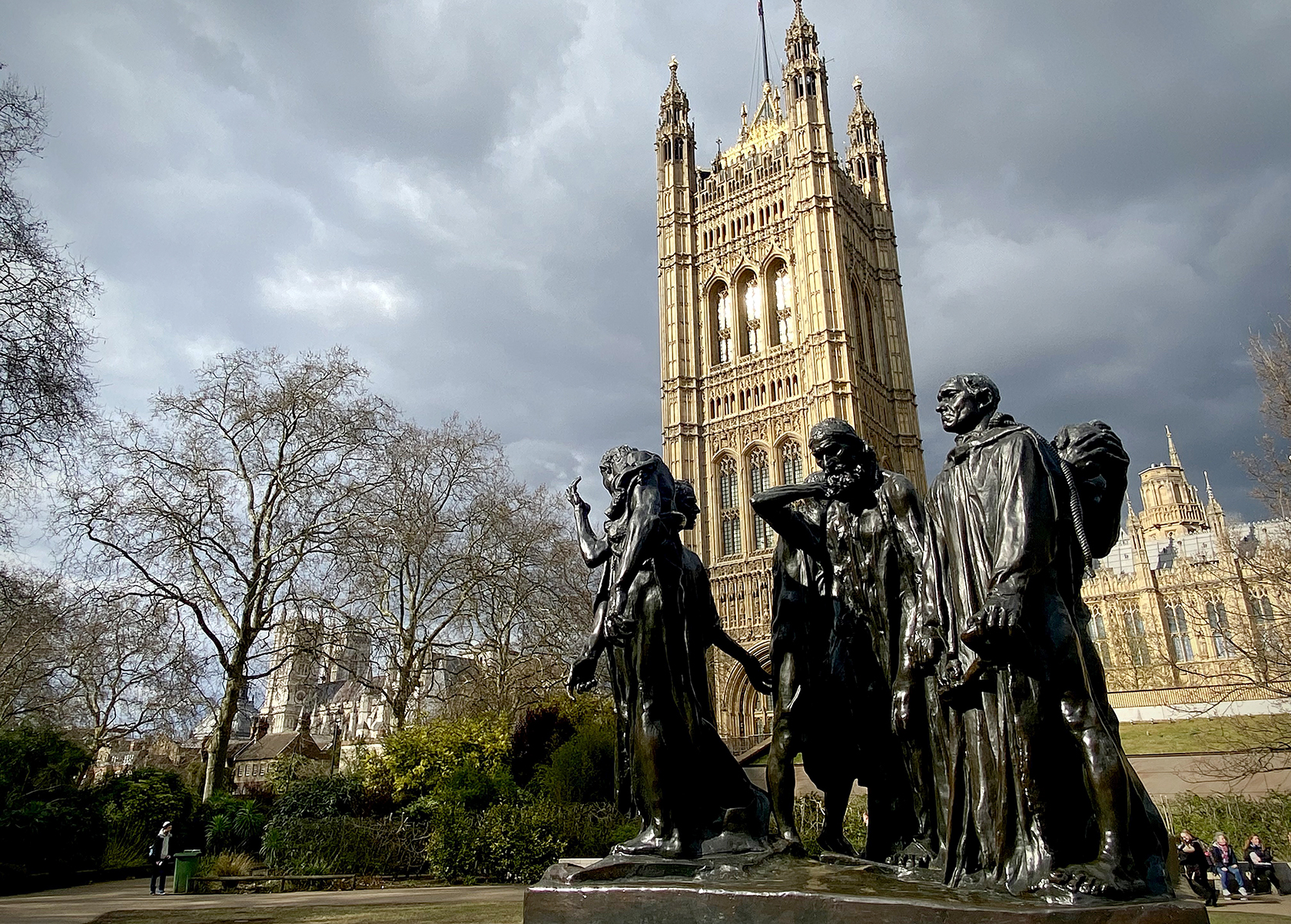
 The Houses of Parliament in London with ‘The Burghers of Calais’ by Auguste Rodin, Victoria Tower Gardens, in the foreground. (Photo: Tiara Walters)
 London says it is moving to codify action against mining in its first-ever Antarctic strategy — a direct response to the UK Parliament’s concerns about Russian “prospecting” in Antarctica’s Southern Ocean.
The oil and gas surveys are led by Rosgeo, the Kremlin’s mineral explorer, aboard the Akademik Alexander Karpinsky: a US-sanctioned ship with a history of sailing to Antarctica via Cape Town since the mining ban became law in 1998.
The move by the Foreign, Commonwealth and Development Office (FCDO) follows a landmark Westminster inquiry report. The UK government’s lead agency, the FCDO, says it has now accepted most of the inquiry’s 99 recommendations on “prospecting”, climate change, tourism and more, forcing it to grapple with Moscow’s mineral ambitions.
Escalating worries about the Russian activities are likely not random.
In September 2023, expert written testimony to the inquiry cited the “current Russian activity” as “troubling”. Just months later, on 5 February 2024, expert oral evidence cited Daily Maverick’s articles for exposing the Rosgeo expeditions. Three weeks later, Washington placed the Karpinsky under energy sanctions — making it the first state to recognise the surveys as more than science.
Washington, in August 2025, called for hearings into how Russian mineral interests could erode American influence around the South Pole.
And this week in Hobart, Tasmania, the UK-chaired talks charged with proclaiming new marine protected areas (MPAs) in the Southern Ocean face an uneasy test.
It is hardly likely to be tabled in Hobart’s already tense atmosphere, where Ukraine authorities have levelled an extraordinary accusation at Moscow — arresting one of its delegation members and MPA proponents in Crimea for “opposing” Russia’s fishing plans in the Southern Ocean.
Still — the Westminster inquiry findings invite an obvious question.
Have the Karpinsky’s seismic airgun blasts in an MPA blocked by Beijing and Moscow caused irreversible “harm” to “marine living resources” there?
‼️In the temporarily occupied Crimea, Russians arrested Ukrainian marine biologist and Antarctic researcher Leonid Pshenichnov.
He became the first political prisoner in the history of Antarctica for opposing Russia's overexploitation plans on the Southern Ocean.
He was accused… pic.twitter.com/GeejNndiy7
— National Antarctic Scientific Center 🇺🇦 (@nasc_ua) October 21, 2025
The inquiry’s historic recommendations
The 2023-to-2025 Westminster inquiry is the first of its kind to call on London’s FCDO to respond to the Karpinsky’s surveys, warning they could “endanger the fragile Antarctic environment”.
The inquiry also directs London to define clear measures in its Antarctic strategy to safeguard the region against “commercial mining”. The strategy is expected to be published in coming weeks.
To block “any unauthorised activities”, the parliamentary recommendations demand full data disclosure from Rosgeo under the treaty’s open-science rules.
Daily Maverick’s reporting was central to the inquiry’s outcomes.
- In October 2021, we revealed the Karpinsky had used Cape Town as a launchpad for about 25 years. South Africa played no formal role in the surveys — it says it supports the ban and the treaty’s environmental protection policies.
- In 2022, we exposed several Russian state documents suggesting up to 70 billion tons of oil and gas in the Southern Ocean off East Antarctica.
- In May 2024, we exposed Rosgeo’s surveys in West Antarctica’s Weddell Sea — the explorer said it had also studied this sea’s “mineral resource potential” in 2011, 2012, 2015, 2016, 2017 and 2018.
Rosgeo’s subsidiary, the Polar Marine Geosurvey Expedition (PMGE), abruptly stopped posting regular expedition reports after six-month protests in Cape Town against the Karpinsky’s airgun surveys drew international headlines.
To this day, that seems to leave the Weddell Sea’s hydrocarbon potential unknown to all but Moscow.
The Karpinsky’s complicated affair with science, ‘prospecting’
When we first approached Rosgeo in October 2021, it insisted in an exclusive, lengthy response it was doing nothing more than legal “scientific research” allowed by the ban.
Indeed, as recently as August 2025, a paper led by the Alfred Wegener Institute drew on, among others, the Karpinsky’s 1994 data to help resolve a fascinating scientific mystery.
Far from being a “lost continent”, the researchers argue that the southernmost Kerguelen Plateau is an underwater volcanic outcrop, built by outpourings from deep mantle plumes as India and Antarctica drifted apart.
And yet, in 2022, the PMGE’s annual report noted it was doing more than science in the same ocean.
The seismic smoking gun text is winding. It even includes the word ‘scientific’.
But published mere months before Russia professed to reaffirm the mining ban at the 2023 Antarctic Treaty Consultative Meeting (ATCM) in Helsinki, the punchline is explicit.
The Rosgeo subsidiary was tracking Antarctica’s “mineral resource potential” by government decree:
“GEOLOGICAL AND GEOPHYSICAL SCIENTIFIC RESEARCH IN ANTARCTICA (4 state contracts in 2022) is carried out by the PMGE on the Antarctic continent and in the adjacent seas as part of the annually organised Russian Antarctic Expeditions (RAE) … approved by the decree of the Government of the Russian Federation dated August 21, 2020, ‘the objectives of research and work in this area [include] creating an information base for assessing and scientifically forecasting the mineral resource potential of Antarctica’.”
/file/dailymaverick/wp-content/uploads/2025/10/NicBothma-Karpinsky-DM-15-5.jpg "The Karpinsky sails into Cape Town on 3 April 2023 after an expedition in the Southern Ocean. (Photo: Nic Bothma)")
‘Irreversible environmental harm’
For its part, the Westminster inquiry found that the true “nature and intent” of the Russian seismic surveys “cast doubt on compliance with the [Madrid Protocol’s] prohibition and risk undermining its authority”.
The Protocol is Antarctica’s environmental constitution, which governs the “prohibition” — or the ban, as it’s popularly known.
In the language of diplomacy during globally sensitive times, that is about as clear as Westminster can get before dragging Moscow to the International Court of Justice, the court authorised to hear Antarctic disputes if they cannot be resolved in any other way.
“Failure to address these concerns could set a dangerous precedent, opening the door for future exploitation,” the inquiry findings stress, envisaging the possibility of “geopolitical tensions” and even “irreversible environmental harm”.
When testimony backfires: The FCDO’s Antarctic dilemma
Westminster’s recommendations are a tacit admission that the so-called permanent ban may not be enough to prevent a “future” dystopian geopolitical and ecological fallout.
“It is crucial that the international community acts decisively to ensure that any attempts to bypass or erode the Protocol’s safeguards are promptly thwarted,” says the parliamentary recommendations.
So, the FCDO must act. The government agency even responded that it would: “The government will reflect in the Antarctic strategy our longstanding role in upholding the obligations of the Antarctic Treaty, including our commitment to the Protocol’s mining ban.”
But during the May 2024 hearing, FCDO polar chief Jane Rumble defended the “scientific” nature of the seismic surveys — which have persisted in East and West Antarctica throughout her 22 years in the agency.
Without offering evidence, she also told her questioners Moscow had been “tackled” on its activities “before”. Moscow, in turn, had “assured” the annual ATCM on “multiple occasions” that the Karpinsky was just a science ship, she vowed.
This suggests the ambassadorial official tasked with defending “British Antarctic Territory” (BAT) against “geopolitical tensions” and “irreversible environmental harm” is not enthused by “prompt thwarting” in this case.
At the time of Rumble’s comments, the treaty meeting database did not seem to reveal a single assurance to the ATCM by Moscow since she had stepped into the agency as polar deputy chief in 2003, chief in 2007 and BAT boss in 2025.
Moscow’s last and only ATCM “assurance”, in fact, was tabled at the Warsaw meeting — back in 2002, when Russian President Vladimir Putin was still running the Kremlin with a Nokia 3310.
If anything, an earlier, rough draft of that defence — first obtained and published by Daily Maverick — is less assuring than its tabled cousin.
According to the rough draft, the “actual utilisation of the Antarctic mineral wealth may only occur in the indefinitely remote future”.
The draft does not define “indefinitely remote”.
Professor Alan Hemmings, an Antarctic governance specialist delivering a keynote speech at this week’s Polar Law Symposium in Greenland, told us that Moscow’s activities violated the Protocol.
“The Russian Federation,” he said, “has been engaged in what is manifestly mineral prospecting.” The ban does not expire, but it can be lifted — so, Hemmings has proposed options to make it unchangeable.
Professor Klaus Dodds, then at Royal Holloway, University of London, listed the surveys among London’s top Antarctic challenges, alongside others such as fishing disputes and an MPA deadlock.
The prominent polar geopolitician was an expert testifier and warned the inquiry the data collection could constitute prospecting rather than science.
Rumble’s bumble
Rumble doubled down.
“There isn’t any evidence that would point to a breach of the treaty,” she argued.
But the treaty doesn’t govern the ban; the Madrid Protocol does.
And while the Protocol does not define “prospecting”, the inquiry findings conclude that prospecting is a banned “mineral resources activity” — alongside “exploration” and “exploitation for commercial purposes”.
The UK’s own definition of prospecting can be seen in the Convention on the Regulation of Antarctic Mineral Resource Activities (CRAMRA). As agreed in this seminal 1988 mining pact succeeded by the Protocol, prospecting aimed to identify “areas of mineral resource potential for possible exploration and development”.
And this type of commercial “prospecting” is precisely what the PMGE says it has done.
“The works of the PMGE aimed at studying the geological structure and mineral resources of the Antarctic are of a geopolitical nature,” says its 2017 report. “They ensure guarantees of Russia’s full participation in any form of possible future development of the Antarctic mineral resources — from designing the mechanisms for regulating such activities up to their direct implementation.”
The CRAMRA berries: When ‘surveying’ turns sour
“You would need different equipment between surveying and actual exploitation, so that there isn’t a shift to it,” Rumble’s expert testimony pressed on with a word salad seemingly seasoned in fudged sauce.
In the case of Rosgeo’s seismic surveys, the accepted tension lingers between legal science and banned prospecting. It does not linger between “surveying and actual exploitation”.
“Surveying” is actually the missing ingredient in the CRAMRA pact. “Exploitation” pops up only once. Rosgeo’s favoured term — “development” — is tossed into the mix 59 times, together with “prospecting” and “exploration” as the pact’s three “Antarctic mineral resource activities”.
“But yes, we’re watching it very closely,” Rumble hastened to add. She did not volunteer details on how they were “watching it”.
The treaty database shows the Russian Antarctic Expedition has not filed an environmental impact assessment for the Karpinsky since 2001 — when underwater noise pollution was still poorly understood. This assessment also does not consider the impact of underwater noise on marine life.

Jane Rumble testifies on the seismic surveys to the Westminster inquiry, 8 May 2024. (Source: Screenshot — Parliamentlive.tv)
In other words, mining activities may already be having an impact on Antarctica and its species without mitigation measures in place.
The ship, in fact, actively advertises the “services” of 18 submerged airguns designed to map hidden rock layers for geology and mineral deposits — towed across about 4.5 million km² of the Southern Ocean. (A survey area larger than the EU.)
The SG-IIB sleeve gun array may have fired every 10 seconds at 200 decibels or more — louder than a jet engine — levels known to disrupt fish behaviour, deafen whales and kill krill, the base of the Antarctic food chain.
That same 2001 environmental impact assessment outlined plans to study East Antarctica’s “oil-gas-bearing perspectives”, which have since gifted the PMGE a body of hydrocarbon data from vulnerable marine habitats spanning several thousand nautical miles.
So, as the UK assumes the chair of the CCAMLR in Hobart this week, Jane Rumble faces a credibility test. After deferring to Russia’s judgements about those “scientific” surveys, she must now enforce the rules she once downplayed.
Daily Maverick contacted Rumble by mobile and email. Would she, for instance, request data on how the Karpinsky’s airguns affected Southern Ocean marine life?
We did not receive a response from Rumble to our seventh set of repeat questions, first sent May 2024.
However, replying to our detailed questions on behalf of Rumble, the FCDO’s communications division offered a pithy response: “The UK is committed to the Antarctic Treaty and working within the Antarctic Treaty system to strengthen it and advocate for full compliance with all provisions, including the ban on the commercial exploitation of minerals.”
A geopolitical love triangle
If love triangles have muddied the waters of history since time immemorial, it seems apt that Moscow as international rule-breaker has inserted itself into the sea coveted not just by London, but Buenos Aires and Santiago, too.
That counter-claimed Weddell Sea region — where maritime rights are not recognised as long as the treaty remains in force — is also where both Buenos Aires and Santiago have proposed an Antarctic Peninsula MPA, vetoed by Beijing and Moscow every year since 2018.
For Chile’s President Gabriel Boric, born in the Antarctic gateway of Punta Arenas, the fight is personal. As Daily Maverick’s findings attracted global attention at the May 2024 inquiry, he publicly vowed — in two tweets — to defend the icy waters he gazed out at as a child.
“We cannot dedicate ourselves to exploiting resources if we do not adopt adequate conservation measures, as this results in the destruction of marine life on which we also depend,” Boric told the September 2025 UN General Assembly in New York, while calling for the proposed MPA. “Let us not forget that we are part of the same ecosystem.”
We did not receive responses from Argentinian, Chilean and Russian authorities by the publication deadline.
/file/dailymaverick/wp-content/uploads/2025/10/Russian-survey-areas.jpg "Rosgeo’s seismic surveys in the Southern Ocean since the mining ban entered into force in 1998. (Graphic: Tiara Walters / Righard Kapp)")
The threats against mining have been mostly rhetorical.
Under the CCAMLR, Santiago and others do not have a remit to tackle ban violations. That’s the annual ATCM’s job. But the commission is legally bound to demand proof that Russia’s airgun surveys have not caused “irreversible” noise “harm” to “marine living resources”.
If Moscow refuses, the commission’s constitution compels it to flag non-compliance — or risk confirming that power, not the best-available science, now rules the Southern Ocean.
The commission is already shaken after Russia’s reported arrest of marine biologist Leonid Pshenichnov, the Ukrainian delegation member. In August, it closed its season early for the first time after Beijing and Moscow had vetoed a conservation measure at the 2024 talks — triggering a record catch in prime whale-feeding areas.
At the centre of Moscow’s Antarctic push stands Pavel Lunev, Rosgeo’s former top PMGE executive promoted to head the Russian Antarctic Expedition in 2023.
Lunev served on the delegation that blocked emperor penguin protections at the treaty’s June meeting in Milan.
If he surfaces again at the May ATCM talks in Japan, London and friends can probably expect more hardball than harmony. DM