




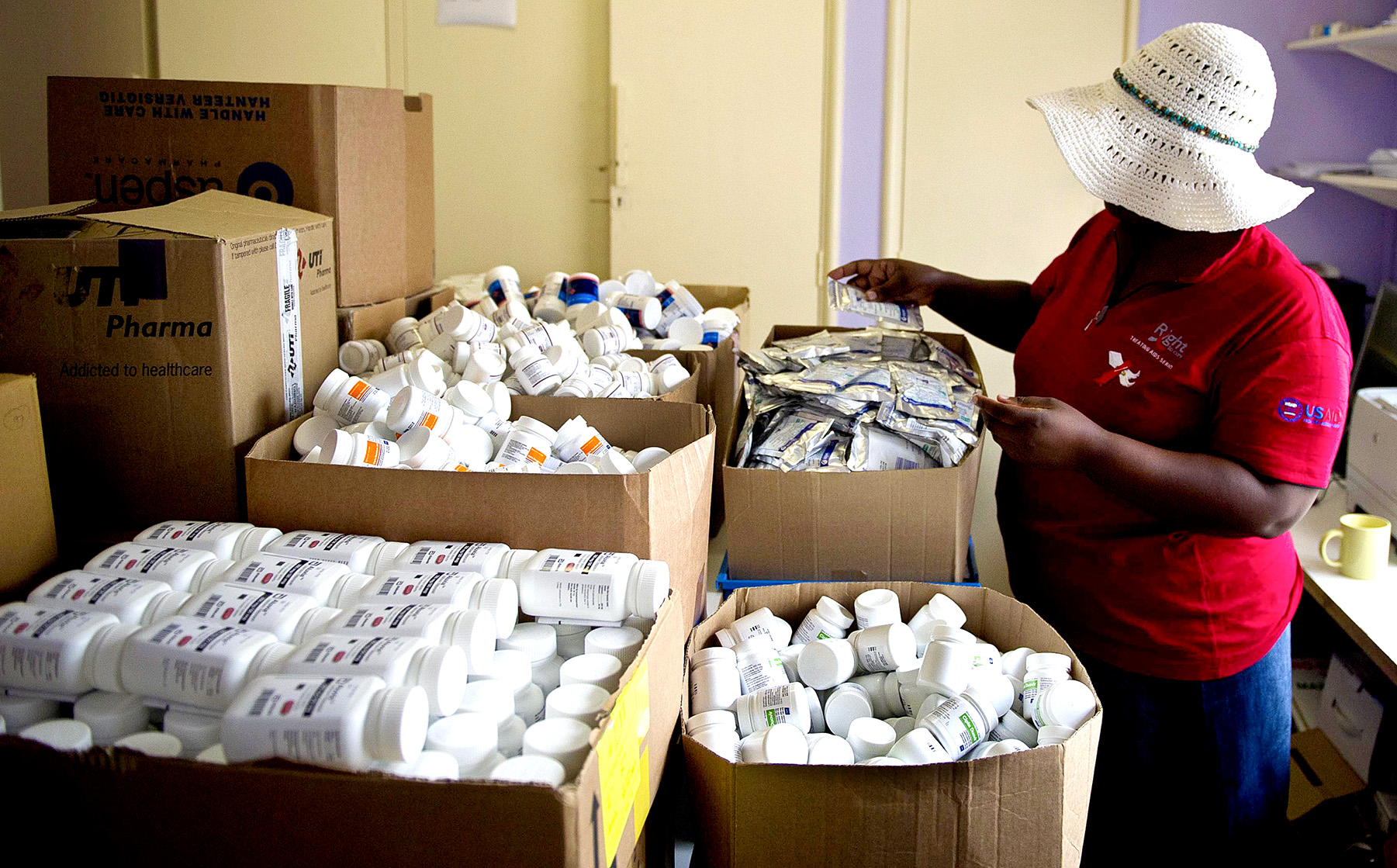
 Inside the Right To Care Aids clinic in Johannesburg on 27 January 2012. The Right to Care NGO had, with Pepfar funding, managed to revive its Alexandra Aids clinic, providing quality medical treatment to more than 8,000 patients. (Photo: Gallo Images / Foto24 / Cornel van Heerden)
 A report by the community-led monitoring group Ritshidze has raised the alarm about a “system-wide slide” in basic service delivery standards at clinics across the country in the wake of the cut in US President’s Emergency Plan for Aids Relief (Pepfar) funding cut made earlier this year.
Ritshidze falls under the Treatment Action Campaign (TAC), an HIV/Aids activist organisation, and has been monitoring the state of primary healthcare since 2018 through surveys and interviews with patients and providers. Its recent report, based on data collected between April and June 2025, shows a worrying trend of staff shortages, increased waiting times, failing filing systems and shorter antiretroviral (ARV) refills at public health facilities.
“The pattern is consistent across provinces and coincides with the withdrawal of partner support [through Pepfar],” said Anele Yawa, general secretary of the TAC.
Facility data was collected across 326 public health facilities in 16 districts in the Eastern Cape, Free State, Gauteng, KwaZulu-Natal, Limpopo and Mpumalanga.
According to engagement with facility managers, 85% of facilities reported not having enough staff to meet the needs of patients, with 21% blaming these gaps on Pepfar partners no longer working or working at reduced capacity at facilities.
Among the public health facilities monitored by Ritshidze, 48% reported reduced capacity after the Pepfar disruptions.
Adjusting to Pepfar cuts
In January, US President Donald Trump signed an executive order imposing a 90-day freeze on all foreign development assistance, pending a review. By late February, almost all Pepfar funding provided to international and South African HIV programmes through the US Agency for International Development (USAID) had been permanently axed.
/file/dailymaverick/wp-content/uploads/2025/10/12796793-scaled-1.jpg "A protester outside the US Agency for International Development in Washington, DC, on 3 February 2025. USAID staff had been instructed to stay away from the agency’s Washington headquarters following an announcement by Elon Musk that President Donald Trump had agreed with him that the agency should be shut down. (Photo: EPA-EFE / Will Oliver)")
/file/dailymaverick/wp-content/uploads/2025/10/0000154726.jpg "Patients at the Right To Care Aids clinic in Johannesburg on 27 January 2012. (Photo: Gallo Images / Foto24 / Cornel van Heerden)")
Pepfar provided South Africa with about $440-million in funding for the US financial year spanning October 2024 to September 2025. It constituted 17% of South Africa’s R44.4-billion campaign for HIV counselling and testing.
Pepfar funds are distributed to South African implementing partners by USAID and the Centers for Disease Control and Prevention. About half of the Pepfar-supported programmes in South Africa received funding through USAID.
The Ritshidze report found that 62% of public healthcare users surveyed reported too few staff at facilities, with 19% of people saying these shortages had become worse following the Pepfar disruptions.
Waiting times for health services had worsened across a number of districts monitored by Ritshidze, with the healthcare users surveyed linking these delays to reduced staff at facilities (68%) and problems with lost files or longer times for finding files (54%).
Among the healthcare users surveyed, 22% said that waiting times were longer than usual after the Pepfar cuts.
Yawa said patient filing systems had “collapsed” in places like the King Cetshwayo district in KwaZulu-Natal and the Buffalo City district in the Eastern Cape.
Ritshidze reported that in some districts, 80% or more of sites had filing systems in disarray.
“For years, Pepfar implementing partners have worked directly on clinic filing systems, knowing how much disorganised filing contributes to delays and poor data quality. They also funded large numbers of data capturers who kept records up to date and files in order,” Yawa said.
“Now, with those posts gone, data capture is falling to whoever is available – including nurses who are being taken away from clinical duties – or simply not happening at all. Files pile up, waiting to be captured or refiled, and there are too few hands to keep up. It’s no surprise that filing has deteriorated sharply in districts where partners withdrew.”
The longer waiting times are particularly worrying when it comes to HIV services, noted Yawa, since they can act as a barrier to care. He pointed out that people living with HIV, like many in South Africa, are under immense pressure just to survive, hustling to earn money, care for children and keep households running.
“Losing half a day at a clinic means losing income and having to neglect other responsibilities that families depend on. Long waits aren’t just frustrating – they drive people out of the system. Every extra hour in a line is another reason to miss a treatment collection, to skip a visit or to stop coming back,” he said.
HIV care
When it came to HIV care and the delivery of ARVs, Ritshidze said that progress had plateaued in some districts and reversed in many following the Pepfar disruptions.
Surveys among people living with HIV found that 9% fewer people reported getting a three-month supply of ARVs compared with January 2025, with decreases across all provinces except the Eastern Cape. Additionally, 8% more people reported only getting a one-month supply, with “worrying” increases in the Free State and KwaZulu-Natal, according to the report.
Other key trends noted since the Pepfar cuts were that:
- 35% of people living with HIV reported that it took longer to collect their ARVs;
- The use of external pick-up points for ARVs had dropped by 8%;
- Only 47% of people not on antiretroviral therapy (ART) said they were offered an HIV test while at the clinic, dropping below 30% in some districts;
- 12% of facilities reported fewer or no staff to perform HIV viral load testing; and
- 13% of sites reported fewer or no staff to provide pre-exposure prophylaxis (PreP) services.
Yawa said that despite a circular from the director-general of the National Department of Health, Dr Sandile Buthelezi, greenlighting six-month ART dispensation for eligible patients in February 2025, no facilities were officially implementing this strategy during Ritshidze’s reporting period.
Read more: Health Department green-lights longer supply of antiretroviral medicine amid US aid freeze
“A small number of people living with HIV said they had received a six-month supply, but this likely reflects either individual clinician discretion or confusion between a six-month prescription and a true six-month supply of medication. In reality, refill lengths became shorter – with more people getting one-month supplies and fewer receiving three-month ones,” he said.
“This must change urgently. Six-month dispensing only began at a handful of health facilities from August 2025, far behind national commitments and long overdue for full roll-out.”
Report recommendations
Among the recommendations made by Ritshidze were giving out longer medicine supplies and increasing access to external pick-up points for ARVs, to reduce congestion and delays at clinics.
Ritshidze noted that many community-based organisations (CBOs) were ready to run pick-up points in their communities, but were limited by the current funding model designed for large private pharmacy networks serving thousands, rather than small CBOs supporting 50 to 100 people. It encouraged the Department of Health and Treasury to create a “dedicated CBO-friendly model” that made it easier to register, contract and fund community-led pick-up points.
Earlier this year, Treasury allocated R753.5-million to address the impacts of international funding cuts for health, including R590-million for provincial departments of health and R32-million for the national department.
Read more: Putting a price on health — five key takeaways from Minister Motsoaledi’s budget vote address
“Evidence on human resources shortages must be used to inform plans for use of the additional funds provided by Treasury. Counsellors are critical and must be prioritised. In addition, Centres of Excellence for members of key populations need additional staffing so that they can function effectively and to support and instil culture change within the facility,” said Ritshidze.
Yawa said that there had been limited government acknowledgement of the “true scale” of the funding gaps left by international aid cuts, with the additional funds allocated by Treasury representing “a fraction of the nearly R3.3-billion reductions in Pepfar and Global Fund HIV funding previously contributed”.
Read more: Global Fund cut for HIV, TB programmes poised to hit SA’s health sector
“Critical areas Pepfar supported – like counselling, data capture, key population services and community-led monitoring – remain largely unfunded. These are not add-ons but essential components of how the HIV response stayed accountable and people stayed in care,” Yawa said.
“Until government and donors accept and address the breadth of what was lost… the response will remain weakened, and communities will keep paying the price.”
/file/dailymaverick/wp-content/uploads/2025/10/IMG-20241201-WA0013.jpg "Protesters in Mdantsane, Eastern Cape, gather to hand over a memorandum demanding that people living with HIV have access to six months’ worth of antiretroviral medicine in December 2024. (Photo: Treatment Action Campaign)")
/file/dailymaverick/wp-content/uploads/2025/10/GettyImages-2232791460.jpg "Demonstrators hold signs during a protest calling for the restoration of Pepfar, outside the Eisenhower Executive Office Building in Washington, DC, on 2 September 2025. (Photo: Kayla Bartkowski / Bloomberg via Getty Images)")
Ritshidze itself was affected by the Pepfar cuts, which reduced its reach from 26 to 16 high-priority HIV districts. Yawa said that it pushed ahead on a “shoestring” budget, with only a quarter of the community monitors previously tasked with conducting outreach.
“We hope all this effort to understand the impact at facility level will be taken seriously by district, provincial and national health departments – and that concrete action will follow. As TAC and Ritshidze, we have had to sacrifice a great deal to prioritise getting this data collection done,” Yawa added.
Lynne Wilkinson, a public health specialist in the HIV/Aids sector, said the Ritshidze report showed the vital role of community-led monitoring in South Africa’s HIV response.
“It complements Department of Health data by providing real-time warning signals from the ground – signals that must be acted on. With nearly two million people needing to start or restart ART, we can’t afford longer queues, fewer HIV tests, shorter refills or fewer collection options,” Wilkinson said.
She called for sustained funding to maintain the community-led monitoring system’s ability to give critical insights and ensure greater access to public sector HIV data.
/file/dailymaverick/wp-content/uploads/2025/10/12853613-scaled-1.jpg "Protesters participate in a 'die in' in the Cannon Building of the US Capitol in Washington, DC, USA, 26 February 2025. The group was protesting cuts to USAID's Pepfar program, a US government program designed to tackle the spread of HIV/AIDs. (Photo: EPA-EFE / Will Oliver)")
Looking to the government
Daily Maverick asked the Department of Health about the outcomes of the Ritshidze report but had not received a response by the time of publishing.
Minister in the Presidency Khumbudzo Ntshavheni announced at a post-Cabinet media briefing on 16 October that the US government had approved a “Pepfar Bridge Plan” (PBP) of $115-million for South Africa between 1 October 2025 and 31 March 2026.
“The PBP is meant to ensure uninterrupted HIV service delivery in South Africa by supporting HIV/Aids service continuity and prioritising country-specific needs and life-saving impact… Cabinet expressed its appreciation to the government of the United States of America on its commitment to supporting and sustaining progress in the fight against HIV/Aids,” Ntshavheni said. DM