



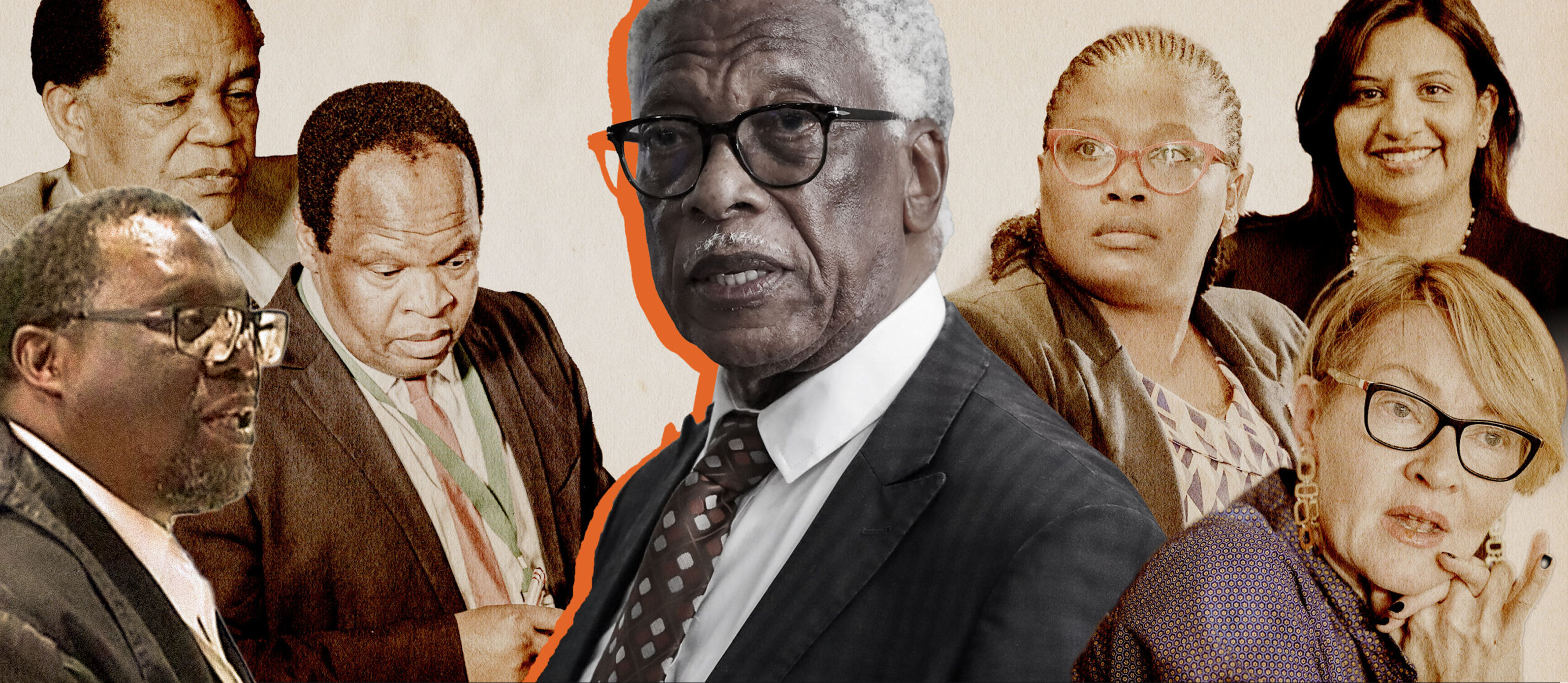
 Illustrative image: Judge Bernard Ngoepe. (Photo: Gallo Images / Sunday World / Mabuti Kali) | Griffiths Madonsela SC. (Photo: X) | Advocate Muzi Sikhakhane. (Photo: Gallo Images / Sharon Seretlo) | Eastern Cape Judge President Selby Mbenenge. (Photo: Gallo Images / Luba Lesolle) | Andiswa Mengo. (Photo: Gallo Images / Luba Lesolle) | Lisa Vetten. (Photo: Chris Collingridge) | Advocate Nasreen Rajab-Budlender. (Photo: LinkedIn)
 Retired Judge Bernard Ngoepe, Judicial Conduct Tribunal chair of the hearing into alleged sexual harassment by Eastern Cape Judge President Selby Mbenenge, has suggested “god or nature” provided women “absolute power” to decide who “has the keys to her heart”.
The startling thought bubble from the chair came after hours of closing argument by advocate Nasreen Rajab-Budlender, for the complainant, former court secretary Andiswa Mengo, as the marathon tribunal resumed on Tuesday, 21 October 2025.
Mbenenge has denied the charges and has maintained his contact with Mengo had been consensual as well as “cultural” in nature.
Read more: Judge’s sexual harassment hearing pits the old guard against a brave new world
‘Find him guilty’
Rajab-Budlender argued on Tuesday that Mbenenge should be found guilty of sexual harassment and gross misconduct. Earlier, a Judicial Conduct Committee had found that there was prima facie evidence of this.
“In Mbenenge’s case, there were no circumstances in which it was appropriate for him to engage in the manner in which he did.
“If the JP (Judge President) had genuinely wanted to engage in an open relationship with Ms Mengo that everyone was aware of, there is nothing wrong with it. However, this is not what occurred,” she told the tribunal.
The introduction by Mbenenge’s legal team, advocates Muzi Sihkakane and Griffiths Madonsela, of the Xhosa “cultural” nature of Mbenenge’s approach was an afterthought and had never been proffered earlier, argued Rajab-Budlender.
From “day one”, Mbenenge had bombarded Mengo with sexually suggestive WhatsApps and requests for naked photographs.
Read more: Tribunal hears Judge President Selby Mbenenge could not take ‘no’ for an answer
“Mbenenge wanted to engage with her around sexual content without this formal relationship.”
Applying a qualitative assessment of Mbenenge’s evidence, Rajab-Budlender said, “He is guilty of sexual harassment and that this conduct renders him unfit for a judicial role.”
Wider implications
Rajab-Budlender had earlier set out, in no uncertain terms, the legal frameworks and codes of conduct governing harassment in the workplace as well as the judicial code of conduct.
That Mengo had said “no” to her superior, Mbenenge, more than 13 times, while he bombarded her with sexually suggestive WhatsApp messages, was evidence of this.
“We know that sexual harassment is prevalent in society, and a Judges Matter report on sexual harassment in the legal profession indicated it was more prevalent than the global average”, she said.
The study showed that 43% of women in the legal profession in South Africa had experienced sexual abuse, and 25% had said they considered leaving as a result, she added.
“This complaint is important because it is not about only Ms Mengo and JP Mbenenge. How this tribunal assesses this will likely determine whether women with legitimate claims come forward in future,” said Rajab-Budlender.
No whiffs of impropriety allowed
While Mbenenge had argued that the Judicial Code of Conduct did not apply to him as Mengo was not an employee, this was not the case. One could not look at the matter without considering the appropriate standards of judicial conduct, Rajab-Budlender said.
“The aim of the code is to assist every judge and inform the public about the ethos of the judiciary, dealing with ethical and professional issues. It is important to look at this code in this matter.”
A judge, she said, was expected to “behave in his/her professional and private life in a manner that enhances trust in the judicial system and avoids any whiff of impropriety”.
Mbenenge’s conduct had taken place in the workplace, and it was irrelevant whether he was Mengo’s employer or not.
“He does not have to be her employer for the Employment Equity Act to apply. It applies to employees, but also in situations in which third parties are present.”
The Office of the Chief Justice, Mandisa Maya, had introduced a sexual harassment policy with a “zero tolerance” approach and created a dedicated Gender Desk to manage complaints and offer support.
Read more: New judiciary sexual harassment policy must be a living document if it is to have impact
Rajab-Budlender said that even the SA judiciary acknowledged that each of its members was in a considerably powerful position in relation to employees, lawyers and advocates, and that “every member should remain vigilant of how their conduct might be perceived by those who do not share this power”.
Zelensky vs Trump
As the afternoon wore on, Ngoepe seemed taken with his notion that women held all the power in relation to men.
Earlier in the day, the chairperson revealed his suspicion of gender expert, Dr Lisa Vetten’s testimony, offering his opinion that “it was from A to Z as if from the beginning to end in terms of power relations, the JP was dominant”.
And then came the shocking thought bubble.
“You know a woman has got given, by God or nature, depending on what you believe, the absolute power to decide who has access into her heart.
“There is not a duplicate key there, not even a duplicate key to a Mercedes. That is an indication of power and I become curious, if not uncomfortable, when a witness [Vetten] comes to say there was no display of that power by a woman.”
He rambled on.
“When a beautiful woman wants to give her heart and she says, ‘You want me? Catch the stars for me,’ that is an assertion of power. When a man wants to marry a woman, where does power lie? A man goes down on his knees and kneels in front of a woman. You humble yourself. Is that not power?”
Ngoepe went on, “I am trying to say to you we must be careful how we engage these complex issues of power relations. Zelensky [Volodymyr – Ukrainian President], if he wants to talk to Trump [US President Donald]... Trump can’t go to Zelensky. He is not in a position of power.”
Suggesting women are Trump and men Zelensky, we suppose.
Read more: Tribunal hears Judge President Selby Mbenenge could not take ‘no’ for an answer
Earlier, Rajab-Budlender told Ngoepe that Sikhakhane and Madonsela had implied in their arguments that “only the perfect victim can be sexually harrassed”.
“They assert she must be sufficiently meek and mild, she must also be strong enough to reject advances outright from someone in power. That victim does not exist,” Rajab-Budlender responded to Ngoepe.
Ngoepe later argued that it was “astounding” to suggest that a woman could not assert her power.
About power and sex, not romance
Rajab-Budlender responded: “We do not suggest that there are no circumstances, but what we are talking about there, is a workplace. The most senior and the most junior employee. When we talk about the balance of power, it is in that context,” she schooled Ngoepe for the umpteenth time.
Vetten, in her witness testimony, had set out how Mengo had attempted to exercise some agency “limited by the complexities”.
“She resisted repeated transgressions of her boundaries. She may have rescinded in other ways that are ambiguous, but no one way works in all circumstances for women,” said Rajab-Budlender.
“To suggest that women always had power over their bodies or an invasion of your most intimate private space is so simple – as you suggest – that should this be the case, we would not be a country with the highest rate of GBV in the world.
“Women do not have that power. This is not about romance, but about power and sex.”
The tribunal continues. DM