




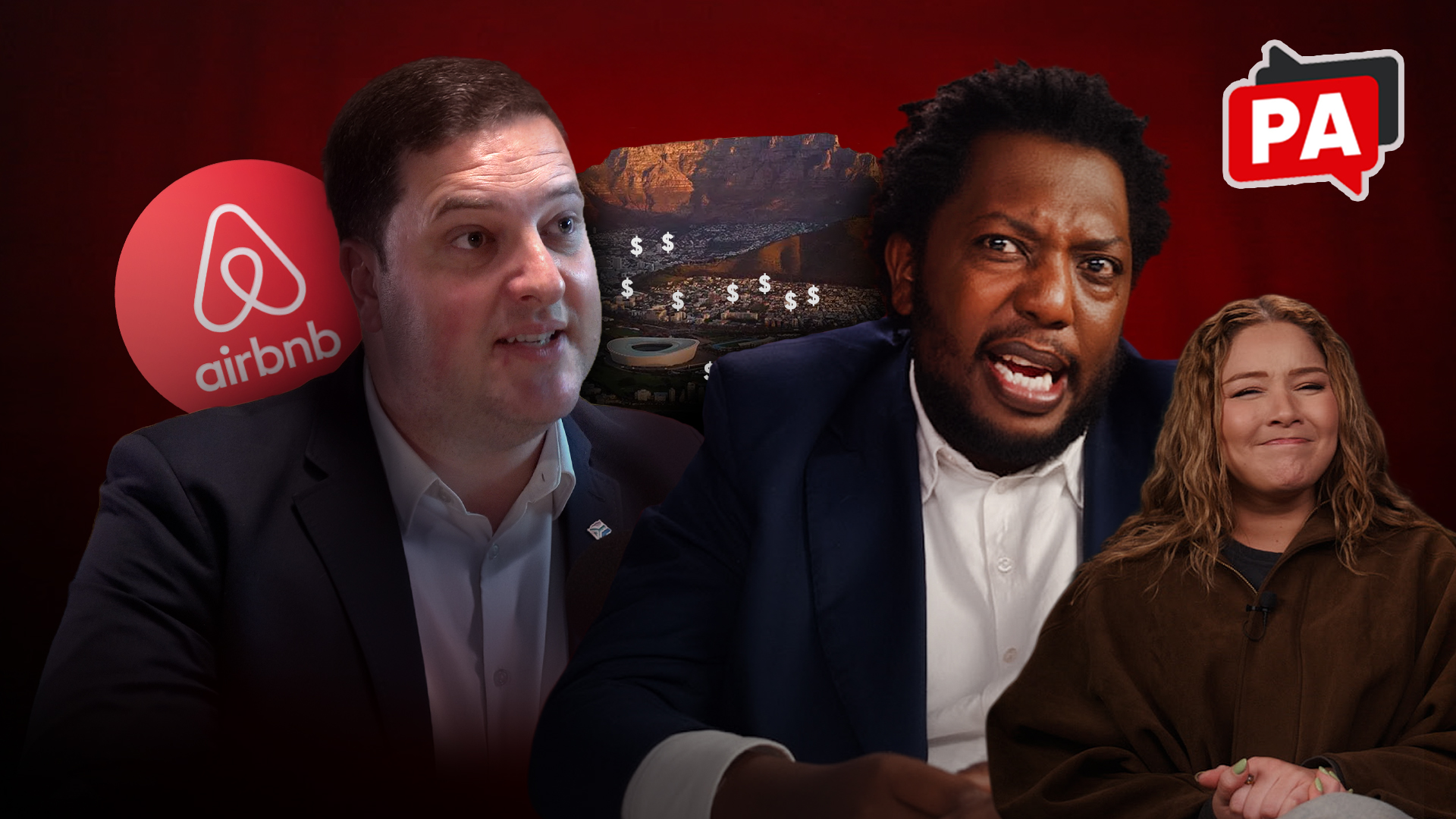
 Illustrative image: KG Mogadi. (Source: Politically Aweh Episode 6) | Zoë Human. (Source: Politically Aweh Episode 6) | Geordin Hill-Lewis. (Source: Politically Aweh Episode 6) | Cape Town Skyline. (Source: go2africa.com) | Airbnb logo. (Source: airbnb.com)
 ‘I’m starting to get the impression that tourists are being prioritised over locals. So if you’re poor, sorry,” KG says sarcastically.
Behind the beautiful views and artisanal coffee lies a city still haunted by apartheid spatial planning that’s now rebranded as “Airbnb opportunity.”
According to Airbnb they have 33,000 rentals in the city. Meanwhile, Cape Town’s rental prices have soared by 68.5%, and it’s not just “the market”. From digital nomads on tourist visas, to landlords chasing euros and dollars, everyone’s cashing in except the people who actually live here.
The episode features voices from housing activists like Ndifuna Ukwazi, a grassroots housing lobby called Rent Control, Spatial Planning researcher and historian Edgar Pieterse, and fed-up Capetonians who have taken to TikTok to vent their frustrations.
We even hear from Cape Town mayor Geordin Hill-Lewis (who is appearing in a standalone podcast this week on Politically Aweh), who insists that the city isn’t facing “overtourism”.
“We’re nowhere near overtourism,” says Hill-Lewis. “Barcelona gets more tourists in a month than Cape Town gets all year.” But when there are more Airbnbs than affordable flats, and locals are travelling 50km just to get to work, we have to ask: who is this city really for?
Which is why the resistance is growing.
Housing activists are taking over empty buildings, renaming them after struggle icons, and forcing the city to face its own hypocrisy. The fight even reached the courts, when groups like Reclaim the City and Ndifuna Ukwazi challenged the R135-million sale of the Tafelberg site in Sea Point, arguing that prime public land should be used for social housing, not luxury flats.
“You’d think after 30 years [of democracy], someone would’ve figured out how to build homes without a court case,” KG says.
The latest thorny question the episode leaves viewers with: can Cape Town really be a paradise for tourists and a home for its people? Or are we watching the Mother City become a millionaire’s playground with a sea view?
The episode is funny, it’s factual and it exposes the real cost of Cape Town’s soft life. DM
For more from Politically Aweh, subscribe on YouTube, visit our website or follow us on Instagram, Facebook, TikTok or X.