




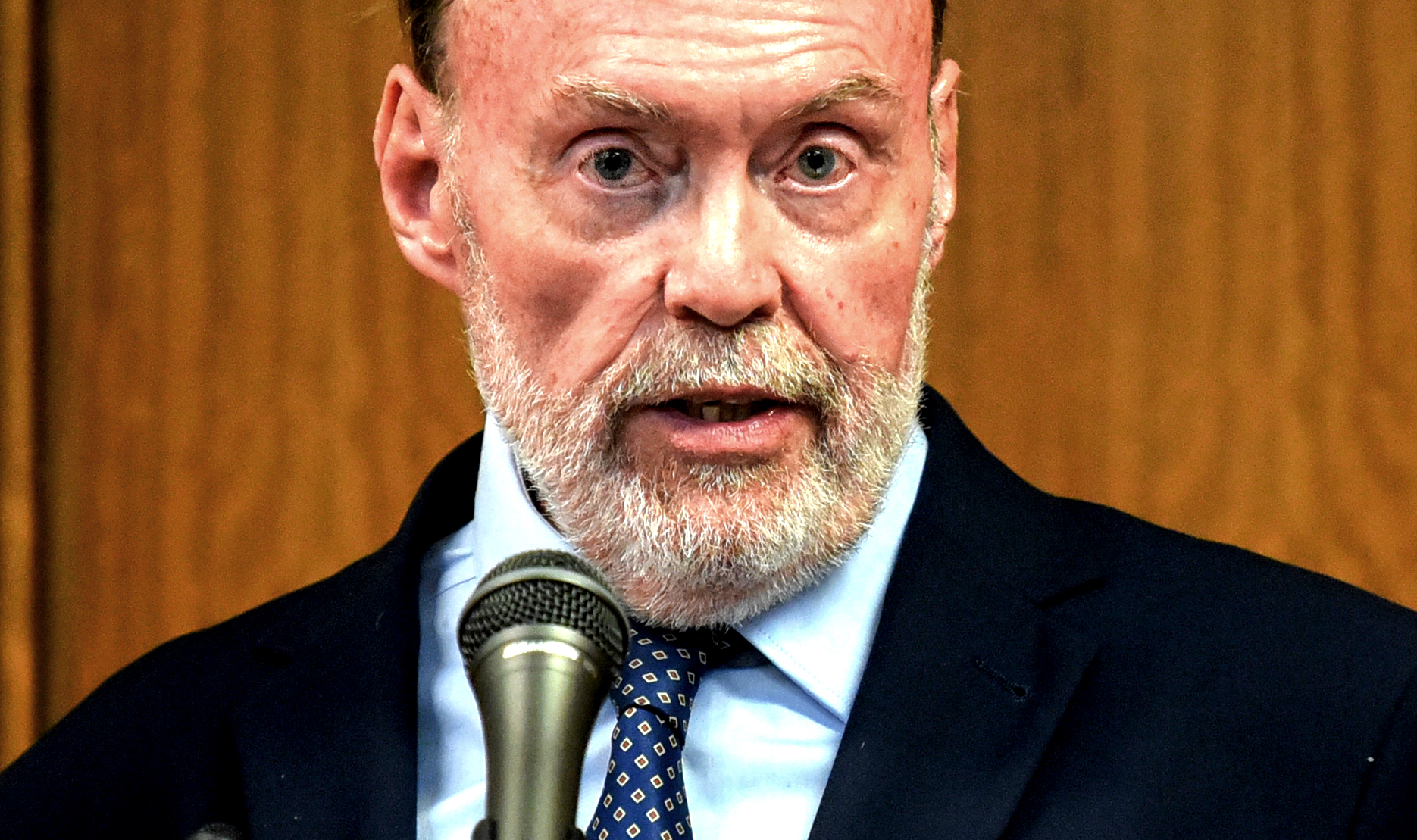
 Craig Williamson testifies at the Cradock Four inquest at the Eastern Cape High Court in Gqeberha on 21 October. (Photo: Deon Ferreira)
 As he vehemently denied any involvement in the plot to kill the political activists known as the Cradock Four, former Security Branch operative Craig Williamson said it was “ludicrous” to think he would have sent the man who implicated him to carry out such a sensitive operation.
Williamson said he was “irritated” by the “absurd allegations” made against him during the amnesty application of the late Security Branch strategic communications officer Lieutenant Jaap van Jaarsveld, one of the masterminds behind the deaths of the anti-apartheid activists Fort Calata, Sicelo Mhlauli, Sparrow Mkonto and Matthew Goniwe.
Williamson was testifying at the third inquest into the murders of the Cradock Four, which is being held in the Eastern Cape Division of the High Court in Gqeberha.
The Cradock Four were murdered on 27 June 1985 when they were returning to Cradock from Gqeberha (then known as Port Elizabeth). They were arrested at a roadblock manned by members of the Security Branch, assaulted and killed.
/file/dailymaverick/wp-content/uploads/2021/07/Cradock-four.jpg "The Cradock Four. (Photo: Supplied)")
The 75-year-old Williamson cut a cold figure in the witness box on Tuesday. The matter-of-fact manner with which he recounted violent operations to disrupt and suppress anti-apartheid activities came across as robotic and almost devoid of emotion.
Read more: Book Extract: Spy – Uncovering Craig Williamson
Williamson was asked to unpack his rise through the ranks of the apartheid government’s intelligence structures and shed light on some of the political killings he had a hand in, as well as the methods used by the regime to target, infiltrate and eliminate threats to the pre-democracy government.
After joining the police in 1968, he was approached by the Security Branch three years later and enrolled at the University of Witwatersrand as an undercover officer to infiltrate student organisations with ties to the ANC and SA Communist Party (SACP).
During his time at the student organisations, he assisted political activists to flee South Africa to gain favour with the ANC and SACP and better position himself to gather useful intelligence for the Security Branch.
Nusas vice-president
He became the vice-president of the National Union of South African Students (Nusas) and moved to Europe as a representative of the International University Exchange Fund before his cover was blown and he was stationed at the head office of the Security Branch Intelligence Section in the early 1980s.
This was followed by short stints in the SA Defence Force, Parliament and PW Botha’s President’s Council, before he retired from politics and entered the private business world.
Read more: Cradock Four inquest postponed over legal fees delays, families fear truth will die with witnesses
Williamson was directly involved in three violent operations conducted by the Security Branch, for which he was granted amnesty at the Truth and Reconciliation Commission (TRC):
- The 1982 bombing of the ANC’s headquarters in London, which claimed no lives, but caused large-scale property damage.
- The assassination of political activist Ruth First, who was killed by a bomb hidden inside a parcel while she was in exile in Mozambique in 1982.
- The letter-bomb murder of anti-apartheid activist Jeanette Schoon and her six-year-old daughter, Katryn, in Angola in 1984.
/file/dailymaverick/wp-content/uploads/2022/08/MC-Tuesday-16Aug_4.jpg "Ruth First. (Photo: Gallo Images / Sunday Times)")
During his amnesty hearings, Van Jaarsveld said Williamson had sent him to spy on Goniwe in Cradock and devise a plan to assassinate the activist in his home.
Williamson said he received a letter from the TRC stating that Van Jaarsveld’s testimony could implicate him in the murder of the Cradock Four, and State advocate Jannie Coltman questioned his decision not to challenge Van Jaarsveld’s version of events during his initial testimony.
“Perhaps you are not as used to being accused of murdering people you had nothing to do with as I am,” Williamson countered.
He said the allegations had surprised him as he bore no knowledge of the murder plot, but when asked if Van Jaarsveld’s testimony had shocked him, he replied: “Nothing shocks me.”
He added that, in hindsight, it would probably have been better to have legal representatives present during Van Jaarsveld’s testimony, but at the time, he believed he would have an opportunity at a later stage to state his case and deny any involvement in the matter.
Williamson said back then his priority was operations outside South African borders, and while he was aware of Goniwe as an “enemy of the state”, it was not in his “purview to do anything about it”.
During cross-examination, advocate Howard Varney, representing the families of the Cradock Four, referred to comments made by Williamson during the TRC hearings in which he said it was “ludicrous” to think he would have been involved in the murder plot.
Condescending tone
Williamson adopted a condescending tone as he explained his statement to the court.
“Jaap van Jaarveld was a young lieutenant when he joined my unit. He was a theologian, working in strategic communication, and the idea that I would have used somebody with his [limited] knowledge and experience, and lack of operational ability to do such a job is inconceivable.
“It would not have happened, and it did not happen,” he said.
He said that given the fact that everybody knew he was involved in the bombing of the ANC’s London office, he had people at his disposal who were “far more competent to carry out this type of instruction”.
He said he found it strange that during Van Jaarsveld’s evidence at the TRC hearings, he did not seem to know who the late Sakkie van Zyl was. (Van Zyl was named as one of the key figures behind the plot to kill the Cradock Four.)
“For anybody to think I would have sent young Jaap van Jaarsveld to give Sakkie van Zyl, a hardened, ex-Koevoet operator, advice or instruction on how someone should be taken out is ludicrous,” said Williamson.
The day’s proceedings wrapped up when Williamson completed his testimony.
The court is expected to hear from other persons of interest this week, including the former head of the Port Elizabeth Security Branch, Lieutenant General Gerrit Erasmus; the former head of the police’s Counterintelligence Department, Major General Izak “Krappies” Engelbrecht; and a former SA Defence Force lieutenant general, Christoffel “Joffel” van der Westhuizen. DM