



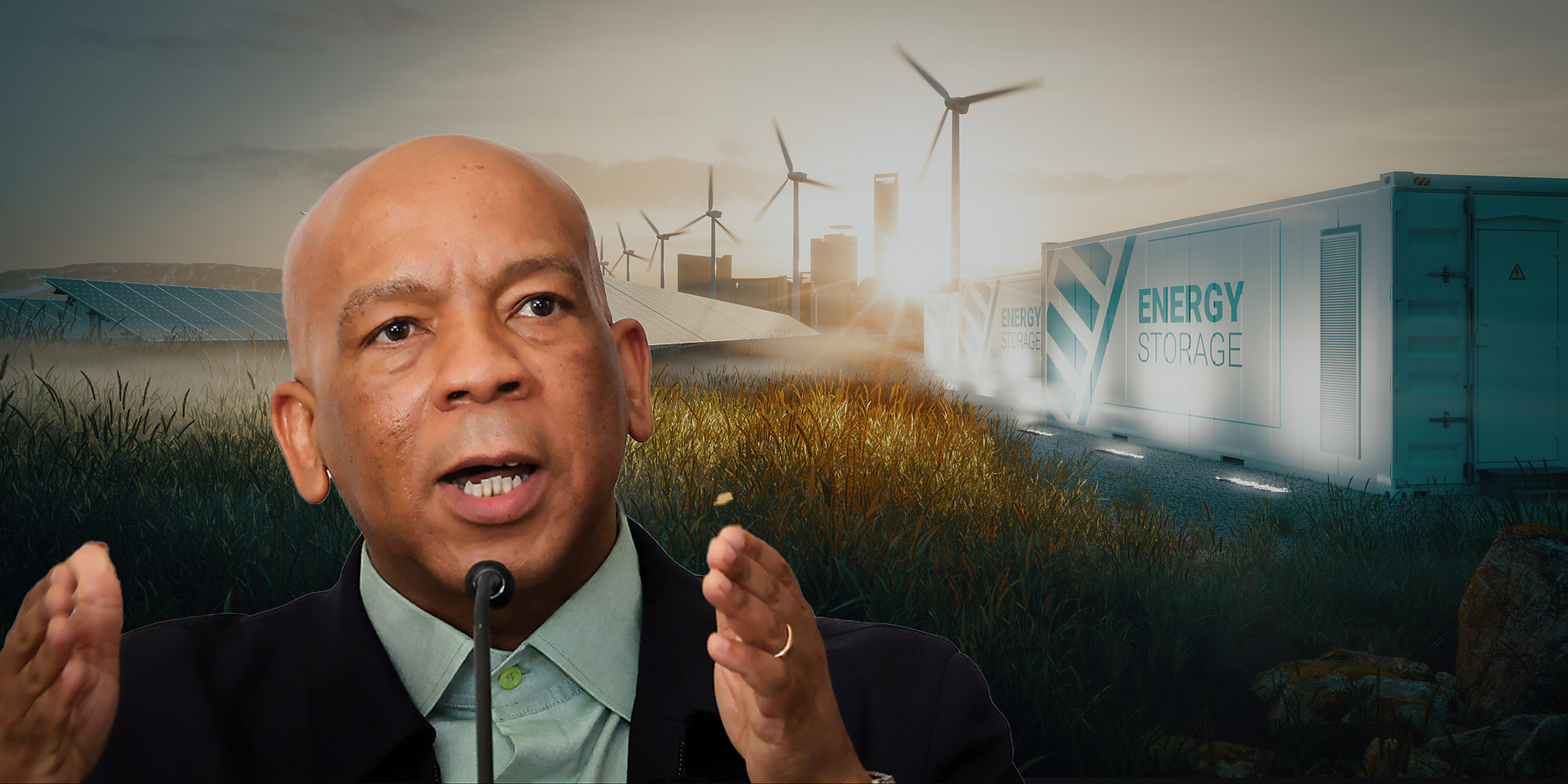
 Illustrative image: A smart grid renewable energy system for future smart cities. (Photo: iStock) | Minister of Electricity and Energy Dr Kgosientsho Ramokgopa. (Photo:
Ntswe Mokoena / GCIS)
Illustrative image: A smart grid renewable energy system for future smart cities. (Photo: iStock) | Minister of Electricity and Energy Dr Kgosientsho Ramokgopa. (Photo:
Ntswe Mokoena / GCIS) 
Sometimes making decisions about where you will be financially in, say five years’ time, are incredibly difficult.
The decisions have become a lot harder as we have moved from a sort of career-in-one-company model, or even just one career, into the strange and sometimes very scary gig economy.
The impossibility of long-term planning for you and I probably really comes to the fore when you buy a house. It’s usually your biggest purchase (unless you have a Lamborghini collection and are thus no longer welcome to subscribe to this column.)
A recent returnee from exile in Cape Town told me over the weekend how they’d made money on their house there.
But he also said that he’d lost money on every single other property he’d ever owned.
Electricity production and the longer-term plan
Kgosientsho Ramokgopa reminds me a little of a prospective house-buyer.
As Electricity and Energy Minister he has to manage the longer-term plan.
And as a veteran of load shedding, you know how long-term electricity planning is, and more importantly, what happens if you (insert your own word here…) it up.
For the moment, we don’t yet have the full plan, what is formally known as the Integrated Resource Plan. But it is supposed to provide a framework for where we will get our electricity for the next 15 years.
I don’t know if there are any predictions I can make about South Africa in 2040.
We might be at the tail-end of a long-term AI boom, we could be living virtually, we might have decided that screens are inherently bad and are living a fuller and richer physical life.
It’s so far away I’d give the All Blacks about even chances of winning the World Cup perhaps once in that time.
And this is why the plan will be so contested.
Nuclear visions
For every person who believes that we will need more nuclear power, I can probably find you another who believes we don’t.
The one thing about nuclear is that it is generally about up-front costs. So once you’ve paid for the construction (and that’s hundreds of billions of rands), and got it fuelled, you are pretty-much guaranteed reliable supply.
I think there must be space for some nuclear, especially when you need large amounts of regular power to run things like smelters.
One of the reasons we are de-industrialising so quickly is because our power prices are just too high to keep our smelters running.
I’m not so sure about the idea of using new technology though. I remember all the excitement about the Pebble Bed Modular Reactor so many years ago, and then it all just disappeared.
Read more: Eskom’s chief nuclear officer on renewed interest in the Pebble Bed Modular Reactor
Along with probably all the people who were working on it.
There are also suggestions that fairly soon there will be modular nuclear reactors that you might one day buy, virtually off the shelf.
Read more: Ramokgopa makes the case for small modular reactors
I have no idea which is more likely to work out, the modular route or the pebble bed version.
I also can’t tell you what on Earth is happening at the Nuclear Energy Corporation of South Africa) Necsa. It suddenly has a new board, although the Chair, Dave Nicholls, stays on.
I can tell that almost no matter what happens, in 2040 the sun will still be shining, and Cape Town will still be a very windy place in which to hold a marathon.
Renewables
The other almost-certainty is that both the storage capacity for renewables (the batteries) and the technology to generate solar and wind power will be much cheaper then than they are now.
And this must be one of the most important factors.
Even Texas, which is firmly Trump territory, gets more of its power from renewable sources than all the other US states, for the simple reason that people will put economics above politics.
Perhaps the biggest variable then, is whether battery technology will ever get big enough and cheap enough to use for baseload. That would unlock the potential of a renewable-only economy (especially in a country that crosses weather zones, as ours does).
I would add one other important consideration.
Considering that most of us have no idea of what will happen politically WCG (When Cyril Goes…a collection of letters I suspect we will see a lot of in the near future), I think any long-term electricity plan does need to both make technical sense, and have broad buy-in.
The second-last thing you want is for another party or group of parties to come into government and change the entire plan.
And the absolute last thing you want is for some aspect of our energy mix to become a political issue. Given the zero-sum politics so many of our parties play, and the deliberate creation of binaries, that scenario would see a proper plan becoming impossible to create.
Let’s make sure this is a long-term plan that works out. Both through timing and a little bit of luck. DM