




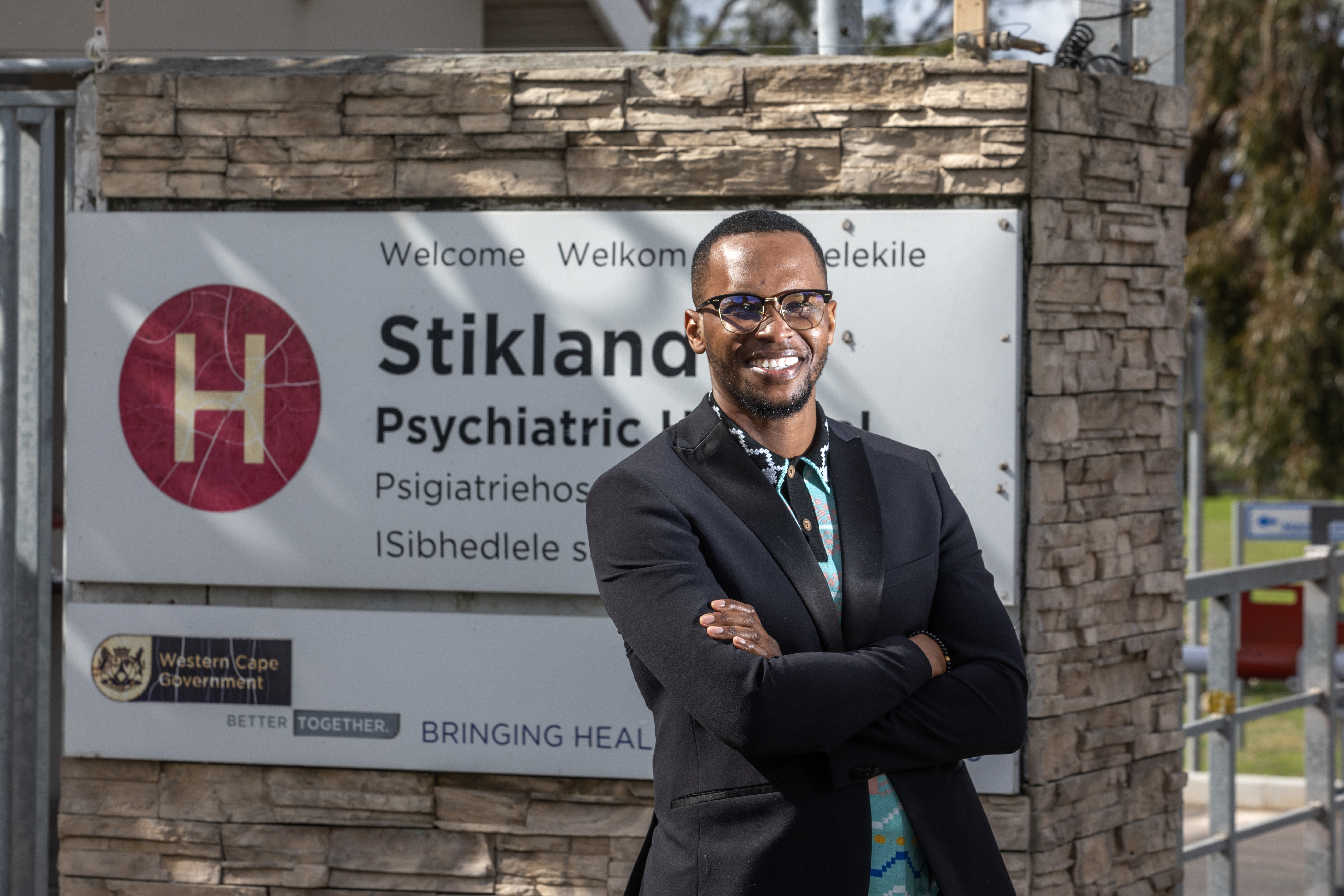
 Dr Thabo Mogotlane. Photo: Shelley Christians
 Each October, the world observes World Mental Health Day (10 October) and Mental Health Month – a time to raise awareness about the importance of accessible, quality mental health care. One in six South Africans suffers from anxiety, depression, or substance-use disorders. Dr Thabo Mogotlane is determined to break the cycle between addiction and mental illness. This Discovery Foundation 2023/2024 Subspecialist Award recipient is training to become one of the country’s first black addiction psychiatrists, and aims to understand how the causes behind mental illness can be treated.
Raised in rural Winterveld, Mabopane, Dr Mogotlane’s journey into psychiatry was anything but conventional. Born into a family of limited means, he was raised by his mother and grandmother, who instilled in him an unrelenting belief in the power of education. “My mother always wanted me to be a teacher. She would sit me down every day after school to teach me, sometimes with stern discipline, moulding me into becoming a teacher,” he recalls.
While his mother’s dream was for him to teach, circumstances charted another path. When financial pressures mounted, he became the family’s breadwinner and initially set his sights on nursing, attracted by the training stipend. “Even the money for registration, I had to borrow,” he says. After upgrading his grades, he was accepted into Sefako Makgatho Health Sciences University, supported by a bursary from the Limpopo Department of Health.
During his internship at Polokwane Provincial Hospital, he was transferred to Thabamoopo Psychiatric Hospital in Lebowakgomo, which ignited his life’s calling. Under the mentorship of Dr Julia Molepo-Mokoena, he discovered psychiatry’s deep human complexity.
This was when he began to appreciate the intricate intersection of brain, behaviour and healing – opening a private practice in Mabopane before deciding to specialise in addiction psychiatry, a field still emerging in South Africa.
A new era for addiction psychiatry in South Africa
Now a fellow at Stikland Hospital in Parow, Cape Town – South Africa’s only institution offering a certificate in addiction training – Dr Mogotlane is simultaneously pursuing a Certificate in Addiction Psychiatry from the Colleges of Medicine of South Africa and a Master of Philosophy in Addictions from Stellenbosch University. His studies are funded by the Discovery Foundation Subspecialist Award (2023/2024), a grant supporting specialists in fields critical to strengthening the nation’s healthcare system.
“The grant came at the right time. I had to leave my practice and move to Cape Town for two years, which was a major sacrifice. Thankfully, Discovery Foundation covers my tuition, and living expenses, making it possible for me to focus on my studies without the burden of financial worries,” he explains.
Guided by supervisor Dr Lize Weich, a senior psychiatrist at Stellenbosch University, the training combines research, clinical exposure, and a compassionate understanding of addiction’s ripple effects. His current research explores how COVID-19 lockdown restrictions affected patients struggling with alcohol dependence – a topic with significant social implications.
“Addiction is not an individual problem. If you’ve been exposed to a loved one with an addiction, you know it affects mothers, fathers, siblings, and the entire community,” he says. “As psychiatrists, we are trained to deal with mental illnesses without addressing the root cause, which is often addiction.”
South Africa faces a mounting mental-health and substance-abuse crisis. According to the South African Depression and Anxiety Group (SADAG), nearly 50% of teenagers consume alcohol, while the average age for drug dependency is just 12. Globally, the World Health Organization (WHO) reports that one in eight people live with a mental disorder and calls for urgent reform. The organisation’s Global Status Report on Alcohol and Health and Treatment of Substance Use Disorders further reveals that harmful alcohol use contributes to more than three million deaths annually. In SA, mental illness remains one of the top five leading causes of disability, yet only around 5% of public-health expenditure is allocated to mental-health services, according to the National Mental Health Policy Framework and Strategic Plan 2023–2030.
Dr Mogotlane’s approach integrates psychiatry with social services to ensure holistic recovery. “Every patient is like a book – you have no idea what’s inside until you open it. Every brain is different and has a unique story to tell,” he reflects.
In a country where one in three people will face a mental health challenge in their lifetime, Dr Mogotlane’s every achievement is a testament to resilience rooted in humble beginnings. “I’m grateful to all the mentors who gave me the space to grow, including my current supervisor Dr Weich, who’s made my study into addictions amazing. Above all, my gratitude goes to my grandmother, Ramadikela Mkoba, who, despite having nothing, made it all possible. I owe my life and my career to her.”
As the world marks World Mental Health Month, Dr Mogotlane’s journey serves as a reminder that healing begins with understanding – and that South Africa’s next chapter in mental healthcare depends on voices like his. DM