




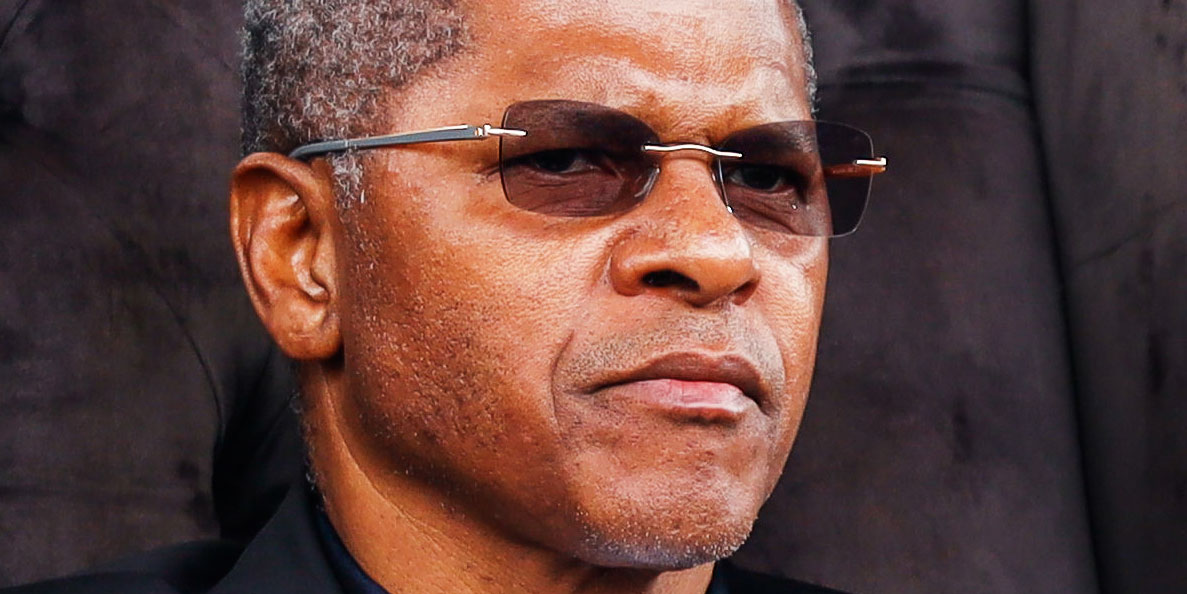
 IFP President Velenkosi Hlabisa at the party's 50th anniversary celebration at Jabulani Amphitheatre, Soweto, on 18 October. (Photo: Sharon Seretlo / Gallo Images)
 The Inkatha Freedom Party (IFP) celebrated its 50th anniversary in Soweto this weekend and, underlying the songs, speeches and green, red, black and white regalia bearing the face of its late founder, Prince Mangosuthu Buthelezi, one thing was clear: the party has set its sights on Gauteng ahead of the 2026 elections.
Thousands of IFP supporters packed the Jabulani Amphitheatre for the party’s Golden Jubilee celebration — a symbolic choice of venue for a party long associated with KwaZulu-Natal, but now seeking to entrench itself in South Africa’s political heartland.
/file/dailymaverick/wp-content/uploads/2025/10/ED_582806.jpg "An IFP supporter in traditional garb at the party's 50th anniversary celebration. (Photo: Sharon Seretlo /Gallo Images)")
/file/dailymaverick/wp-content/uploads/2025/10/ED_582796.jpg "Thousands thronged the Jabulani Amphitheatre for the celebration. (Photo: Sharon Seretlo / Gallo Images)")
The IFP, once dismissed as a regional player, has quietly been building a foothold in Gauteng’s municipalities. It holds seven seats in the Johannesburg council, three in Ekurhuleni and one in Tshwane. While the numbers may be modest, they are large enough to give it a voice in the coalition politics reshaping the province.
Although the party has a presence in Johannesburg, voter turnout there is low. In the 2021 local elections, only 43% of registered voters cast ballots, highlighting both the challenge and the potential opportunity for the IFP, which will need to win a share of the stayaway voters to expand its influence in the city.
The party’s support base, at least according to those who attended the celebration, includes migrant workers from KwaZulu-Natal who have settled in townships like Soweto, Tembisa and Katlehong.
But contestation will be tough in Gauteng, where the party faces competition from traditional parties like the ANC and the DA, and newer players such as the EFF, Patriotic Alliance, ActionSA, Rise Mzansi and Build One South Africa, all of which have made inroads into township and city constituencies.
“Gauteng is one province that is close to our hearts,” said party president Velenkosini Hlabisa after the celebration.
“They have been faithful for many years. We are going to build open communication and relationships to ensure that we level the playing field.”
The Gauteng City-Region Observatory noted the IFP’s “marginal increase” in the province in the 2021 elections.
Hlabisa used the celebration for a soft launch of the party’s election campaign in the province, urging residents to “choose real change, honest leadership and a government that truly listens and responds.
“These elections are not just about votes; they are about shaping a better Gauteng. This battle will not be won with slogans or empty promises. It will be won by a leadership committed to action,” said Hlabisa.
/file/dailymaverick/wp-content/uploads/2025/10/ED_582798.jpg "The party used the celebration as a soft launch for its 2026 election campaign in Gauteng. (Photo: Sharon Seretlo / Gallo Images)")
/file/dailymaverick/wp-content/uploads/2025/10/ED_582801.jpg "Birthday cakes at the celebration. (Photo: Sharon Seretlo / Gallo Images )")
New supporters
Once seen as a rural KwaZulu-Natal party rooted in Zulu tradition and led by Buthelezi, the IFP now has a more urban and youthful support base.
Read more: ‘Silent conflict’: Factions jockeying for IFP leadership roles
New supporters include young professionals, students, small business owners and unemployed young people who feel left behind and let down by the ANC and the DA.
These supporters are less interested in liberation history and more focused on honesty, jobs, safety and working municipalities.
While the IFP’s traditional voters still value cultural pride and community leadership, this newer group sees the party as disciplined, reliable and less tainted by corruption.
Small business owner and Soweto resident Mpatho Mncwago (30) said the IFP was trying to bridge the rural-urban divide while focusing on issues of the day.
“The situation in this country is dire, especially for young unemployed people. I do feel like the popular parties have not worked for us, yet the IFP works respectfully and truthfully in Parliament. It’s the only party that seems serious about youth employment and rural development,” said Mncwago.
Nomhlangano Kheswa, of White City, Soweto, said: “In the IFP, there is no corruption, no crime. There is integrity.”
For 71-year-old Bhekumuzi Sithole from George Goch, Soweto, voting for IFP is a lifelong commitment. “I joined the IFP when I was 15,” he said, adjusting his white shirt with Buthelezi’s image emblazoned on it. “I’ve never voted for any other party. I’ll vote for the IFP until I die. There’s nothing good these parties have done for me or our people; we see their greediness and hunger for power every day.”
Thulani Mangayi (22) of Benoni was among a group of about 100 people whom the party introduced as new members
He said, “I have been unemployed since I completed my Grade 12. When [IFP volunteers] approached me, they sounded serious and had a plan about creating employment opportunities for people like me.”
Coalitions will still govern
Even if the IFP makes significant gains in the province, it is most likely that Gauteng will be governed by a coalition.
“South Africa has entered an age of coalitions; anyone who disagrees is clearly not from here, so we are prepared for that,” Hlabisa told journalists.
On a local level, he said, the focus was less about policy and more about delivering services such as electricity and water, and the IFP was ready to partner with like-minded parties to ensure communities were served effectively.
Hlabisa told the crowd: “For five decades, despite struggles and triumphs, we have remained true to our mission: to serve with integrity, to lead wisely and to uphold the dignity of every South African.”
He defended the party’s decision to be a part of the Government of National Unity (GNU).
“We joined this GNU because we are committed to serving the people of South Africa. Not the interests of a party, not the interests of the elites — only the people. We entered with a clear conscience, knowing that our role is to be reasonable, honest and constructive,” said Hlabisa.
Illegal migration
The crowd broke into applause when Hlabisa spoke about illegal migration, calling it a problem that affected people’s daily lives and a national emergency that deprived law-abiding citizens of jobs and healthcare services.
“The IFP supports legal migration because we need skilled workers to grow the economy. But illegal migration has become a crisis — a national emergency,” he said.
Hlabisa said it was estimated that up to 15% of South Africa’s population may be undocumented. “Illegal immigrants cross our borders, threaten our security, and put pressure on healthcare, education and social services,” he said. DM