




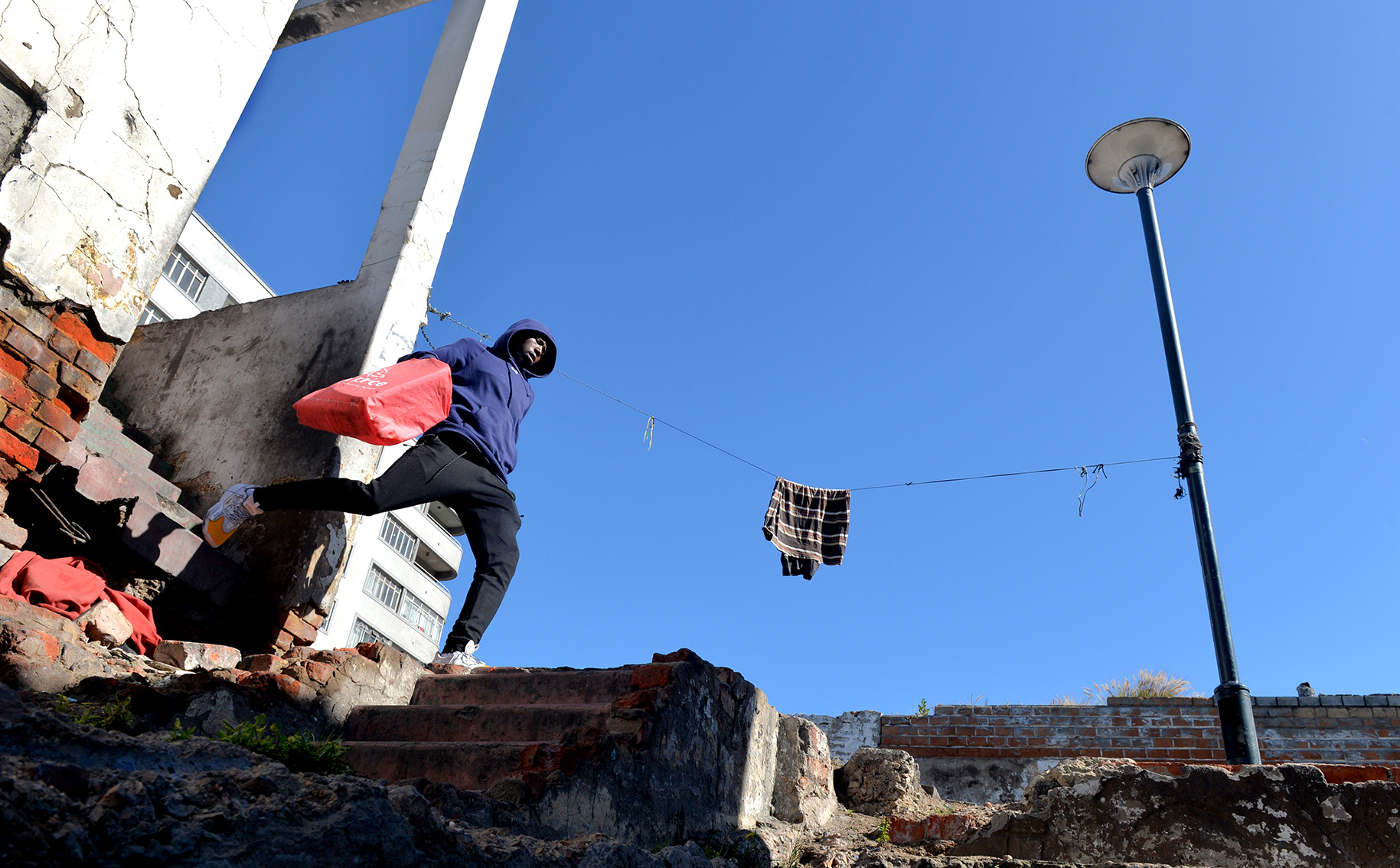
 The abandoned Clifton Mansions in Gqeberha. (Photo: Deon Ferreira)
 Seventy years ago, Clifton Mansions was a sought-after piece of real estate. Central Gqeberha was a bustling hub of business and nightlife, and the apartment building, consisting of four upmarket flats, took up the entire block between Hope Street and Military Road. Behind the apartments, the property consisted of additional facilities and four garages.
/file/dailymaverick/wp-content/uploads/2025/09/DSC_0774-copy.jpg "Homeless people in Nelson Mandela Bay are moving into abandoned buildings such as Clifton Mansions. (Photo: Deon Ferreira)")
/file/dailymaverick/wp-content/uploads/2025/09/DSC_0680-copy.jpg "Clifton Mansions, Gqeberha Central. (Photo: Deon Ferreira)")
But the years have not been kind to Clifton Mansions, and over the past two decades, it began to decay, along with several other buildings in surrounding Central.
Dozens of other buildings around Nelson Mandela Bay have taken the same route in recent years, and the municipality has drawn up a list of 68 properties that have been branded as “problem buildings” across the metro.
Ironically, Hope Street is home to two such addresses. The faded date on the front of Clifton Mansions, where brass letters have long since been stolen, shows construction was completed in 1955.
/file/dailymaverick/wp-content/uploads/2025/09/DSC_0676-copy.jpg "Graffiti at Clifton Mansions, Central. (Photo: Deon Ferreira)")
The building was abandoned by the owners more than 15 years ago, when the doors and windows were first boarded up. This did not deter homeless people looking for shelter, and all entrances to the structure were sealed with brick and mortar. Still, this was not enough to keep people out.
For Luyanda Kongqobe, this derelict structure has been a home on and off since his release from prison in 2006, after serving a sentence for housebreaking. About a dozen people live here. Kongqobe (42) shares a sparsely furnished room with several other men on the ground floor. The top floor has been abandoned since a fire destroyed the roof last year.
/file/dailymaverick/wp-content/uploads/2025/09/DSC_0790-copy.jpg "A makeshift dressing table inside Clifton Mansions. (Photo: Deon Ferreira)")
“We look out for each other here. When I lived on the street, I was not safe, but since I came here, I feel much safer. The only time when we have trouble here is when robbers run in here to hide from the police. But most of the time it’s quiet here,” he said.
At the back of the structure, a few blocks have been removed from the bricked-up basement door. Clambering through the opening reveals a gloomy and miserable space. Two small rooms are hidden behind dirty linen curtains. There are no lights in this space, and flies swarm around anyone who enters. Pulling aside one curtain reveals walls covered in vulgar graffiti and two dirty mattresses against the walls.
Tattered clothes and trash form a pile in one corner. In the middle of the room is a plastic baby bath containing old urine and faeces. Behind the second curtain, a wooden board has been turned into a makeshift dressing table with a mirror and old beauty product containers.
/file/dailymaverick/wp-content/uploads/2025/09/DSC_0798-copy.jpg "What appears to be tik paraphernalia in Clifton Mansions, Central. (Photo: Deon Ferreira)")
Among the containers is an eerie collection of broken children’s toys. Three mattresses with dirty bedding line the walls, and what looked like a tik pipe lay on the table.
Not an isolated incident
Two properties down the street, St Helens, another block of apartments, is much the same.
While the bricked-up doors and windows at the front of the building show no signs of being reopened, the missing roof and scorch marks from a recent fire are evidence that someone had gained entry and started a fire inside.
Around the corner, No 3 Prospect Hill has become a major headache for private security firms that regularly patrol the area.
/file/dailymaverick/wp-content/uploads/2025/10/No-3-Prospect-Hill-3.jpg "No 3 Prospect Hill is another headache for security services in Central. While no one stays in the derelict building permanently, it has become a popular camping ground for drug users, and thieves who want to discard unwanted loot. (Photo: Riaan Marais)")
/file/dailymaverick/wp-content/uploads/2025/10/No-3-Prospect-Hill-1.jpg "No 3 Prospect Hill in Central. (Photo: Riaan Marais)")
Residents report homeless people using these buildings at night for shelter, often leaving behind needles, trash and unsafe conditions.
Operatives employed by City Wide Security, who operate a dedicated patrol in Central, said they often chase suspects into the building, which is a maze of bricked-up doors, burnt timber floors and health and safety hazards.
“I cannot even count the number of times I’ve seen police or security officers come to this building. It feels like every weekend there is another person being arrested here,” Akhona Blouw, a resident at the next-door apartment block, Somersroost, said.
Blouw says no one in the building stays there permanently, but he sees people arrive at night. “I’ve seen them use needles and smoke stuff out here. Then they pass out, and tomorrow they get up and leave.”
For more than 15 years, the expansive apartment building has been without a roof after it was gutted by a fire. But by then, it had long been abandoned.
Homelessness and survival
More than 4,500 people are homeless in Nelson Mandela Bay. For many, survival means sex work or scavenging. Experts say that most are not criminals, but victims of a broken system.
According to a Statistics South Africa 2022 report, Nelson Mandela Bay accounts for just 2.7% of the country’s homeless population, the lowest proportion among metropolitan areas. However, the metro’s worsening economic climate is compounding the crisis. According to the latest Quarterly Labour Force Survey (Stats SA, Q2 2025), Nelson Mandela Bay’s official unemployment rate climbed to 26.4%, one of the sharpest increases among the country’s metros.
/file/dailymaverick/wp-content/uploads/2025/09/DSC_0783-copy.jpg "Squatters occupy dilapidated and hijacked buildings in Central. (Photo: Deon Ferreira)")
Last year, PE Express reported that local authorities have acknowledged the urgent need for additional shelters and support services, warning that without action, the number of homeless people in the metro could rise to 6,000 by 2030.
The crisis was highlighted after a group of homeless men was abducted last month and severely assaulted, resulting in a murder investigation after one succumbed to his injuries.
Read more: Murder of homeless man highlights deepening crisis on streets of Nelson Mandela Bay
People, not statistics
When Nola Witbooi came to Gqeberha 10 years ago, her friends promised that jobs were plentiful and life in the big city would be much better than it was in the township where she grew up. However, reality set in when she started dating a foreign national who coerced her into sex work, a trade she worked in for nearly a decade in Central. And just when she thought things could not get any worse, her so-called boyfriend died, leaving her without an income or a place to stay.
For nearly a year now, the 37-year-old has been sharing a small, dark room with three others in Clifton Mansions in Hope Street.
“My boyfriend handled all the business, and since he died, life has been tough. It was not easy before, but now I am really struggling. I had no other option – it was either this building or the street. This is all I have,” Witbooi said, gesturing at her threadbare clothes and the ramshackle structure behind her.
/file/dailymaverick/wp-content/uploads/2025/09/DSC_0737-copy.jpg "‘We feel safe here. We are almost like a family here. None of us has anywhere to go. Our families are dead, or they don’t want us. So we come here, and we are accepted. We don’t want any trouble here,‘ says Thandazo Phethani about living at Clifton Mansions. (Photo: Deon Ferreira)")
Witbooi’s neighbour in the same building, Thandazo Phethani, has also resorted to sex work or rummaging through trash for scrap metal to make a living. “We feel safe here. We are almost like a family here. None of us has anywhere to go. Our families are dead, or they don’t want us. So we come here, and we are accepted. We don’t want any trouble here.”
While the manner in which some homeless people make a living may be against the law, those who regularly work with the homeless across the metro feel they should not be criminalised for their actions.
Patricia van Niekerk, a Gqeberha Salvation Army community care and ministry coordinator, said desperation led many homeless women into sex work. “These women are not criminals. They are desperate and they have no other answer. They have lost their way and their dignity, and to criminalise them will do nothing to improve the situation.”
Albie Basson, a manager at the Maranatha Shelter in Forest Hill, agrees with Van Niekerk that homelessness is increasing, and it will need a collaborative effort from various organisations to address the problem.
“We can house as many as 40 people comfortably, but we are seldom at capacity. Shelters like ours come with certain rules and regulations, and we often find that those visiting our facility prefer the streets, where they are not monitored.”
Basson said their facility housed people who were in genuine need – those who were down on their luck, unemployed, had no support network, and were genuinely looking for a place to stay.
“We do not accept people with substance disorders, and our residents undergo a screening, with the help of the police, to ensure we do not take in hardened criminals.”
Their residents earn a place to stay by working at the facility’s urban farming initiative and have the opportunity to earn a stipend for the work they put in.
“Many people who come here relapse, or they try to steal. Unfortunately, we have to show them the door because they endanger other residents.” He said some residents simply did not seem to want to work.
He said in the colder winter months, they were filled to capacity with people willing to work for a roof over their heads. But come spring, many quickly vacated the premises in exchange for the streets and fewer rules.
Seeking solutions
Experts and national policy suggest urban renewal and inner-city housing interventions could help. The Department of Human Settlements has launched an urban renewal framework aimed at restoring liveability and dignity to neglected inner-city spaces.
Municipal response to problem buildings
Municipal legal services are in the process of looking at solutions to the problem, though red tape slows implementation. The Problem Building By-law targets abandoned, unsafe, unsanitary, overcrowded, illegally occupied, or crime-linked properties, allowing fines, imprisonment or cost recovery for negligent owners.
“These buildings pose serious risks to public health and safety, degrade surrounding property values and often attract illegal activity, including homelessness and criminal elements,” municipal spokesperson Sithembiso Soyaya said.
“The challenge in implementing by-laws is that action is often delayed by legal processes not of our own design, or lack of implementation,” Soyaya said.
If building owners cannot be tracked down, the municipality can issue a demolition order or demolish the structure itself, within the prescription of the law.
“The municipality remains committed to upholding the safety and integrity of the community and continues to monitor and act on problem buildings across the city.” DM