



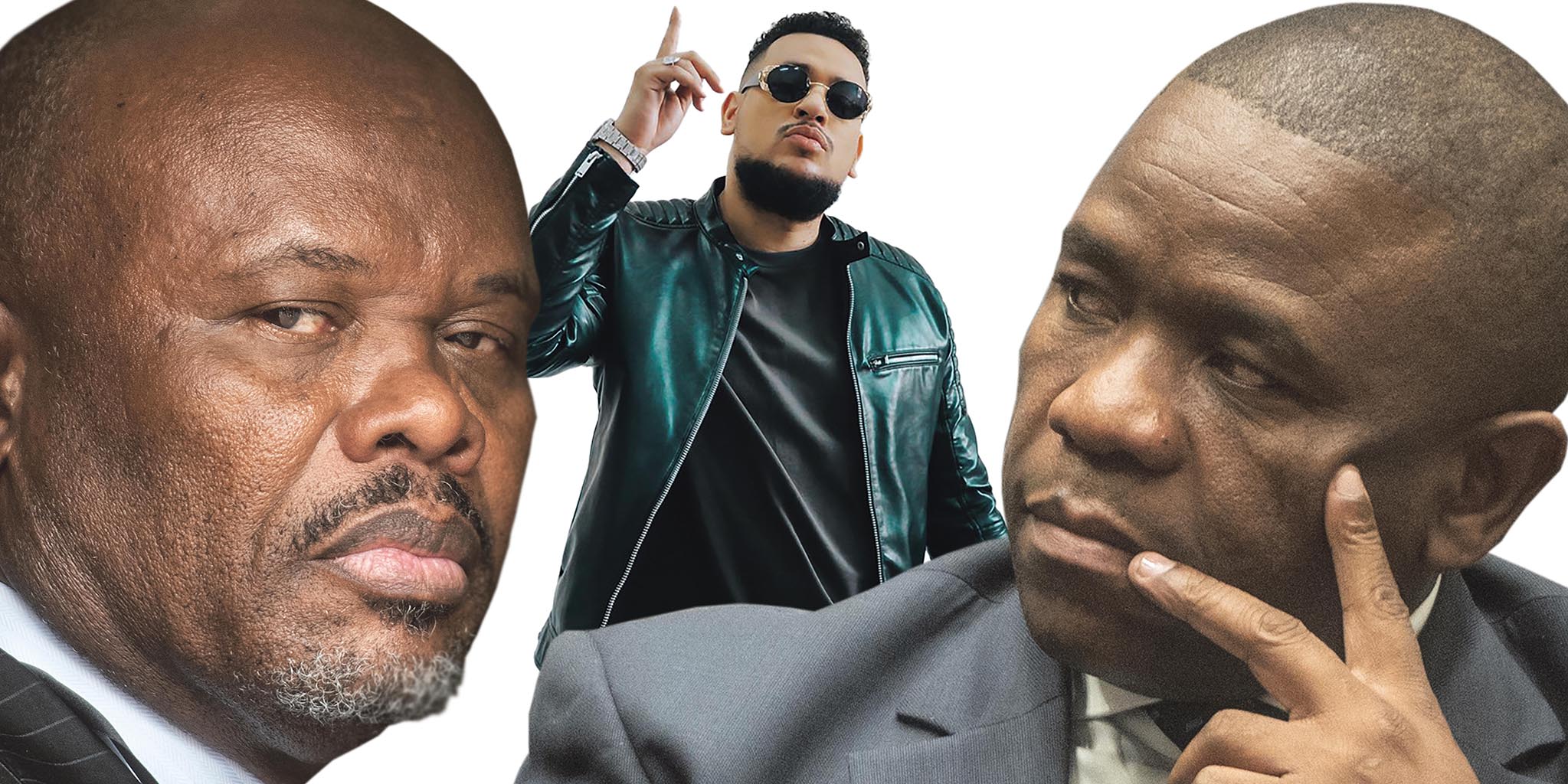
 Illustrative image: From left, Shadrack Sibiya, Kiernan ‘AKA’ Forbes and Nhlanhla Mkhwanazi. (Photos: Gallo Images/Jacaranda FM)
 Several celebrity murders and a R200-million drug consignment stolen from a police building during a power cut now connect different parts of South Africa’s seismic law enforcement scandal.
This week, suspended deputy national commissioner of crime detection Lieutenant General Shadrack Sibiya told Parliament how bad blood developed between him and his colleague, KwaZulu-Natal police boss Lieutenant General Nhlanhla Mkhwanazi.
Sibiya alleged this happened because of a ministerial request related to arrests for the 2023 murder of rapper Kiernan Forbes, better known as AKA.
“He was fuming, he was very angry,” Sibiya said of Mkhwanazi.
Mkhwanazi, meanwhile, has separately explained the strategy behind the arrests for the Forbes murder: suspects were kept in custody on different charges before the overall case related to the killing was solidified.
Mkhwanazi has provided details about other killings in the music industry and how a R200-million drug consignment, stolen from an unguarded Hawks building in KwaZulu-Natal, is allegedly linked to the murders of DJs.
“The picture we’re going to see when the matters get to court is that this one thought he’s clever by stealing [that] one’s drugs and he start[ed] selling [it] and [that] one then killed him,” Mkhwanazi said last week.
All this has emerged during Parliament’s ad hoc committee hearings into accusations he made during a press conference in July. His claims have rocked South Africa’s policing arena.
Divided policing
The parliamentary hearings started about two weeks ago and are running parallel to the Madlanga Commission of Inquiry, which is investigating Mkhwanazi’s accusations as well.
Several high-profile people have been implicated in this increasingly complicated saga. Mkhwanazi previously accused Sibiya of essentially being part of a vast plot to thwart investigations into a drug-trafficking cartel that had infiltrated South Africa’s law enforcement, politics and private security.
/file/dailymaverick/wp-content/uploads/2025/10/Drugs200M.jpg "Cocaine worth R200-million seized by the Hawks from a container at a depot in Durban. The 541kg haul was later stolen from the Hawks’ offices in Port Shepstone. (Photo: DPCI)")
According to his allegations, the police minister at the time, Senzo Mchunu, was influenced to disband KwaZulu-Natal’s political killings task team as part of that plot.
Read more: Sibiya challenges Mkhwanazi amid growing tensions in South African police force
Sibiya and Mchunu denied wrongdoing. This week they both appeared as witnesses at Parliament’s ad hoc committee – the first time they have had a chance to directly address the accusations against them on a public platform.
Sibiya made his stance on Mkhwanazi clear while he was on the witness stand, alleging: “The people of South Africa are being taken for a ride… He’s playing a mind game [with] the country.”
AKA murder arrests
Sibiya explained his version of events to MPs, saying he had had a good working relationship with Mkhwanazi “for years” until tension arose involving the Forbes murder case.
Forbes and his friend Tebello “Tibz” Motsoane, a chef and entertainer, were shot dead outside a restaurant in Durban in February 2023. Five men face charges in connection with the double murder.
According to the National Prosecuting Authority, they are Lindokuhle Mkhwanazi, Lindani Ndimande, Siyanda Myeza, Mziwethemba Gwabeni and Lindokuhle Ndimande.
Read more: Police top brass sit in at court as five suspects appear for murder of rapper AKA and Motsoane
Their trial is expected to run in two stretches next year, from 20 July to 21 August and from 5 October to 6 November.
Sibiya, testifying in Parliament, said he had been present at an operation in Cape Town when Bheki Cele, who was the police minister at the time, approached him and asked about the Forbes case. It was not clear when exactly this happened.
/file/dailymaverick/wp-content/uploads/2025/10/ED_582299-1.jpg "The deputy national commissioner of crime detection, Lieutenant General Shadrack Sibiya, at the parliamentary inquiry on 13 October. (Photo: Brenton Geach/Gallo Images)")
Cele had apparently asked: “Tell me, are you sure the people that were arrested are the right people?”
Sibiya replied that he was “quite sure”.
He said Cele had asked to be briefed on the Forbes case and Sibiya had said he would arrange it.
‘Whoa, we are not fighting’
Mkhwanazi headed policing in KwaZulu-Natal, where Forbes and Motsoane were killed, but Sibiya chose to contact Mkhwanazi’s deputy.
Sibiya told the Parliamentary ad hoc committee that he had done so because Mkhwanazi was often in meetings when he tried to make contact.
According to Sibiya, he asked the deputy to arrange the briefing on the Forbes case with Cele and to tell Mkhwanazi about it.
The deputy later asked Sibiya to rather contact Mkhwanazi directly.
“I called [him] with all the confidence that I had because I knew we had a relationship … and then when he responded he was angry,” Sibiya testified. He said Mkhwanazi was angry that Sibiya had “ordered around” people in his province.
“I said, whoa, whoa, General, we are not fighting. Nobody’s fighting, please. Let’s not go there,” Sibiya said.
Read more: SA’s policing scandal explodes – ‘Under siege’ Sibiya and Mchunu’s chief staffer raided
According to his version, Mkhwanazi had retorted by saying that his officers would not go to the police head office in Pretoria and that he did not “report to politicians”.
Sibiya told the ad hoc committee that he was upset when Mkhwanazi told him to relay his (Mkhwanazi’s) response to Cele.
This was because in the police hierarchy, Sibiya was senior to Mkhwanazi, who he felt should not be telling him what to do.
Sibiya said this spat escalated to the point of his “being banned by the provincial commissioner to operate in KwaZulu-Natal when in fact I’m operating nationally”.
This part of the scandal, which relates to the Forbes case, also casts light on how authorities sometimes deal with suspects.
Molefe, Matlala and murders
Mkhwanazi testified at Parliament’s ad hoc committee the week before Sibiya.
At one stage he was asked about allegations outlined during a sitting of the Madlanga Commission that a drug-trafficking cartel known as the Big Five was operating in South Africa.
During previous Madlanga Commission proceedings, two alleged members of the Big Five were named – Vusimuzi “Cat” Matlala and Katiso “KT” Molefe.
It emerged during those proceedings that Matlala, who had a health services contract with the police that has since been terminated, allegedly had access to confidential policing information.
He faces charges of attempted murder and money laundering, while Molefe faces charges of conspiracy to murder. Neither faces drug-related charges at present.
About a week ago, Molefe was released from custody on R400,000 bail. A National Prosecuting Authority statement outlined the case against him.
Evidence allegedly connects certain rifles to killings in Gauteng, including those of:
- Hector Buthelezi, also known as DJ Vintos, who was shot in March 2022.
- Oupa John Sefoka, better known as DJ Sumbody, who was murdered in November 2022.
- Armand Swart, an engineer who was shot in Vereeniging in April 2024 after the company he worked for unearthed corruption related to Transnet contracts.
About a week ago, during Parliament’s committee hearings, Mkhwanazi was asked why Molefe and Matlala were not currently facing drug charges when they had been accused of being part of the Big Five cartel.
Mkhwanazi explained that there was a broader investigation being conducted into narcotics. “It’s a strategy we employ in the police to keep people behind bars until we’re ready with a bigger case,” he said.
Mkhwanazi referred to the Forbes murder case – the matter that Sibiya alleged was linked to the friction between them – saying that the same strategy had been used in it.
“We arrested a whole lot of them for other cases just to keep them in custody until we’re ready with the main case,” Mkhwanazi said.
Focusing on the killings in Gauteng, he said Swart’s murder “had nothing to do with drugs” and was linked to a tender.
Police have previously said that Swart’s killer or killers had been under the impression that he had blown the whistle on corruption and therefore needed to be silenced.
Stealing stolen cocaine
Mkhwanazi, testifying in Parliament last week, revealed details about “the murders of these DJs”, which he alleged were “drug-related”. Though he did not name the DJs, they are presumably Buthelezi (DJ Vintos) and Sefoka (DJ Sumbody).
Mkhwanazi explained the police procedure when a drug consignment was seized: an officer was meant to identify it as an exhibit and book it into a police station. If the consignment was large, it had to be transferred elsewhere for safe storage.
Mkhwanazi turned his attention to a drug consignment discovered in Durban, which was meant to have been stored in a forensic laboratory.
There was a laboratory about 15km away in Amanzimtoti, but it did not have a facility for such storage, so he said the consignment should have been sent to Pretoria to be stored there.
/file/dailymaverick/wp-content/uploads/2025/10/ED_577598.jpg "Lieutenant General Nhlanhla Mkhwanazi testifies at the parliamentary ad hoc committee inquiry into alleged corruption and political interference in the criminal justice system at Good Hope Chambers in Cape Town on7 October. Mkhwanazi first made the allegations at an explosive press conference in July. (Photo: Brenton Geach/Gallo Images)")
But Mkhwanazi said the drug stash had instead been moved to the Hawks building in Port Shepstone and locked in an office “that had no one guarding it”.
He added: “During so-called alleged load shedding at night, there was a break-in.”
Read more: R200m cocaine theft from KZN Hawks office may tie police to global drug traffickers
Daily Maverick has reported extensively on a 541kg cocaine consignment, worth about R200-million, that was stolen during a burglary at the Hawks offices in Port Shepstone in November 2021. This was widely viewed as an inside job.
It appears Mkhwanazi was referring to this incident when testifying in Parliament.
He said the drug consignment had been stored with other intercepted narcotics, as well as illegal firearms, in the Hawks’ Port Shepstone building.
“But when the break-in happened, the only thing that was stolen was this specific consignment of R200-million worth of drugs and nothing else,” Mkhwanazi said.
“The mission was drugs. So, they came to collect what is theirs and they took it away.
“They left everything else untouched, and that made us conclude that it was a planned break-in… The question we are asking [the Hawks] is: ‘Why did you allow these drugs to come to your offices and there is nobody guarding it?’ ”
(The Madlanga Commission, meanwhile, heard more this week about how the head of the Hawks in KwaZulu-Natal, Major General Lesetja Senona, was allegedly in contact with “Cat” Matlala.)
Mkhwanazi, testifying to the parliamentary committee, said it was believed the stolen drug consignment ended up in Johannesburg and that individuals stole from it instead of delivering it where it was ultimately meant to go.
He alleged that this sparked “a majority of the murders” that happened in Johannesburg. Presumably, this included the murders of the DJs.
A theory along the same lines previously surfaced about Sefoka and was reported on, but his family, in a joint statement with a foundation linked to him, denied he had been involved in illicit activity.
The family put the allegations down to a smear campaign – a key theme that has surfaced in South Africa’s policing scandal, with accusations and counteraccusations about who is telling the truth and who is pushing misinformation to conceal wrongdoing.
The parliamentary committee on Mkhwanazi’s accusations as well as the Madlanga Commission continue. DM
This story first appeared in our weekly DM168 newspaper, available countrywide for R35.
