




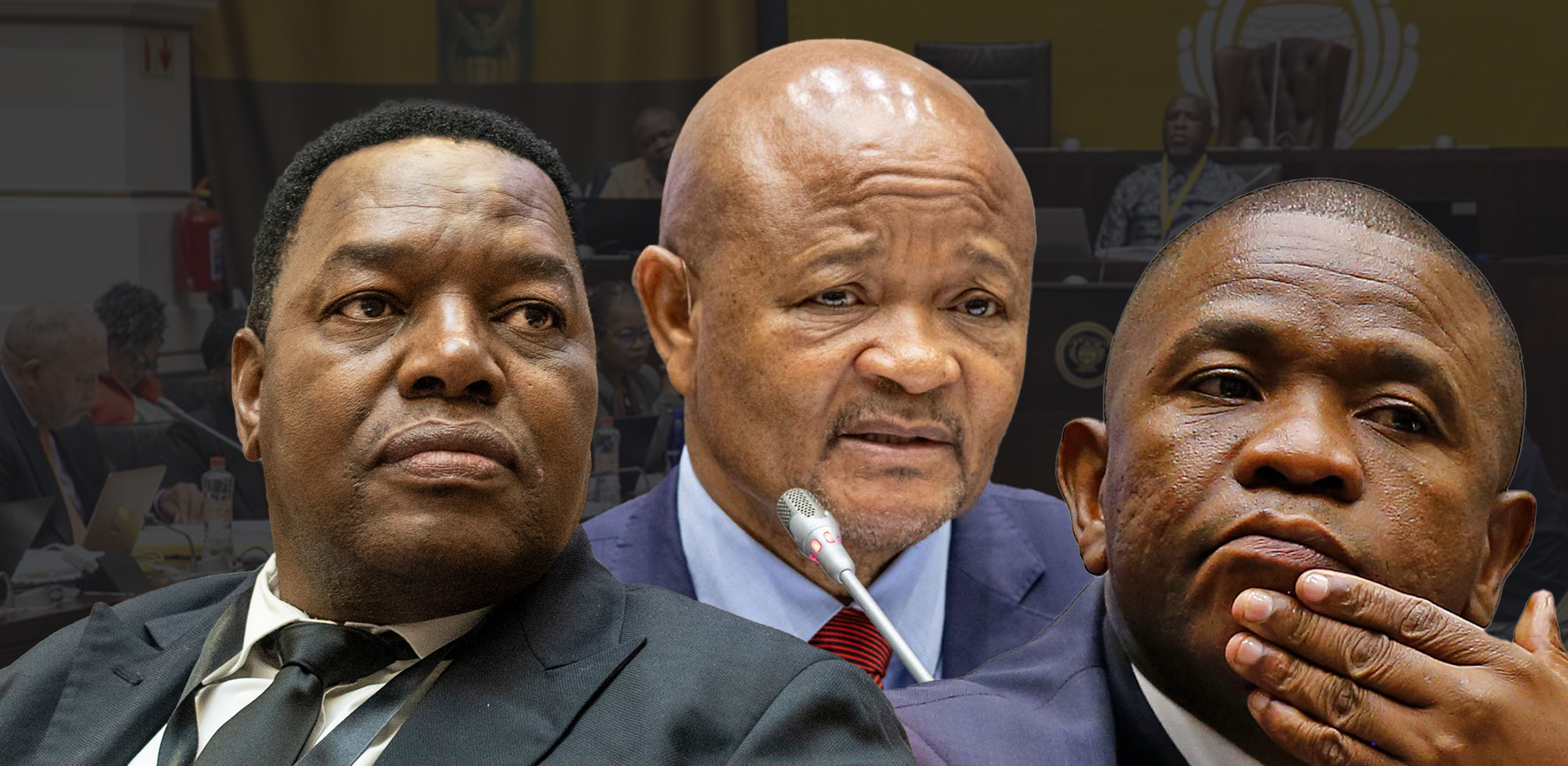
 Illustrative image: The ad hoc committee to investigate allegations made by Lieutenant General Nhlanhla Mkhwanazi. (Photo: Zwelethemba Kostile / Parliament of RSA) | Lieutenant General Fannie Masemola. (Photo: Brenton Geach / Gallo Images) | Police Minister on special leave Senzo Mchunu. (Photo: Zwelethemba Kostile / Parliament of RSA) | KwaZulu-Natal provincial head Lieutenant General Nhlanhla Mkhwanazi. (Photo: Phando Jikelo / Parliament of RSA)
 Senzo Mchunu, the police minister who is on enforced leave, says he disbanded the Political Killings Task Team (PKTT) for various reasons, including a tight budget and to avoid reputational risk to police officers.
Mchunu went into detail about this while testifying on Thursday, 16 October, at Parliament’s ad hoc committee hearings into accusations that a drug trafficking cartel had infiltrated South Africa’s law enforcement, politics and police.
The allegations were first made by KwaZulu-Natal Police Commissioner Lieutenant General Nhlanhla Mkhwanazi at a press conference in July.
Mkhwanazi’s accusations resulted in Mchunu being placed on special leave.
In Parliament on Thursday, Mchunu said that since the day of the July press conference, it felt as if he had been “wearing” and “smelling” Mkhwanazi, and this was his first chance to present his version of events.
/file/dailymaverick/wp-content/uploads/2025/10/WhatsApp-Image-2025-10-08-at-13.05.21_84045230.jpg "Lieutenant General Nhlanhla Mkhwanazi delivers his testimony before the parliamentary ad hoc committee inquiry in Parliament. (Photo: Phando Jikelo / RSA Parliament)")
Mchunu’s moment
“I am going to do justice to that,” Mchunu affirmed.
He spoke at great length about his directive to disband the PKTT, which, despite his order, is still operational.
The reasons Mchunu gave on Thursday for his order to disband the PKTT contradict testimony from other police bosses and the National Prosecuting Authority head in KwaZulu-Natal, who believed the team was “essential and necessary”.
According to Mkhwanazi’s allegations, Mchunu was influenced to disband the PKTT as part of a plot to derail investigations into crime suspects.
Other allegations that Mkhwanazi made included that Mchunu was connected to the ANC-aligned businessman Brown Mogotsi.
Read more: Mchunu cites ‘damage risk’ and duplicate policing as reasons for PKTT disbandment decision
/file/dailymaverick/wp-content/uploads/2025/07/ED_563993.jpg "Vusimuzi 'Cat' Matlala. (Photo: Sharon Seretlo / Gallo Images)")
Mogotsi, in turn, has been accused of acting as an intermediary between Mchunu and Vusimuzi “Cat” Matlala, who is facing attempted murder and money laundering charges.
On Thursday, during the Parliamentary proceedings, Mchunu confirmed knowing Mogotsi, but said he knew nothing of certain communications, which were put to him, between Mogotsi and Matlala.
Mchunu portrayed himself as someone who wanted what was best for South Africa and policing.
Shortly after Mchunu finished testifying in Parliament on Thursday, national police spokesperson Brigadier Athlenda Mathe issued an alert saying: “The SAPS confirms that there is police presence at the business premises of Mr Brown Mogotsi in Seweding village in Mahikeng.
“This visit is part of an ongoing investigation that has already been discussed before the ad hoc committee and the Madlanga commission.”
The Parliamentary ad hoc committee is running parallel to the Madlanga Commission of Inquiry — both are investigations of criminal infiltration into law enforcement and politics.
/file/dailymaverick/wp-content/uploads/2025/09/Presentation-170-1.jpg "Brown Mogotsi. (Photo: Truth and Solidarity Movement / @TruthMovemen / X)")
‘Constitutional right’ vs ‘usurping power’
Mchunu ordered the PKTT disbandment via a letter, dated 31 December 2024, that contained two other directives, which were not as controversial.
The letter ordered the team to be “disestablished” because it was not “adding any value to policing in South Africa”.
Mchunu told Parliament on Thursday: “I stand by it. It was written by me, that letter.”
During proceedings, the evidence leader, Advocate Norman Arendse SC, pointed out that the date of the letter, New Year’s Eve, was “bizarre” and the tone of it was “disturbing”.
/file/dailymaverick/wp-content/uploads/2025/10/WhatsApp-Image-2025-10-16-at-12.23.42.jpeg "Evidence leader Norman Arendse. (Photo: Zwelethemba Kostile / Parliament of RSA)")
Mchunu said there was nothing unusual about the date as the police worked on that day.
He said he had acted constitutionally.
“The Constitution of the republic allows the minister … to take the decision that I took in relation to directives.”
Read more: Mchunu ‘unlawfully’ usurped Masemola’s power in political killings saga, Madlanga Commission hears
/file/dailymaverick/wp-content/uploads/2025/10/IMG_7661.jpg "National Police Commissioner Fannie Masemola. (Photo: Sune Payne)")
Mchunu’s testimony was at odds with what emerged at the Madlanga Commission.
Major General Petronella van Rooyen, the governance, legislation and policy head at the South African Police Service’s (SAPS's) Legal Services Division, testified there last month.
She said Mchunu did not have the authority to disband the PKTT and that his doing so equated to the “usurping of powers of the national commissioner”, Fannie Masemola.
“The minister unlawfully strayed into the constitutional competence of the national commissioner when he issued the letter for the disbandment of the PKTT,” Van Rooyen testified.
(Mchunu’s 31 December 2024 letter to disband the PKTT was issued when Masemola was on annual leave.)
/file/dailymaverick/wp-content/uploads/2025/09/G1rSe60XkAAC9D1.jpg "Major General Petronella van Rooyen. (Photo: Sourced / X / @CrimeWatch_RSA)")
‘Avoiding duplication’
On Thursday, via Mchunu’s testimony in Parliament, the public finally got a chance to hear from him.
He detailed his reasoning for disbanding the PKTT.
He referred to a work study that gave rise to a new police structure, in other words, a policing organogram.
He said it was his “belief that if you continue to have a Political Killings Task Team you are not recognising the new work study and the new organogram”.
This organogram was in place, signed and needed to be funded and implemented.
“I’m convinced that if this organogram is implemented it will have an impact on murders, on firearms and so on, on crime in South Africa,” said Mchunu.
The organogram dealt with political killings not just in KwaZulu-Natal, but nationally.
Mchunu made it clear that if the PKTT remained operational and the organogram was implemented, this would, in effect, duplicate what was in the organogram.
/file/dailymaverick/wp-content/uploads/2025/10/WhatsApp-Image-2025-07-04-at-10.52.39.jpeg "Senzo Mchunu. (Photo: Phando Jikelo / RSA Parliament)")
‘Reputational risk’ and ‘credibility’
He said another reason that he ordered the PKTT’s disbandment was because “when I assumed duties together with the deputy minister, we got a number of people talking to us”.
“A number of people who were part of the national Political [Killings] Task Team sent WhatsApps to me and to the deputy ministers over a long period shortly after we started working.
“Others, as I’ve said, would want to see me privately … and we have talks.”
He said people who approached him spoke about human resources matters relating to the PKTT.
They also spoke about issues which, said Mchunu, if not dealt with expeditiously, had the “potential of damaging the reputation of SAPS, amounting to defeating the ends of justice”.
Mchunu said among the individuals with whom he was in contact were Patricia Morgan-Mashale, whom he said passed along “rumour” as well as legitimate policing documents to him, and analyst Mary de Haas.
Read more: Why did Senzo Mchunu order the Political Killings Task Team to be shut down?
Daily Maverick has reported that De Haas called for the PKTT’s disbandment, which aligns with Mchunu’s directive.
In a complaint to Parliament’s police committee this year, she raised issues relating to the PKTT, including “excessive expenditure”, and called for an audit of its funds.
Based on Mchunu’s testimony on Thursday, he had no issues with De Haas.
This was very different to Mkhwanazi’s opinion of De Haas.
When testifying in Parliament, Mkhwanazi said he did not know De Haas. “I did not study at the University of KwaZulu-Natal, but I learned that she’s in academia there, and then I’m disappointed.
“If I was a student of Mary de Haas, if she was a lecturer and she would’ve made me pass a certain qualification, I would begin asking myself whether [it’s] … credible,” Mkhwanazi asserted.
Money matters
Mchunu, during proceedings in Parliament on Thursday, said another reason he directed the PKTT to be disbanded was related to the police budget — he wanted the PKTT wrapped up to save money and divert resources.
“Throughout our discussions with SAPS management, from when we arrived during orientation [in the police ministry] up to the … beginning of the year, there was always focus on the decreased budget … resources … within SAPS,” he said.
Read more: MPs slam Mchunu’s R114bn budget, citing SA’s murder stats and ‘celebrity treatment’ for politicians
He often heard there was “no money” available when resourcing issues were dealt with.
“The budget allocated to SAPS became one of the things I considered when I wrote the letter,” Mchunu said, apparently referring to the 31 December 2024 letter to have the PKTT disbanded.
It was previously heard that the task team had funding until March next year.
/file/dailymaverick/wp-content/uploads/2025/09/WFD_8903.jpg "Retired Justice Mbuyiseli Madlanga chairs the Commission of Inquiry in Pretoria on 17 September 2025. (Photo: Felix Dlangamandla)")
Contrary testimony
Several of those who testified at the Madlanga Commission and the parliamentary ad hoc committee hearings before Mchunu have given versions that differ from his.
Masemola said Mchunu wanted the PKTT disbanded because Mchunu was of the view that there had been no political killings in South Africa after apartheid. (There have indeed been many political killings in democratic South Africa.)
Mkhwanazi told the Madlanga Commission that Mchunu ordered the PKTT to be disbanded because “Someone influenced the minister to do this. Someone thought that the PKTT was the one that was responsible for the investigations in Gauteng towards these criminal syndicates … which involved the participation of senior police officers in the SAPS in head office as well as senior politicians and their associates.”
Read more: ‘I thought it was fake news’ – KZN prosecution’s boss on controversial political killings order
Elaine Harrison, the Director of Public Prosecutions in KwaZulu-Natal, testified at the Madlanga Commission, “I have considered the Political [Killings] Task Team as an essential and necessary structure for the province … and the country as a whole.
“This is so as the team is precisely aimed at dealing with politically motivated and related crimes that gained momentum and threatened to destabilise the province and to spiral into other provinces.”
Parliament’s ad hoc committee is expected to resume on Friday, and Mchunu will continue testifying. DM