




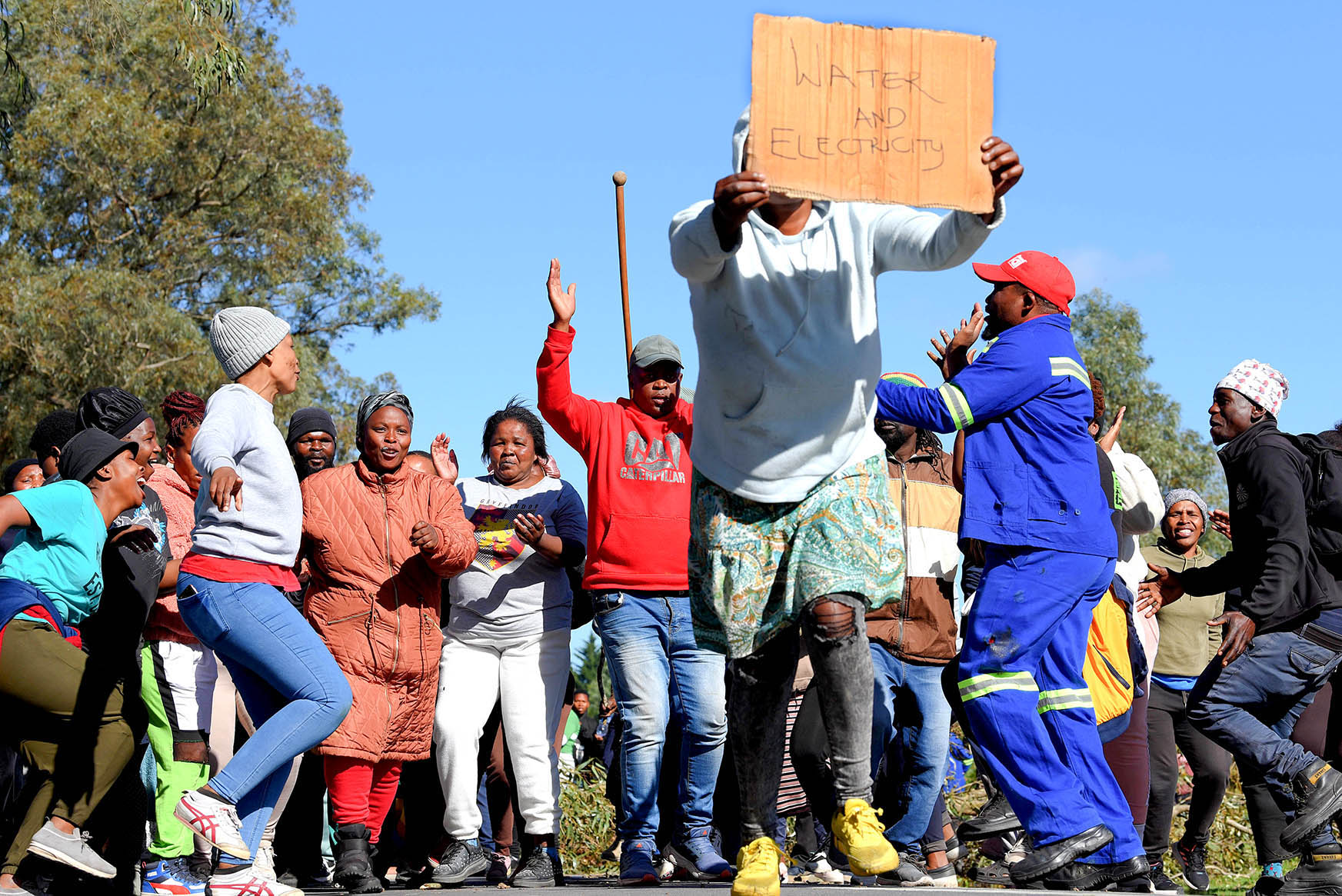
 Grogro residents protest on 15 October against the cutting of illegal electricity connections. (Photo: Deon Ferreira)
 In recent months, the Nelson Mandela Bay Municipality has embarked on a series of operations to clamp down on illegal electricity usage to recoup a R1-billion deficit in its energy revenue.
But now, it faces the wrath of residents of an informal settlement who have been accessing power through illegal connections without consequence for years. A tense standoff with the illegal users came to a head on Wednesday, 15 October.
/file/dailymaverick/wp-content/uploads/2025/10/DSC_1790-copy.jpg "Grogro informal settlement residents protest against the cutting of illegal electricity connections on 15 October 2025. (Photo: Deon Ferreira)")
One of Gqeberha’s arterial routes, Kragga Kamma Road, became the scene of violent clashes between law enforcement and about 300 disgruntled residents of the Grogro informal settlement.
Their illegal connections were taken down last week, becoming the latest among the city’s efforts to address electricity losses.
This came against the backdrop of months of “efficiency measures” implemented by the municipality to recoup energy losses.
A year ago, former acting electricity and energy boss Tholi Biyela submitted a turnaround strategy for the beleaguered department he inherited. Among the concerns he raised was electricity theft and low revenue collection.
The metro’s non-revenue electricity losses for the previous financial year stood at R1.049-billion, due to meter tampering and illegal connections, among other challenges.
Read more: Nelson Mandela Bay faces electricity crisis: proposed 12.8% tariff hike sparks controversy
In July, energy regulator Nersa approved a 12.74% tariff increase – 0.06% below the municipality’s requested price hike.
Read more: Nersa approves lower electricity tariff increase, forcing Nelson Mandela Bay to rethink plans
Municipal spokesperson Sithembiso Soyaya said the shortfall, while seemingly small, would affect revenue, and the city would have to take action to “improve internal operational efficiencies, reduce electricity losses and illegal connections, enhance billing accuracy and strengthen revenue collection”.
/file/dailymaverick/wp-content/uploads/2025/10/DSC_1726-copy.jpg "Freedom Front Plus councillor Bill Harrington was the first city official on the scene to try to restore calm while the community waited for a meeting with deputy mayor Gary van Niekerk on 15 October 2025 (Photo: Deon Ferreira)")
A report tabled at an electricity and energy committee meeting earlier this week showed that three operations conducted in July, to cut power to defaulting ratepayers, resulted in the recovery of R29-million.
Municipal officials said large-scale illegal connections at various informal settlements had been a growing concern for some time, due to safety concerns and revenue losses, and a decision had been made to address the ongoing problem at Grogro.
Speaking during a stand-off between residents and law enforcement officials on Wednesday, community leaders said the first residents settled on the privately owned land, just off Kragga Kamma Road, as far back as 40 years ago.
We concede that we have been using electricity illegally, but we have no other choice. We do not want to steal; we are willing to pay. But that would still require the city to provide electricity
The community has since grown to upwards of 1,000 people, and despite previous requests and protests for basic services, their plight has fallen on deaf ears.
For years, residents have resorted to illegal connections from transformers along Kragga Kamma Road, resulting in a spider’s web of dangerous electrical cables hanging from trees and running across roads.
According to residents, these connections have led to damaging fires and at least two electrocutions.
Road shutdowns
Last week, municipal contractors took down the illegal connections, leading to threats from the community that they would shut down roads in the area. In the early hours of Wednesday morning, they made good on those promises.
“We need electricity. We have been staying here for decades without electricity and without water,” community leader Zukile Futa said.z
He said arrangements were made to meet municipal officials at their offices at the Noninzi Luzipho Building. After four hours, no officials had arrived. This led to the decision to block roads with burning tree stumps and rubble, forcing city officials to pay attention to their plight.
“We concede that we have been using electricity illegally, but we have no other choice. We do not want to steal; we are willing to pay. But that would still require the city to provide electricity,” Futa said.
Futa, with others, said that during previous engagements with the municipality, they had been told that electricity infrastructure could be provided only with the consent of the private landowner.
Landowners’ letter
They say this consent was granted in 2022 when the owners, the WJ van Rooyen Trust, signed a letter shared with the community and the municipality.
However, the community seems to have misinterpreted the contents of the letter. Residents say the trust gave the municipality unconditional consent to provide basic services to Grogro, and they blame the city for delaying service delivery.
In truth, the letter, dated October 2022, of which Daily Maverick has a copy, made two recommendations.
The first proposal entailed that the municipality purchase the land “at fair market value” and then provide the community with the services it requires.
Failing that, the letter proposed that the municipality come up with a relocation plan for the residents of Grogro. Only once the landowners receive a detailed relocation plan, including a clear timeline, in writing, will the trust agree to having temporary services installed at Grogro while the relocation takes place.
Traffic disruptions
The protest led to traffic disruptions and road closures from as early as 4am on Wednesday, with groups blocking Kragga Kamma Road on two fronts, as well as roads in Sherwood later in the morning.
Community groups began forming from the entrance to Grogro and slowly made their way in two directions – west towards Seaview and east towards Lorraine, where they were confronted by police officials who drove them back by firing rubber bullets into the crowd.
Several people reported injuries, including a 19-year-old man with a large welt on the side of his head where a rubber bullet hit him.
/file/dailymaverick/wp-content/uploads/2025/10/DSC_1876-copy.jpg "Mihlali Jack (19) was among the protesters when police opened fire, using rubber bullets. An ambulance was at the scene to treat Jack and others who were injured. (Photo: Deon Ferreira)")
Despite efforts from various city representatives, including Freedom Front Plus councillor Bill Harrington, to resolve the situation, protesters refused to reopen the road before speaking to Mayor Babalwa Lobishe.
This resulted in a tense stand-off with police and metro police until the community agreed to meet deputy mayor Gary van Niekerk shortly after noon.
After a brief discussion with officials on the scene, Van Niekerk received a cold welcome from the protestors.
/file/dailymaverick/wp-content/uploads/2025/10/DSC_1715-copy.jpg "Several protestors covered their faces during the protest action, even while addressing deputy mayor Gary van Niekerk about their demands. (Photo: Deon Ferreira)")
They accused him of disrespecting them for arriving without prior knowledge of their plight, despite being in his position for more than a year.
They provided Van Niekerk with a copy of the letter and said he had 48 hours to come back to them with solutions, or they threatened to implement “plan B”.
They did not elaborate on this backup plan.
/file/dailymaverick/wp-content/uploads/2023/10/Adcock013-copya.jpg "Nelson Mandela Bay deputy mayor Gary van Niekerk. (Photo: Deon Ferreira)")
In turn, Van Niekerk apologised to the community for the municipality’s failure to attend the meeting scheduled for Tuesday.
He read through a copy of the letter from the WJ van Rooyen Trust and acceded to the community’s proposed 48-hour deadline.
Van Niekerk said he would engage with the relevant municipal officials, and together they would contact the landowners to discuss a resolution before returning to Grogro on Friday.
After he left, the protests briefly flared up again before the community dispersed. DM