




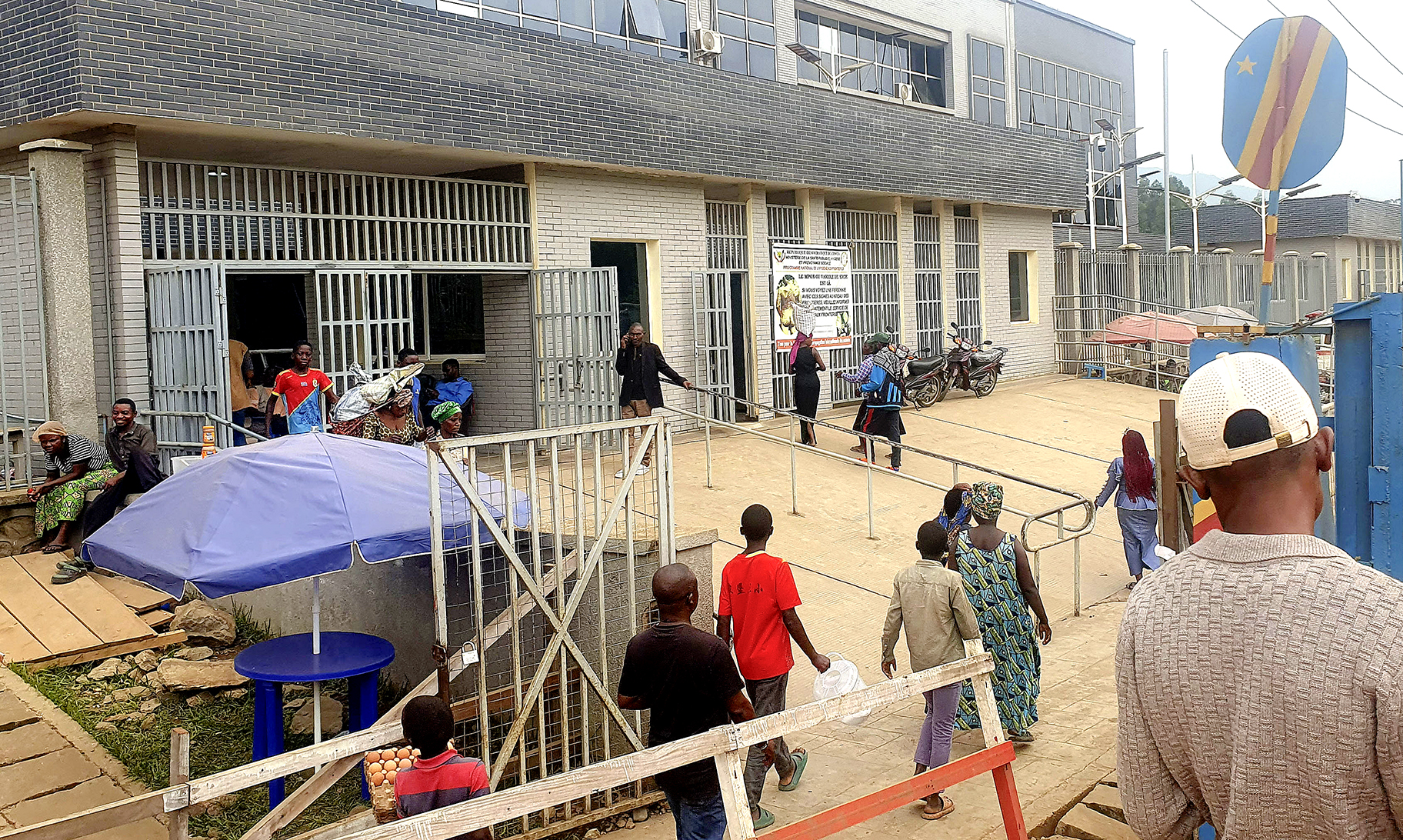
 The building housing both entry and exit checkpoints for the Democratic Republic of Congo at the Kasindi border crossing on 16 September 2025. The facility plays a central role in regulating cross-border movement but faces challenges related to transparency and service delivery. (Photo: Jérémie Kyaswekera / SA | AJP)
 At the Kasindi border post between the Democratic Republic of Congo (DRC) and Uganda a handful of dollar bills is all that it takes to bypass one of the most important health requirements of international travel in the region: proof of yellow fever vaccination.
This was confirmed by this reporter’s own experience, and by half a dozen other travellers interviewed for this investigation. All had purchased fraudulently issued health documents that allowed them to travel unencumbered across the border. These documents were “sold” by officials from the Programme National d’Hygiène aux Frontières (PNHF), who staff health check points at the border.
PNHF officials are responsible for health-screening travellers, verifying vaccination certificates, and administering vaccinations to those who require them for legal travel. Instead these officials profit from skirting these responsibilities.
In an area where outbreaks of yellow fever and other tropical diseases can lay waste to communities, such fraud poses a significant threat to the region’s public health.
Buying a yellow card
On the morning of 16 September 2025 I stood in line with dozens of travellers at the Kasindi crossing’s health checkpoint.
When asked for a “yellow card” — a proof of vaccination certificate — I admitted I did not have one. That should have meant vaccination and a 10-day quarantine, as international regulations demand. Through official channels, a yellow card costs $35 (about R605).
Instead, the PNHF officials on duty offered me a quick-fix option: I could pay $5 for a “free passage” token declaring me healthy. Ordinarily, these tokens are only issued to people who live near the border and travel regularly across it for work. As an international traveller from far afield, I was not eligible for such a token.
/file/dailymaverick/wp-content/uploads/2025/10/SAAJP-YellowFever-01_1.jpg "An awareness poster displayed at the Programme National d’Hygiène aux Frontières office in Butembo, Democratic Republic of Congo, on 19 August 2025. The poster indicates the official cost of an international vaccination certificate. Despite this travellers frequently report being overcharged for the card in order to obtain it without vaccination at border posts and in Programme National d’Hygiène aux Frontières offices. (Photo: Jérémie Kyaswekera / SA | AJP)")
Still, I bargained the price down. I did this to help confirm that the officials were probably requesting a fraudulent payment. After slipping $4 in cash to one of the PNHF officials, she placed the money in a small notebook on the desk. Her colleague issued me a token.
But, I noticed that the token issued to me did not contain an official stamp, so I expressed concern. The officials said that another option for a more official document existed, but that it would be much more expensive. A yellow card would cost me $50 in cash, they said. There was no mention of the vaccination and legally mandated quarantine period.
After some further negotiation, one of the officials led me to an office away from the main checkpoint. I paid this man $45 and in return he issued me with an authentic yellow card. It was backdated to July 2025, signed, stamped and filled in with records of vaccines I had not received: for polio, for Covid-19 and for yellow fever.
A thriving black market at Congo’s borders
Between January and July 2025, I interviewed and observed a number of travellers at Kasindi and Nobili border posts. It was clear that PNHF officials routinely and fraudulently sold the health and vaccination documents needed for cross-border travel.
Travel tokens are intended only for residents who live within 30km of the border and who cross it daily. These certify that the holder is of good health, and are intended as a pass for same-day travellers across the border and back. But, these are sold to international travellers for between $4 and $7.
Real yellow cards are sold for between $35 and $50 to travellers who have not been vaccinated. Agents might advise them on how to answer questions from other authorities.
Counterfeit yellow cards circulate for as little as $15 or $20. These often lack serial numbers or seals, but are still used successfully at checkpoints.
The people I interviewed had all participated in a crime in purchasing one of these documents. They therefore agreed to be interviewed only on condition of anonymity.
A student from Butembo told me she bought her yellow card at a PNHF office in Butembo, a town near the Kasindi border, without being vaccinated.
“I was preparing to go on vacation. But, honestly, I don’t even know which part of the body the yellow fever vaccine is administered on,” she said with a nervous laugh.
/file/dailymaverick/wp-content/uploads/2025/10/SAAJP-YellowFever-05_1.jpg "An international vaccination certificate fraudulently obtained by the reporter without vaccination at Kasindi border, Democratic Republic of Congo, on 16 September 2025. The certificate issued by Programme National d’Hygiène aux Frontières agents was obtained in exchange for bribes. The card grants travellers a false sense of immunity and undermines vaccination efforts against yellow fever and other preventable diseases. (Photo: Jérémie Kyaswekera / SA | AJP)")
/file/dailymaverick/wp-content/uploads/2025/10/SAAJP-YellowFever-04_1.jpg "A Health Police Certificate issued at the Tshomia border post in Ituri Province in the Democratic Republic of Congo in July 2025. This legal document is supposed to be issued by Programme National d’Hygiène aux Frontières to border residents without a yellow fever card. However at some borders such as Kasindi, this certificate does not exist and appears to be replaced by 'free travel' tokens with the money collected being untraceable. (Photo: Jérémie Kyaswekera / SA | AJP)")
/file/dailymaverick/wp-content/uploads/2025/10/SAAJP-YellowFever-03_1.jpg "A free travel token sold by Programme d’Hygiène aux Frontières (PNHF) agents to travellers without a yellow fever vaccination card, obtained in the Kasindi National PHNF office by a traveller in the Democratic Republic of Congo on 25 June 2025. These tokens are issued in exchange for payment allowing travellers to bypass vaccination requirements, which undermines public health measures. (Photo: Jérémie Kyaswekera / SA | AJP)")
Another traveller recounted being offered a “fast-track” card when he pleaded that he needed to travel urgently. He also haggled the price down from $50 to $45, he said. And, the document was also pre-populated with multiple vaccines he had not received.
A university lecturer explained that he once had to send money to an intermediary in Beni, another town near the border, to obtain a yellow card remotely in 2021, as local offices in Butembo had run out.
“I was told that I had to act quickly, because stocks were scarce and in high demand. The booklet arrived already completed and sealed, without me having received the injection. Under these conditions, I understood that money comes before rules,” he said.
A journalist in Beni recounted travelling to the Kasindi-Lubirihya border in July 2024, where Ugandan officials issued him a yellow fever card for $30 without any vaccine. He said shortages in Beni and cheaper prices across the border made it straightforward, especially with local contacts.
Likewise, a trader in Nobili confirmed that cards are often issued without vaccines, noting the lack of a local vaccination centre and the eagerness of border agents to “find an arrangement” when people are in a hurry.
The health stakes: yellow fever in East Africa
Yellow fever is a mosquito-borne viral disease that can cause fever and death.
The World Health Organization (WHO) classifies it as a “vaccine-preventable disease” requiring strict border control. International Health Regulations mandate proof of vaccination for travellers from or into endemic countries.
Yet eastern DRC remains a high-risk zone. WHO reports show that East Africa — including Uganda, the DRC, and Kenya — recorded new confirmed cases between 2023 and 2025. In 2024 alone, 124 confirmed cases were reported across 12 African countries, including the DRC. WHO warned in April 2025 that “rising outbreaks of vaccine-preventable diseases threaten to reverse years of progress”.
By selling fraudulent documents, PNHF agents create a dangerous illusion of protection: travellers appear immunised on paper, but in reality they are unprotected. This increases the risk of outbreaks in a region marked by regular cross-border movement of thousands of people.
Officials deny wrongdoing
When confronted, PNHF officials either downplayed or denied the allegations.
At the Nobili border crossing, the post’s chief Justin Nguramo insisted: “Here, we don’t even have a vaccination centre or vaccines. Our role is to monitor and control travellers. We ensure that diseases are not transmitted from one country to another.”
Asked about the presence of vaccination cards at his post, health officer Adalbert Muliwavyo claimed they were displayed “for awareness-raising reasons”.
At Kasindi, station chief Dr Richard admitted that agents issued “consultation tokens”, but said they had no legal equivalence to yellow cards. “It is nothing,” he said, likening the slip to a luggage label at an airport. Any payments, he suggested, were merely “gestures of generosity” from travellers to agents — not extortion.
The provincial coordinator of the PNHF, Erick Banga, confirmed that cards lacking serial numbers, seals, or QR codes were forgeries. But he refused to comment on allegations of corruption, saying he was “new to the position”.
An agent’s admission
The ease with which this reporter could purchase both a token and a real, but fraudulent, yellow card is shocking in its own right. But, the testimony of other travellers shows that this fraud is systemic and occurs at multiple PNHF offices in the region.
A former border agent also confirmed that the fraudulent issuance of yellow fever certificates was not an isolated practice, but routine at the border. In the end he declined to be interviewed for this investigation. But, his admission still rings true. DM
This report has been produced by the Southern Africa Accountability Journalism Project (SA | AJP), an initiative of the Henry Nxumalo Foundation with the financial assistance of the European Union. It can under no circumstances be regarded as reflecting the position of the European Union.