



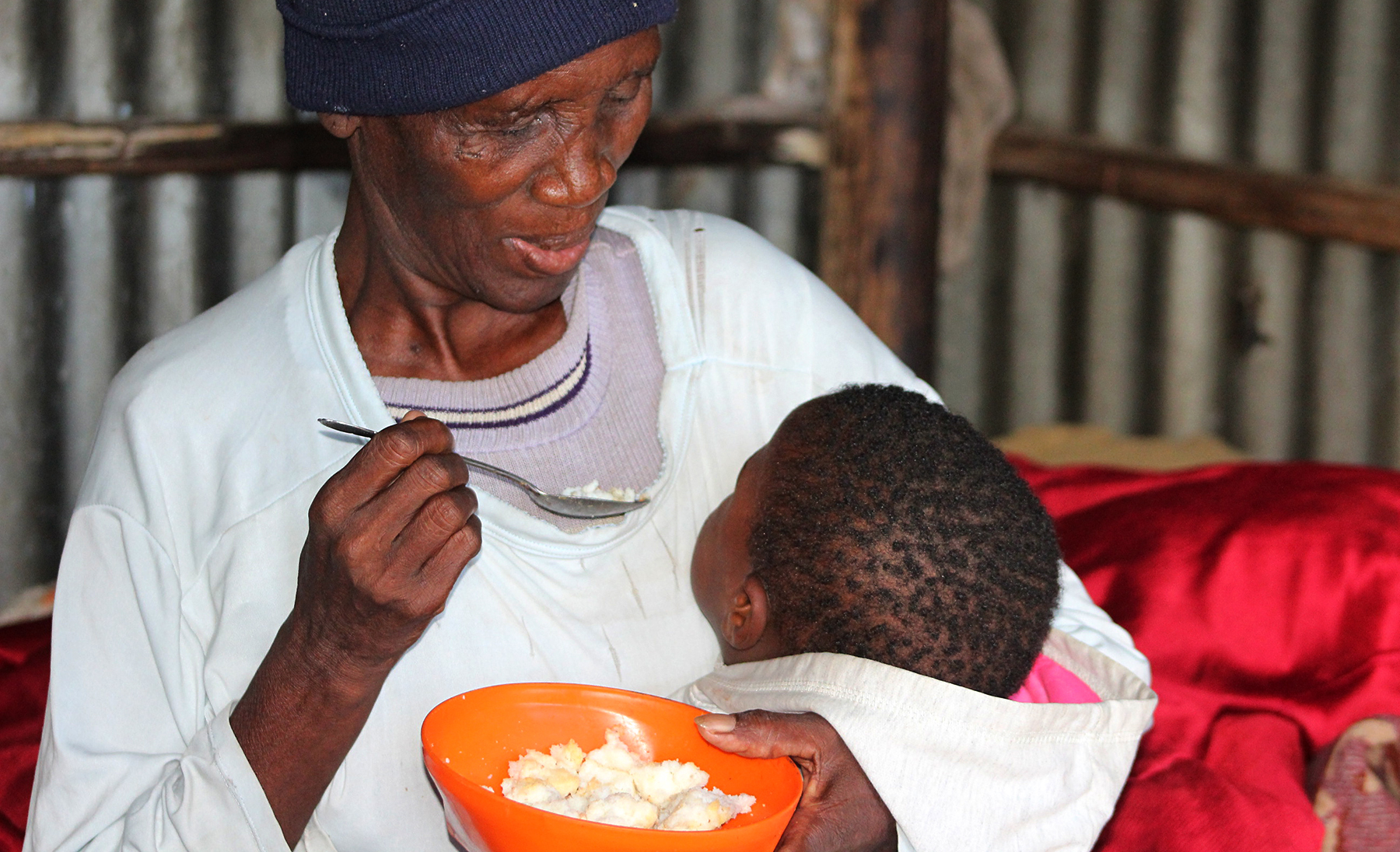
 Nombembe Nolusapho Olivia (70), an old age grant beneficiary, feeds pap to her granddaughter at Chris Hani Park in Mthatha West, Eastern Cape. (Photo: Hoseya Jubase)
 Imagine if every slice of bread and every plate of pap gave you the vitamins and minerals you needed. When South Africa’s fortification regulations came into effect in 2003, this was the idea behind it. Two of the country’s most common staples, maize meal and wheat flour (specifically bread flour), would carry a hidden bonus: essential vitamins and minerals that protect children from disease and blindness, mothers from anaemia and babies from devastating birth defects and poor birth outcomes.
This was no experiment. Across the world, micronutrient fortification had already proven its worth. Adding iodine to salt reduced the odds of goitre by 74% in low- and middle-income countries, and nations that fortified staples with folic acid had 25% to 50% fewer neural tube defects in babies. Today, more than 140 countries mandate fortification of one or more specific foods. Both the World Health Organization and the World Bank consider fortification a smart public health investment: every $1 spent returns about $27 in better health, learning and economic productivity.
Why South Africa chose fortification
Although evidence of child malnutrition in South Africa had been documented since the 1940s, it was only formally recognised as a national priority in 1994 with the new dispensation. Three decades ago, the health minister appointed a National Committee on Nutrition, which developed the Integrated Nutrition Strategy. Together with other studies and consultations it informed the White Paper for the Transformation of the Health System, which ultimately paved the way for South Africa’s fortification programme as a way to close the gap on micronutrient deficiencies. The problem is that many households consume enough food to fill their stomachs and stave off hunger, but their diets fail to provide the vitamins and minerals needed for growth, development and protection against disease. This is known as “hidden hunger”.
The concept of large-scale food fortification (LSFF) is simple and pragmatic: boost the nutritional value of foods widely consumed by a given population so that they deliver more than just calories. Since 2003, by law, maize meal and wheat flour (excluding cake flour) have been fortified with iron, zinc, vitamin A, folic acid and other B-vitamins (B1, B2, B3 and B6). Mandatory fortification of salt with iodine came into effect earlier, in 1995.
What we hoped to achieve
Theoretically, LSFF, if implemented well, shows reductions in children with anaemia and vitamin A deficiency, supporting immunity, improved growth, brain development, school performance, lower rates of neural tube defects and reduced public health costs. In other words, fortification was meant to be a low-hanging fruit in the attempt to reduce hidden hunger.
However, nearly a decade after the programme was implemented, in 2011, a major study led by the South African Medical Research Council sampled maize meal and bread from households in KwaZulu-Natal, Limpopo, the Northern Cape and the Western Cape. The findings, published in 2015, were disappointing: only 10% of maize meal samples met minimum requirements for vitamin A, iron and zinc. Sixty percent were below statutory levels for all three micronutrients. Bread fared better for iron and zinc, but vitamin A was consistently inadequate. Nutrient levels varied widely between brands and provinces, pointing to poor quality control and weak monitoring.
In 2015, the Global Alliance for Improved Nutrition, in partnership with the US Centers for Disease Control and Prevention and the University of the Western Cape’s Centre of Excellence in Food Security, conducted a Fortification Assessment Coverage Tool (FACT) survey in Gauteng and the Eastern Cape. The findings, published in 2017, again showed wide inconsistencies in fortification standards. In Gauteng, only 22% of wheat bread and 11% of maize meal samples were adequately fortified. In the Eastern Cape, just 24% of wheat bread and 17% of maize meal samples met the standard, again highlighting poor and uneven compliance.
Why it matters
These findings tell us that the promise of fortification is unfulfilled. Deficiencies are stubbornly high, with 44% of children under five deficient in vitamin A, 61% are anaemic and one-third of women of reproductive age suffer from anaemia. These numbers translate into children being more susceptible to disease and too tired to learn, mothers at risk during childbirth, and babies born too small or with preventable defects. It also translates into higher healthcare costs and lower economic outputs.
While we have yet to make nutritious food more affordable, for households still dependent on maize meal and bread, fortification is one of the few interventions that can deliver nutrition without demanding more money or changes in consumer behaviour. In a country where poverty drives diets heavy in starch and light on diversity, fortification is not optional, it is essential.
We know that fortification works based on decades of global evidence, and from South Africa’s own gains with salt iodisation which resulted in the near elimination of iodine deficiency disorders.
However, poor implementation and enforcement have blunted the potential of the fortification programme. An independent report commissioned by the DG Murray Trust found current monitoring mechanisms are weak, laboratories lack resources and inspectors are stretched too thin. As a result, consumers cannot be sure that the bread and maize meal they eat are fortified as intended. These gaps undermine the effectiveness of mandatory food fortification and limit its ability to deliver the expected reductions in vitamin and mineral deficiencies.
/file/dailymaverick/wp-content/uploads/2025/09/MC-Baby2-1.jpg "Close to 1,000 children have died of severe acute malnutrition in the past 18 months in South Africa, the Health Department said on 11 September 2025. (Photo: Gallo Images / Sowetan / Sandile Ndlovu)")
A call to action
There is an urgent need for better coordination and monitoring of fragmented systems to ensure that fortified foods consistently reach shops. Stronger systems for oversight, transparency and public awareness are also needed so that people can have confidence in the quality and benefits of fortified foods.
In addition, the government must finalise and implement updated fortification regulations that would strengthen the programme. Draft amendments published in 2016, which introduce more bioavailable iron, increase zinc levels, add vitamin B12 and extend fortification to cake flour, have yet to be finalised.
This does not mean that other interventions are less important. Nutritious foods still need to be more affordable, and broader efforts to reduce malnutrition must continue. But fortification is something we can get right, now.
Calories alone are not enough. Food security should mean more than full stomachs. It should mean children who can grow, learn and thrive. A well-implemented fortification programme can move us closer to that goal. DM
Liezel Engelbrecht is the nutrition lead for the Hold My Hand Accelerator, incubated by the DG Murray Trust. She is also a registered dietitian. Maria van der Merwe is a public health nutrition consultant and registered dietitian.