



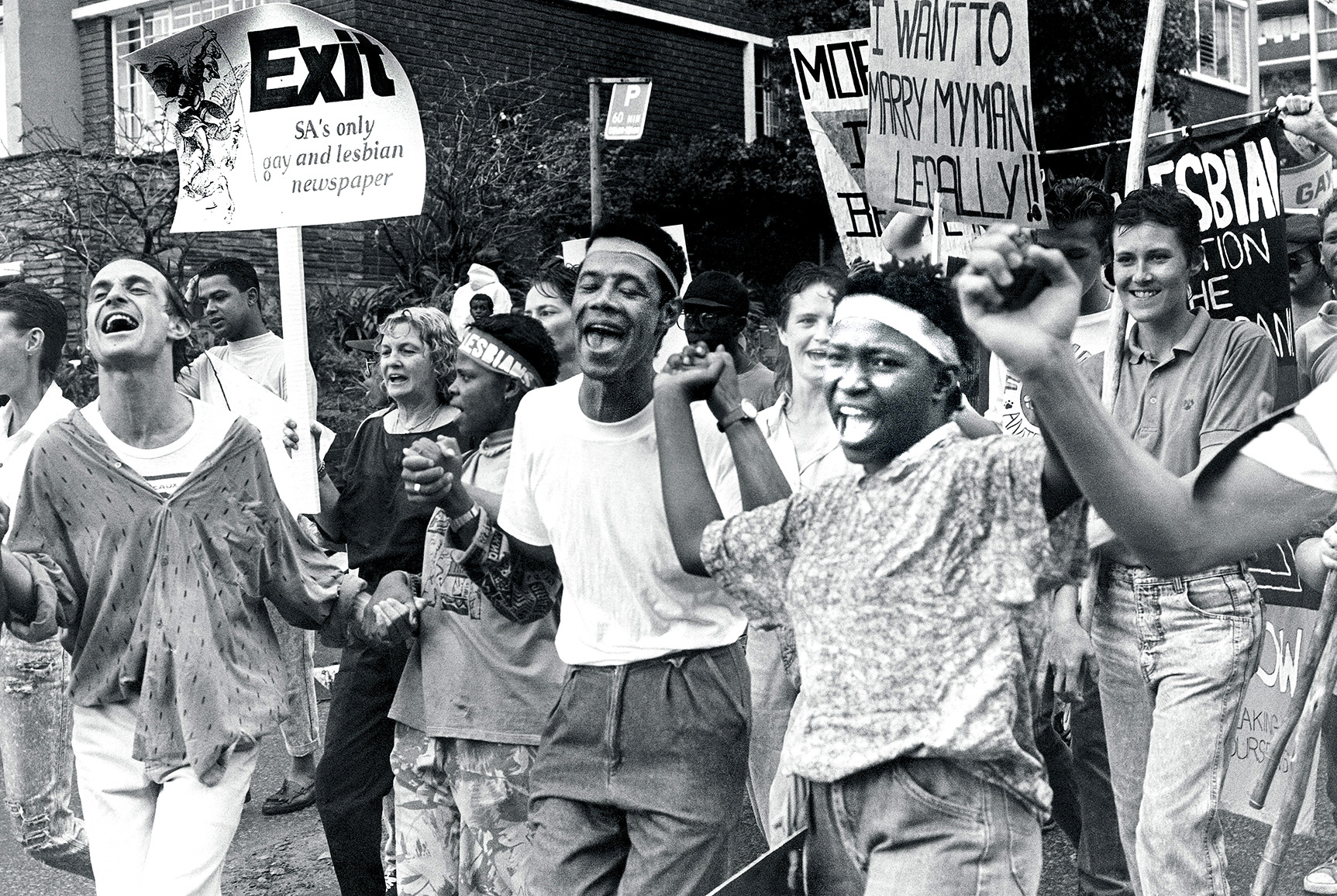
 The Pride March in Johannesburg on 14 October 1990. (Photo: Gallo Images)
On Saturday 13 October 1990, the first Gay and Lesbian Pride march in Africa was held in Johannesburg. That was thirty-five years ago. I was there. The mood was rebellious; it was a sweltering day. We were loud, proud, defiant.
Nelson Mandela had been released on 11 February that same year. (I was there, too.) South Africa (SA) was like a restless teenager, filled with hope; a new dawn was winking.
The eighties were just behind us, hair permed, sprayed, and defying gravity. Afros. Shoulder pads ruled for women, along with boxy jackets, cinched waists, pencil skirts, and belt buckles the size of dinner plates. Men leaned into pastel blazers, sometimes with rolled-up sleeves. The soundtrack? Madonna, Michael Jackson, Whitney Houston, George Michael, glossy, upbeat, synth-heavy anthems.
Onlookers stared at us with disgust as we held hands, kissed and marched down the streets of Africa’s economic capital. But does today’s queer community even care about that day, when it was still a criminal offence to be gay?
It seems SA’s queer history is being bulldozed into oblivion, erased before it can scream. New generations appear uninterested in past struggles, preferring Gatsbyesque Instagram moments, hollow chemsex, and an indifference bordering on rudderless ennui.
Most of the old bars and clubs have closed. Green Point is no longer Queen Point.
Hardly any young queer people I encounter bother to ask about our struggles, the prejudice we endured, the activists who fought for the freedoms they enjoy today. Body dysmorphia masquerades as Muscle Marys; it’s an abattoir of meat in the few gay clubs left in Cape Town. Gone are the little pubs, the numerous clubs, the gay ghetto in Green Point.
Once vibrant, now barely legible, its ghosts drift between the neon of nightclubs and the rubble of forgotten places. What began as a struggle for liberation has been flattened into a burlesque parade sponsored by Jägermeister. What was once radical has become decoration.
/file/dailymaverick/wp-content/uploads/2025/10/000074696.jpg "The Gay and Lesbian Pride march in the streets of Johannesburg on 14 October 1990. (Photo: Gallo Images)")
/file/dailymaverick/wp-content/uploads/2025/10/MC-LifeOfSimon_2.jpg "Simon Nkoli, a gay anti-apartheid activist who was imprisoned in the Delmas Treason Trial. (Photo: GALA Archives)")
Simon Nkoli: The bridge builder
Let’s go back to that day of protest, 13 October 1990. Johannesburg trembled with something new. Around eight hundred people gathered for SA’s first Gay and Lesbian Pride march. Police watched from the edges.
At the front walked Simon Tseko Nkoli, a man who had already tested the country’s tolerance. He was one of the Delmas Treason Trialists, charged with treason by the apartheid regime in the mid-eighties for his opposition to its policies.
Behind bars, Nkoli came out as gay, and his comrades recoiled. He refused to separate his identities. He told the court and the nation that he was both black and gay, both revolutionary and lover, both subject and citizen.
That day in Joburg he led a procession through fear itself. It was not a celebration but a reckoning. SA had never seen queer bodies take the streets and claim them as their own. It was the first Pride on the African continent, and from that fragile beginning a new political vocabulary emerged: liberation was indivisible.
Nkoli’s march lit a fuse that burned all the way to the Constitution of 1996, the first in the world to outlaw discrimination on the grounds of sexual orientation. He did not live to see marriage equality in 2006. Aids-related illnesses took him on 30 November 1998. Yet every rainbow flag that rises in an African wind carries his signature. Thirty-five years later, few remember his name.
As of the most recent data, same-sex sexual activity remains illegal in 32 of Africa’s 54 countries, never mind the trans community, who are treated with even more scorn.
Even the Gay and Lesbian Memory in Action (GALA Queer Archive), a non-governmental organisation dedicated to preserving and disseminating the history and culture of LGBTQI+ people in SA, is ineffective. I typed Nkoli’s name and was offered scant information on him. Why?
/file/dailymaverick/wp-content/uploads/2025/10/MC-LifeOfSimon_9.jpg "Violinist Waldo Alexander and Dancer Lwanele Masiza perform in a scene from ‘GLOW. The cage is many things in the vogue-opera, from disco go-go dancing to a prison cell. It’s symbolic of different aspects of liberation and freedom in Simon Nkoli’s story. (Photo: Mark Lewis)")
/file/dailymaverick/wp-content/uploads/2025/10/MC-LifeOfSimon_4.jpg "Composer and creator Philip Miller with Dr Bev Ditsie, close friends and comrades of Simon Nkoli, during the performance of GLOW, the life and trials of Simon Nkoli. (Photo: Mark Lewis)")
The amnesia of Pride?
In 2023, internationally renowned composer Philip Miller and lyricist S’bo Gyre tried to summon Nkoli’s ghost back to the stage. Their production Nkoli: The Vogue Opera blended protest song, rap, vogueing and opera into a furious act of remembrance. It opened in Joburg before touring to Cape Town. Less performance than resurrection, it demanded that audiences recall the man who stood at the hinge between two freedoms.
Miller spoke of the amnesia within the gay community, the transformation of Pride from protest into pageant. He was right. Today’s marches are sponsored, branded, choreographed. The chants have softened into slogans. Many of the young who dance in rainbow glitter have never heard of Nkoli. White queers especially show little interest.
They don’t know about the police raids on discos, when terrified men were photographed and exposed in newspapers, losing jobs, families and dignity. They don’t know about the handsome officers sent as bait to public toilets where entrapment ended in handcuffs and ruin.
This forgetting is not accidental. It is a quiet, bureaucratic killing of memory. It is memoricide. It stems from an era where wealth and looks buy cachet, not memory, not activism.
As of the most recent data, same-sex sexual activity remains illegal in 32 of Africa’s 54 countries, never mind the trans community, who are treated with even more scorn. Not a word from our own people. Our continent calls, SA’s LGBTQI+ community mostly looks away.
What is also missing are the memories around the many deaths linked to Aids-related illnesses before the discovery of antiretrovirals. Hardly a peep in SA about that. During that period, my partner and I attended a funeral every three weeks for more than two years. Silence.
It’s as if those deceased people who died the most awful deaths didn’t exist, and the mere thought of remembering them is outdated, unfashionable and borders on the infra dig.
Then there were the lesbians, who looked after thousands of gay men during the Aids period. Nobody wanted to touch them, many lesbians took over, washed them, touched them, nurtured them, till they died broken and alone.
Where are the memorials for them? What a sorry lot of zombies our SA’s LGBTQI+ community has become.
/file/dailymaverick/wp-content/uploads/2025/10/000074695.jpg "The Gay and Lesbian Pride March in the streets of Johannesburg on 14 October 1990. (Photo: Gallo Images)")
Graaff’s Pool: A gay monument erased
/file/dailymaverick/wp-content/uploads/2025/10/Graaffs-Pool-in-Cape-Town-was-demolished-in-20005.jpg "Graaff's Pool in Sea Point, was demolished in 2005. (Photo: Supplied)")
Cape Town. June 2005. Twenty years the bulldozers came for Graaff’s Pool, the Sea Point landmark where generations of gay men had swum, flirted, and risked everything for a glimpse of freedom.
The pool began in tenderness. In 1910, a prominent wine merchant built it for his wheelchair-bound wife, who had lost a child and much of her health. He dug a private tunnel from their house to the sea so she could reach the water unseen. Even then, it was a place of discretion, born of love and secrecy.
By the 1970s, it had become a sanctuary for those whom law and morality condemned. Within its high walls, men stripped off both clothing and terror. On one side, elderly Jewish men played chess under the sun, calling their patch The Stockmarket.
On the other, young and older queens laid out bright towels and christened it The Fairy Dell. By night, the air glistened with risk. If caught, as mentioned, there were arrests, names printed in newspapers, lives destroyed.
Graaff’s Pool survived the fascism of apartheid but not the morality of democracy. In 2005, the city council demolished it, cheered on by residents’ groups muttering about perversion and decay. The irony was unbearable. The pool endured the police state but not the open society.
/file/dailymaverick/wp-content/uploads/2025/10/101358237_112625073801816_5501458020724375552_n.jpg "Heritage expert Jim Hislop. (Photo: Facebook)")
Heritage expert Jim Hislop called the demolition “a collective slap in the face of queer history”. As a conservationist he noted, “There was a time when one could be arrested for ‘homosexual activities’. You couldn’t even hold hands in public without fear of being beaten. As a member of the LGBTQI+ community, I felt the City of Cape Town dealt us a collective slap in the face.”
The destruction came wrapped in familiar rhetoric: paedophiles, criminals, moral decay. Right-wing media and residents’ associations wielded every stale stereotype. That the pool survived apartheid but not democracy is a bitter irony.
When the walls finally came down in 2005, they took with them not just a cruising spot but a piece of the gay demi-monde, a place where different struggles intersected, where black and white men existed beyond apartheid's racial boundaries.
Historian Neil Overy asked how a democracy could erase what a dictatorship had tolerated. The city offered no answer, only silence and sand. Oh, the irony: The other day, a young gay friend of mine asked what those ruins were.
/file/dailymaverick/wp-content/uploads/2025/10/000009350.jpg "An aerial shot of Sea Point beachfront, showing Graaf's Pool, taken on 29 September 2005. (Photo: Gallo Images)")
Death of cruising
Before smartphones turned desire into a catalogue of torsos, there was the Sea Point promenade. There were the bushes at Sandy Bay. Cruising was both art and risk, the defiance of presence, the courage to linger and be seen.
I remember those misty evenings, the smell of grass and salt, the glint of a cigarette in the dark. There was danger, but also connection. You had to speak, to read gestures, to trust instinct. In those exchanges, something human survived. Race meant little. The night was its own republic.
Technology killed that world. Now desire lives behind glass. With a swipe, one can summon a stranger or dismiss him. The old skills of conversation and flirtation are obsolete, and with them the sense that queerness was once a shared act of resistance.
Most of the old bars and clubs have closed. Green Point is no longer Queen Point. Sandy Bay’s bushes no longer tremble. What remains are profiles filled with disclaimers: no femmes, no fats, straight acting only, whites only, no whites. Nkoli did not risk his life for this digital segregation.
When I wrote about the death of cruising, only one South African publication took interest. I had sent it to 20. Memoricide.
What remains
Graaff’s Pool is gone, reduced to rubble and memory. Nkoli’s name fades on the air. Pride has been domesticated, its teeth filed down. The queer utopia imagined in the nineties has thinned into an algorithm.
Yet the loss is not irreversible. Memoricide is a choice, and so is remembrance.
We can still tell these stories. We can teach the young about Simon Nkoli, about the men who met in the shadows, about the pool that offered shelter when the world spat on them. We can remember that Pride was born from protest, not profit.
Writer Hennie Aucamp once asked, “What remains of kisses?” The answer is truly little, unless we choose to remember. If we do, what remains is everything: the courage, the solidarity, the defiance, the love.
I think of Nkoli standing at the front of that first Pride, his voice steady in the Johannesburg heat: “I am black, and I am gay. I cannot separate the two.”
That memory is ours to keep, or to lose. The latter? DM
Herman Lategan is a queer journalist and author based in Cape Town.