




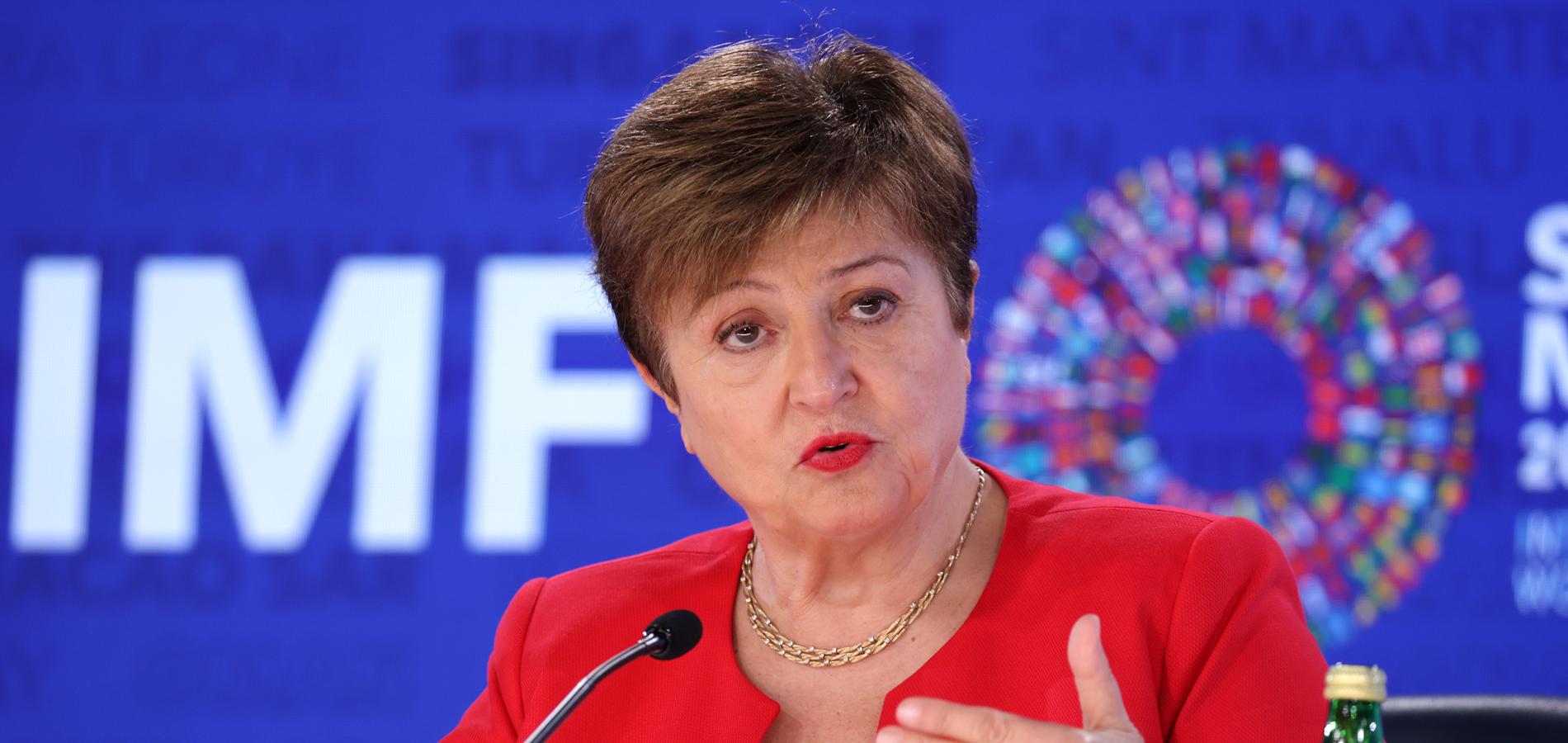
 Kristalina Georgieva, Managing Director of the International Monetary Fund (Source: Getty)
 The IMF meets this week in Washington and will launch its October World Economic Outlook (WEO), already giving guidance to its forecast for global economic growth this year, of around 3.0% y/y, with its Managing Director Kristalina Georgieva commenting it is “better than feared, but worse than we need”.
Economic resilience will be a key theme – underpinned by less severe tariff outcomes than initially expected, private-sector adaptability, supportive financial conditions, and improved policy fundamentals.
US trade policy has, however, been volatile and inconsistent this year, with several delays in implementing the universal tariff until early August. As a result, exports to the US have avoided this tax for most of the year, marginally improving the global growth outlook.
Resilience through policy credibility
In its curtain-raiser speech for the 2025 Annual Meetings, the IMF highlighted significant improvements in monetary-policy credibility worldwide. Coordinated fiscal action during the pandemic helped limit lasting economic scars, while the adoption of new fiscal rules has strengthened outcomes.
Instituting credible fiscal anchors remains essential to improving the governance of state finances, which were heavily strained by the pandemic. Fiscal rules seek to promote long-term sustainability in a context where global public debt is expected to exceed 100% of GDP by 2029; while inflation targets aid in lowering inflation expectations – crucial in a world where the IMF’s Georgieva warns that “uncertainty is the new normal and it is here to stay”.
Trade turbulence and the adaptability dividend
The private sector has shown remarkable adaptability amid the uncertainty created by the US’s protectionist turn. Businesses stockpiled inventories ahead of tariff introductions – many of which were later delayed – softening the impact of trade policy shifts.
Global trade has therefore proved more resilient than feared, but the tendency for the US to make broad sweeping tariff changes keeps risk alive and adds to geoeconomic fragmentation.
The gold price’s record highs reflect ongoing uncertainty, while global equities have surged, buoyed by tariff delays and the rollback of earlier US protectionist measures against its key trading partners such as China and, to a lesser extent, the EU.
AI-driven productivity gains have also been a key driver for global stock markets, while corporate balance sheets remain robust after years of strong profits.
South Africa’s reform trajectory
For South Africa, the IMF has pencilled in 1.0% growth for 2025. Sustained, structural reform in freight, electricity, and other key service sectors will be essential to lift potential growth above a sustainable 3.0% level.
In addition, the domestic bond market remains deep, liquid and transparent, offering attractive returns relative to our emerging market peers.
The banking sector is well-capitalised and prudently managed, while the JSE continues to be one of the deepest and most sophisticated exchanges in the developing world, supported by full capital mobility and strong rule of law.
Lower inflation, credible policy – and market confidence
Globally, the IMF notes expectations still point to “higher-for-longer” interest rates, particularly in real terms, even as inflation moderates. The same applies to South Africa, where the SARB has lowered its inflation target to 3.0%, from the 3–6% range introduced in the early 2000s.
This strengthened monetary policy credibility has already reduced consensus inflation forecasts and should enable a significantly lower interest rate environment for South Africa in the next few years.
The domestic bond market has benefited, while fiscal sustainability remains a priority for the Government of National Unity that emerged from last year’s free, fair and peaceful elections.
From public pressure to private partnership
The IMF’s 2025 themes of resilience, inclusion, and private finance for development underscore the opportunity to use private capital to drive inclusive growth in an era of strained public balance sheets.
For South Africa, these themes resonate strongly:
- Government is advancing public–private partnerships to accelerate infrastructure renewal.
- Private rail operators are expected to begin operations next year.
- Freight volumes are already seeing moderate improvements.
- Rolling loadshedding has been eradicated; and
- Visa reforms have been implemented to attract skills and investment.
As the IMF’s Managing Director stresses: “Durably lifting growth requires higher private-sector productivity. And for this, governments must provide and protect the basic building blocks of free markets, including property rights, rule of law, good data, effective bankruptcy codes, strong financial sector oversight, and independent yet accountable institutions”.
Getting the house in order
The call from Washington is clear: “This is not a time for self-inflicted injuries; it is a time to get the house in order.”
South Africa’s opportunity lies in translating credibility into execution – by maintaining reform momentum, reinforcing institutions and harnessing private capital to unlock sustainable, inclusive growth. DM
For more insights on the IMF and other macroeconomic themes, follow Investec Focus Radio SA on Apple Podcasts, Spotify or YouTube. You can also subscribe to the Investec Focus fortnightly newsletter.
Author: Annabel Bishop, Investec Chief Economist