



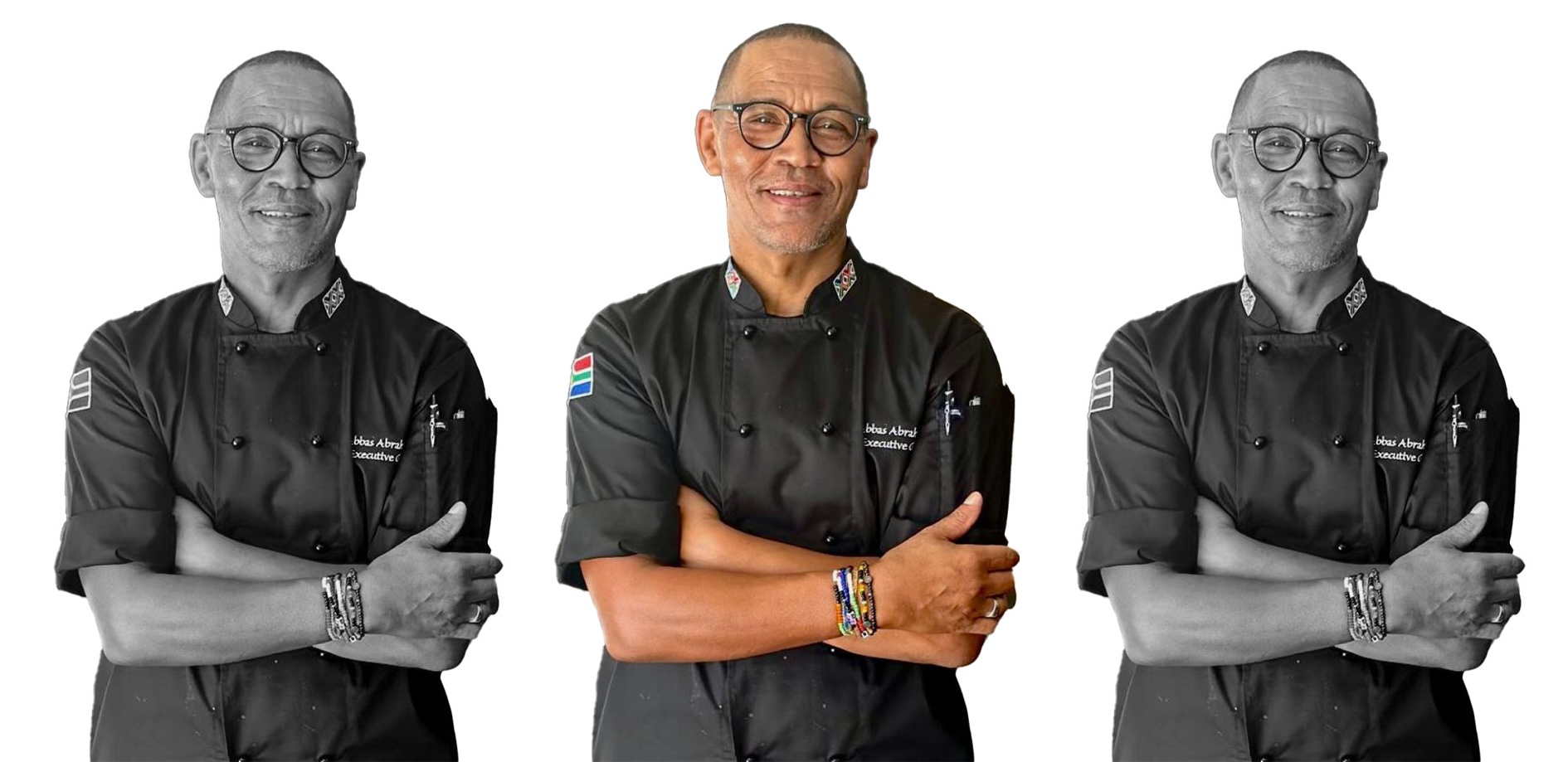
 Meet Chef Abbas Abrahams. (Photo: Supplied)
In decades of writing about food and restaurants at the Cape, I must have eaten this chef’s food many times without knowing it. Unlike so many celebrated chefs, Chef Abbas Abrahams has spent his career in the shadows of others in the Mother City. But he’s always been there.
To meet him, I had to be invited to the Century City Conference Centre, of which I’d never heard. I had no idea there was a second conference centre in Cape Town. If I’d lived there during the last 11 years, of course I would have known it, and doubtless would have been there a number of times.
An invitation to visit the Century City Conference Centre, to interview their executive chef, was followed by mad confusion when even the GPS seemed a tad confused. But my confusion was more to do with where to park, as all the Century City side roads seem to go one way. When I finally figured it out, up in a lift I went to find myself in a beautiful conference centre foyer, where I was met by Sue Levy, Group Marketing Manager.
Everything fell into place immediately. There’s the larger, more famous Cape Town International Convention Centre, and then there are the many hotel-based small conference venues. This one fills the gap, offering a conference experience more personal, less remote, but still on a fairly large scale. If you find the cavernous spaces of the CTICC a bit intimidating, as I do, this is a more attractive option. Sue explained that the venue has just won the Eventex Large Venue Award.
'People come back for the food'
But, she says, “Chef Abbas is the reason why it’s all so successful. People come back for the centre, but they also come back for the food. Anyone who books a conference here is also booking for whatever they need.”
Chef Abbas Abrahams is 100 percent in charge of all that. He’s so fundamental to its success that he has been persuaded out of retirement — twice.
“Basically what we’ve done is bring Cape Town to all of the international and local guests,” Sue says, and her personal passion for this effort is clear to see. It was Levy who wanted me to meet the chef.
Chatting to Abbas Abrahams for an hour at the Century City Conference Centre, I found myself tracking his career. All of it in Cape Town. All of it over the decades that I lived there myself, until 11 years ago. For those decades, this man was in a kitchen somewhere in Cape Town, while I wrote about food and restaurants all along the way.
/file/dailymaverick/wp-content/uploads/2025/10/Century-City-Conference-Centre-Business-Lounge-Bowl-Food-Lunch-with-Wine-1.jpg "Business Lounge bowl food lunch with wine at the Century City Conference Centre. (Photo: Supplied)")
Sue and I chatted for a while in a meeting room, while waiting for the chef. She explained that he was rather shy, and nervous of meeting me. With hindsight, I’m embarrassed that I was not aware of most of his career. In the Nineties when I was all over the Cape restaurant scene for my columns in the Cape Times. Or in the Eighties when I knew all the top restaurants, including the dining rooms of spaces such as the Cape Sun, Townhouse Hotel, Mount Nelson and the President. Always, he was there, somewhere. Never did we meet.
It’s the famous chefs who get all the attention. That’s the thing. And, as chef Abbas and I talked later on, we found our way to a lightbulb moment.
A eureka moment.
'You'd never have found a koesister on a local menu'
We were chatting about how few South African dishes have been on Cape Town menus over the decades, with some exceptions of course. The old Kaapse Tafel in Queen Victoria Street for instance.
But, by and large, the city’s menus were continental. You’d never have found a koesister on a local menu (as I did recently at Veld restaurant at Spier Hotel). Or hardbody chicken, straight out of the farmyard into the kitchen at The LivingRoom in Durban.
And the lightbulb flashed. It was the continental chefs in all the top hotels who were responsible. They scorned local food. Found it inferior to what they regarded as good.
With German, Austrian and Swiss chefs in charge of all the big kitchens, and their distaste for Cape dishes and ingredients, an entire cuisine was casually suppressed. There was no evil intent, no design — it was too flippant for that.
/file/dailymaverick/wp-content/uploads/2025/10/Century-City-Conference-Centre-Business-Lounge-Buffet-2-2.jpg "Business Lounge buffet at the Century City Conference Centre. (Photo: Supplied)")
Ironically, today chef Abbas is in charge of a kitchen so big that he doubts there’s a bigger one anywhere in the city. It’s ginormous. He took me through, past station after sizeable station, and the output of this space is bewilderingly huge.
“I just don’t think those continental chefs have an interest in what we make here,” Abbas said. “And I think that’s a part of the problem. I think they came with their experience and they wanted to showcase what they knew. So we just had to follow suit.”
And chefs born and bred at the Cape found themselves making continental starters, main courses and desserts, ignoring everything they grew up with in their kitchens at home.
But here’s a delicious irony. Now, in his early sixties, Chef Abbas is turning out the delicacies of the Cape, and of his own youth and cultural background, for international delegates attending conferences at the Century City Conference Centre.
'Nowadays it's us in charge'
And they’re loving it. The testimonials from clients are glowing. Invariably, the raves are about the food.
Chef Abbas expounds: “But nowadays, it’s us [who are in charge of kitchens]. As South Africans, we can showcase our dishes. And we like our spice and our fruit. And you know, on the West coast we like a bit of apricot jam with our snoek.
“And so what should a clever chef do? He says, okay, let’s take the yellowtail and the apricot jam and just play with it. And then make something that the European palates will think, ‘I like that.’’’
On his Braai menu you’ll find smoked snoek and apple paté, mini boerewors rolls, smoked lamb loin chops, and hertzoggies. On the Taste of Cape Town menu there is braised deboned oxtail casserole, brilliant chicken thigh breyani (I tasted some), and mini braised masala steak gatsbys.
/file/dailymaverick/wp-content/uploads/2025/10/gatsby.jpg "Lekker miniature gatsbys. (Photo: Tony Jackman)")
If only the continental chefs in the city’s hotels in the Eighties and Nineties had thought to ask their staff what they ate at home. But it was beneath them. And there we were, tucking into vol au vents and apfelstrudel without anyone in the room ever having heard of boeber or a koesister.
No vol au vents here today. Sue explains that the day before, there had been an event called Locally Inspired, that included a “sip and paint”. Artworks hang everywhere in the broad, airy spaces, part of their ethos of supporting local art, and delegates had been treated to a masterclass with Fadiel Hermans, the artist with the largest collection at the venue. He taught them how to paint a skyline of Signal Hill and Bo-Kaap houses.
And Chef Abbas’ food of course. And showcase Cape cuisine he does. He brings out some samples of the menu he presented to conference delegates the day before at the Locally Inspired event. It’s no wonder he receives so much praise. That lovely breyani (I took some home), bobotie springrolls, miniature gatsbys, malva pudding, milk tart.
But his food offerings are flexible: standard menus serve as a starting point, but chef Abbas customises menus to fit individual client needs.
But let’s rewind to the moment I finally met this modest chef…
Not that Long Street
I greet Abbas like a beaming old friend as he walks into the meeting room, and he relaxes visibly. I wanted to defuse his nervousness immediately. I’m intrigued and a little circumspect because I’m thinking: Why am I only meeting him now?
He tells me he was “born in Long Street in 1963”. But not that Long Street. This was Long Street, Constantia. But not the Constantia of today that most people can’t afford. This was the Constantia slap bang in the middle of the apartheid years. And by the mid-Sixties, the young Abbas and his family were forced to move out of that part of the suburb.
In the vicinity of Ladies Mile Drive, he said, “there’s an old school on the corner and we used to live on that side”.
They moved to Lotus River and later to Parkwood, near Wynberg and Plumstead. And it’s here that his food story begins.
/file/dailymaverick/wp-content/uploads/2025/10/breyani-1.jpg "Perfect breyani by Chef Abbas. (Photo: Tony Jackman)")
“When we lived in Parkwood Estate — because it’s flats, you know, it’s government flats — we used to have a neighbour. And I was always intrigued because this auntie could do anything. She could bake, bake a biscuit, bake a koesister. She made beautiful Malay food. And I was always intrigued.
“And then she said to me one day, ‘What do you wanna do when you finish school?’ And I said to her, ‘You know what? I would love to be a chef, but I think you have to go to a school to learn how to do that.’ And she says to me, ‘No problem, I’ll organise it.’”
The auntie next door found out that there were courses being offered at the Landdrost Hotel in Lansdowne Road. The Landdrost Hotel where my family and I stayed on a visit to Cape Town in the early Sixties; I still have a photo of me next to the rented car parked outside, a little two-tone Austin. It could easily have been around 1963, when Abbas was born. This man whose life has been happening not far from my own, for so long.
It was like a year-long crash course, he said, at a mini campus on the hotel site.
“But the good thing about it is that they set you up in the hotel, there, where they applied for jobs for you. And I started in June 1982, at the Capetonian Hotel.”
A three-year internship saw him there, then at the Heerengracht Hotel, then at the Park Inn in Joburg.
Hotel kitchens became his secure space through all the years — including the President, the Westin on the Foreshore, the Crystal Towers at Century City — but he preferred being in a deputy position for most of it.
'I wanna work hard, look smart, be a good chef'
The Austrian and German chefs had drilled them in those early days, he said.
“I said to myself, you know what? I wanna work hard, look smart, and be a good chef, number one: a sous chef. This is the chef beneath an executive chef, because an executive chef takes all the punches.
“And as buildings went up in Cape Town and surrounding areas, I always set myself goals and said, ‘You know, you’re gonna work there in the next two years.” And he’d do that, the (modern) President (where he was head chef) and the Westin being two examples.
And while he was at the Westin, he found himself driving through Century City where the Crystal Towers hotel was going up. And soon afterwards, Gary Koetser, CEO of Century City Conference Centre and Hotels, asked Abbas to open up the kitchen at the new hotel.
But here’s the thing: the CEO and the head chef had met before.
“I knew him when I started at the President, and he was a young boy who came into the kitchen to do his training. Because as [trainee] managers they have to go into the kitchen and you really train them, you know? This is a plate, this is a steak, this is medium, this is rare. And I used to kick his ass big time, because I knew he also had a destiny. And I used to give him all the crappy jobs. Like, pack out that freezer and scrub it, and don’t switch it off.”
And finally, I’m able to pinpoint a time when, I believe, Abbas and I actually did meet, after all. The restaurant at the Crystal Towers was called, well, The Towers. There was a media launch one night in 2010. I remember colleague Bianca Coleman being there too. And after the meal, the chef came out. With hindsight, it’s a bit of a seminal moment for me, brushing shoulders at last with the chef in the shadows.
And I’m smiling now, because I’ve been in his current kitchen, and it’s much bigger than any hotel kitchen I’ve been inside of. All those continental chefs can fall in line.
It was his association with that junior version of Gary Koetser that led him to this role at the Century City Conference Centre. And now, twice returned from retirement, Chef Abbas has marked 10 years of no longer being retired, and of working under that kid who walked into his kitchen. That’s serendipity. DM