




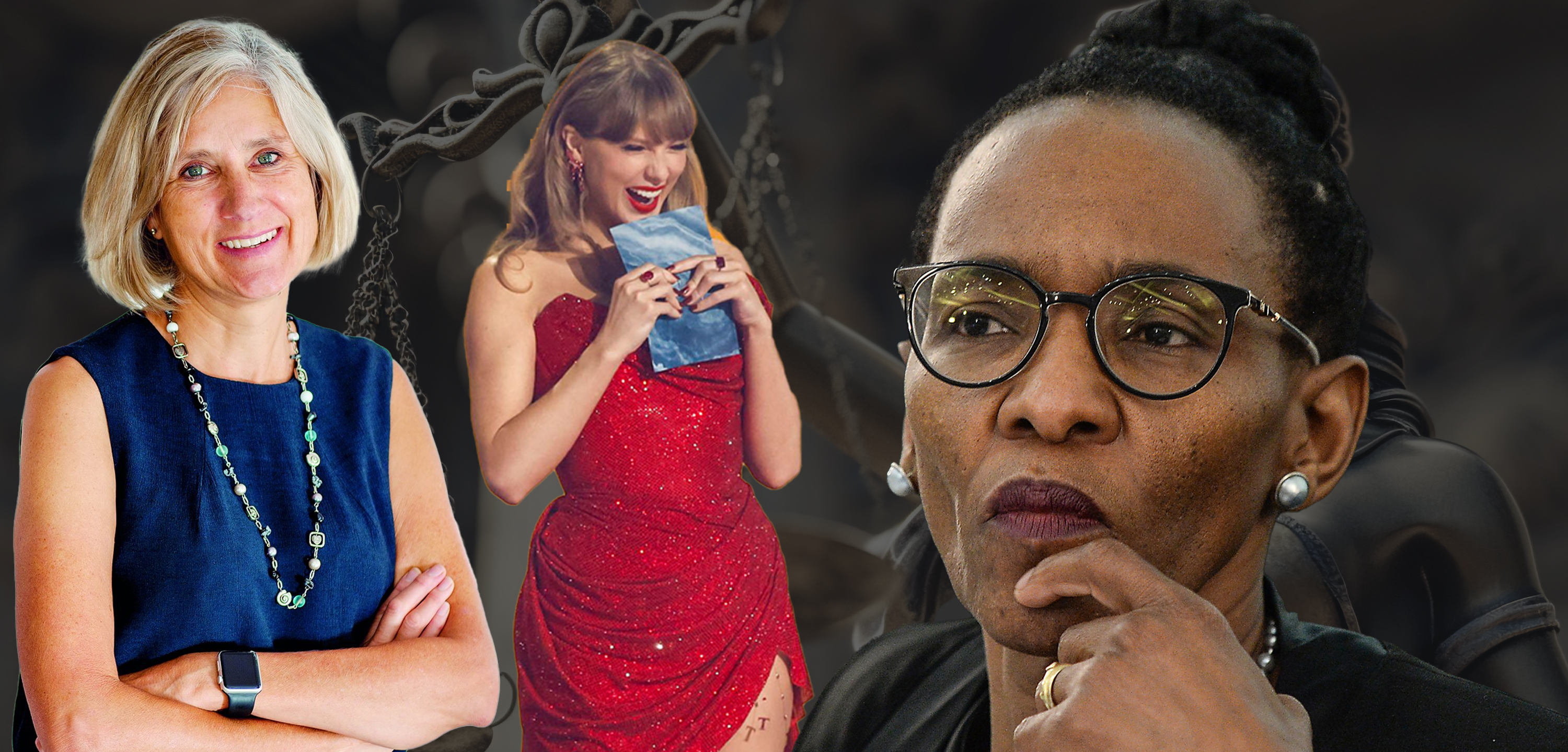
 Illustrative image | Lady justice. (Photo: Freepik) | Judge Kate Savage. (Photo: Facebook) | US singer Taylor Swift. (Photo: EPA / Caroline Brehman) | Chief Justice Mandisa Maya. (Photo: Gallo Images / Daily Maverick / Felix Dlangamandla)
 “Haters gonna hate, hate, hate.”
Such is the cultural reach of Taylor Swift that she has now officially penetrated the proceedings of the Judicial Service Commission (JSC).
In the first-ever instance of a pop song being cited at the JSC’s judge interviews, Labour Appeal Court Judge Katharine Savage quoted the lyric from Swift’s song “Shake It Off” by way of explaining her attitude towards gendered bullying among the judiciary — though she did admit she was “probably 20 years too old” to be a Swiftie.
It was one of the lighter moments in two days of interviews to fill the two vacant positions on the Constitutional Court, which has not had a full bench of judges since 2016.
This has resulted in lengthy delays and significantly elevated workloads.
“There just is too much work!” exclaimed Chief Justice Mandisa Maya at one point, in what she subsequently termed an “emotional outburst”.
/file/dailymaverick/wp-content/uploads/2025/08/ED_561838.jpg "Mandisa Maya (Chief Justice of South Africa) at the 30th anniversary of the Constitutional Court at Constitution Hill on June 20, 2025 in Johannesburg. (Photo: Gallo Images / Luba Lesolle)")
The commission is required to present President Cyril Ramaphosa with three more nominations than there are vacancies to pick from. With such a pressing shortage of judges, the JSC did not have the luxury of not recommending candidates, as it has done in the past.
With only six candidates to interview, all but one were virtually guaranteed a straight shot through to the nomination — and it wasn’t hard to guess who the exception would be.
Candidate accused of theft
Dr Madumetja Malepe was applying for a spot on the Constitutional Court not as a practising advocate or judge but as an academic, which is permissible, but has been rare for Constitutional Court applicants in recent years.
The fact that Malepe had no experience as an acting judge was always going to count against her — but as her interview unfolded, one was left wondering how she was shortlisted at all.
It emerged that Malepe, who has spent 25 years at the University of Venda, had published just two journal articles in her entire academic career, and even these were not in accredited journals.
Malepe explained that she had written nine articles, but “most of them were not published”.
Asked if she could cite any Constitutional Court judgments with which she strongly agreed or disagreed, Malepe seemingly could not produce one from memory.
The interview went from bad to worse when commissioners raised the fact that she had been accused of stealing funds from her church in 2023, and was unable to provide verified proof that she had been found not guilty.
It then emerged that she is currently under debt review, with commissioner Tembeka Ngcukaitobi pointing out that if she were found to be insolvent, she would be ineligible to be a judge.
“The indebtedness I had is coming down,” the academic insisted.
/file/dailymaverick/wp-content/uploads/2025/07/ED_193909.jpeg "Tembeka Ngcukaitobi. (Photo: Frennie Shivambu / Gallo Images)")
Malepe denied that her debt suggested an inability to manage her finances, saying that she was a “budget manager” of her unit at the University of Venda.
“I cannot be discriminated against because of my financial status,” she contended, but her application was dead in the water for a host of other reasons.
Five judges nominated
The five other judges — Nambitha Dambuza, Alan Dodson, Glenn Goosen, Katharine Savage and Ashton Schippers — all had reasonably strong interviews and won nods from the JSC.
With commissioner Julius Malema busy with the Mkhwanazi inquiry in Parliament, the questioning was fair and robust — as it has tended to be with Maya chairing.
/file/dailymaverick/wp-content/uploads/2025/10/JSC-Oxtoby-Feburary-copy.jpg "Illustrative image | Glenn Goosen. | Alan Dodson. | Nambitha Dambuza-Mayosi. | Katharine Savage. | Ingrid Opperman. | Ashton Schippers. (Photos: Judges Matter)")
With delayed judgments already an issue at the Constitutional Court, Dambuza — the first in the hot seat — was questioned on several pending judgments, including one reserved for two years.
Dambuza explained that the issue in that case was that a file was mistakenly taken to the registrar’s office, and said her normal time to deliver a judgment was between three and six months.
“There is no time that I’m not working on a judgment,” including on weekends, she assured the commission.
In previous iterations of the JSC, white male candidates have faced particularly rough rides in terms of defending their candidacy with reference to transformation imperatives, but that appears to no longer be the case.
Indeed, Chief Justice Maya interjected in support of one such candidate, Goosen, when he was asked what he had done to pursue transformation.
Maya described Goosen as having been “a young white man who was a vigorous activist”, pointing to his work at the End Conscription Campaign and involvement in the United Democratic Front. She concluded: “Your stripes in that respect are unquestionable.”
/file/dailymaverick/wp-content/uploads/2025/10/PIC-2.jpg "Kate Savage. (Photo: University of Cape Town / Wikpedia)")
/file/dailymaverick/wp-content/uploads/2024/09/GettyImages-2166920457.jpg "Taylor Swift performs on stage during the \"Taylor Swift | The Eras Tour\" at Wembley Stadium on August 15, 2024 in London, England. (Photo by Kate Green/Getty Images)")
Arguably, the most impressive interview was given by the aforementioned Swiftie, Savage, who seemed to win over the commissioners with her impassioned, energetic delivery and unabashed feminism.
Savage suggested that the Constitutional Court should aim to become the first national apex court in the world to have a female majority on the bench.
Many women in the judiciary had faced “an enormous amount of bullying”, said Savage.
An odd feature of her candidacy seemed to bear this out: despite receiving a record number of nominations, including seemingly from every female silk in the Western Cape, both the Law Society of South Africa and the Black Lawyers Association explicitly noted that they did not support Savage.
“I was amazed,” Savage said candidly when questioned on this seeming paradox by commissioner Athol Trollip.
But there was consolation from Justice Minister Mmamoloko Kubayi, who told her that many women would be “proud to see how you stand your ground”. DM
JSC interviews to fill other court vacancies continue this week.