



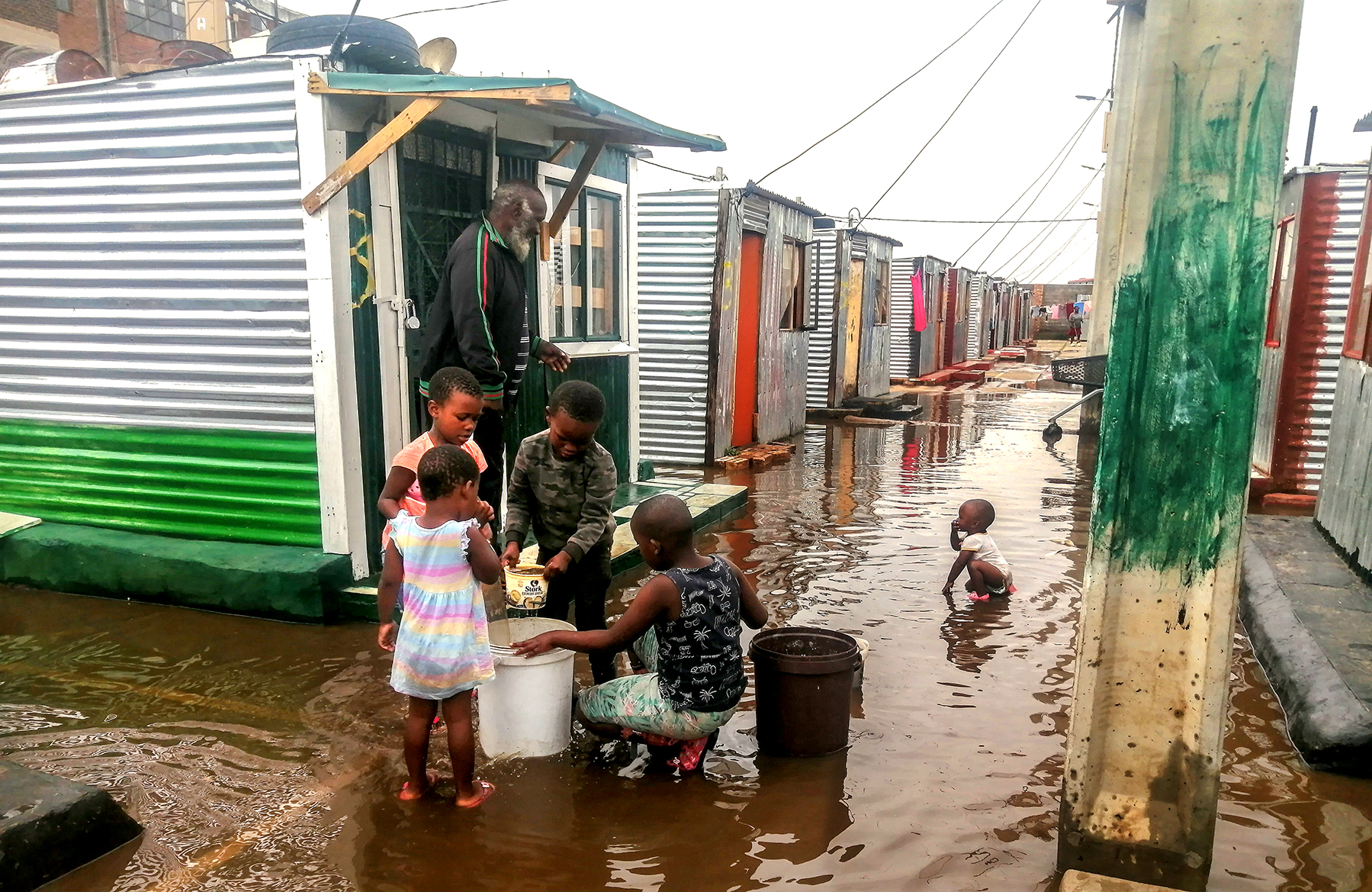
 Children as young as three play in floodwater at the Denver Temporary Relocation Accommodation on 29 September. (Photo: Bheki Simelane)
 Many of the hundreds of residents of the Usindiso building in Marshalltown, Johannesburg who survived the deadly fire in the building on 31 August 2023 continue to face hardship and are still living in temporary accommodation or in buildings that lack basic services.
Many of the survivors were initially placed in shelters and then moved to a newly established temporary relocation area (TRA) near the Denver Men’s Hostel.
Survivors who moved to Denver complained about crime and flooding in the area, and a number left the hostel and moved into small shacks. While many still live in Denver, other survivors are scattered around the Johannesburg CBD and nearby informal settlements.
/file/dailymaverick/wp-content/uploads/2025/10/IMG_20250929_112416.jpg "Floodwater between shacks at the Denver TRA on 29 September. (Photo: Bheki Simelane)")
Read more: Precious little has changed, say Marshalltown fire victims one year after the deadly tragedy
Shootings and flooding
Residents say the Denver TRA has been infiltrated by criminal elements.
Thobeka Biyela, a resident at the Denver TRA, was hit on the hip by a stray bullet this year. She had an operation and lost her unborn baby in the process.
“I was shattered to lose my child,” she said. “I was sleeping in my shack during the day when I was hit.”
She will have the bullet in her body for the rest of her life after doctors told her it was risky to remove it because it was lodged between bones. She said the left side of her body was gradually swelling.
/file/dailymaverick/wp-content/uploads/2025/10/IMG_20250929_121942.jpg "Thobeka Biyela shows the scar from where she was operated on after being hit by a bullet. (Photo: Bheki Simelane)")
Read more: Lest we forget: lessons unlearned, actions undone one year after the deadly Marshalltown fire
In another incident in the area, a bullet penetrated three shacks before landing on the bed of 63-year-old Bonginkosi Dlomo’s shack.
“It landed on my bed, and we also realised that on its way, it had gone through three other shacks,” said Dlamini.
/file/dailymaverick/wp-content/uploads/2025/10/IMG_20250929_114211.jpg "A bullet hole in a shack at the Denver Temporary Relocation Accommodation. (Photo: Bheki Simelane)")
Many of those who have been accommodated in the Denver TRA are unemployed.
When Daily Maverick visited the area recently, many residents were trying to remove water from their shacks, which had been flooded after heavy rain.
“This place was meant to be a temporary shelter, but [it’s] clearly permanent now,” said Linga Dlomo (60). “There must be something the city can do about this flooding and the fact that we cannot make ends meet.”
Temporary becomes permanent
The TRAs established by the City of Johannesburg were meant to offer temporary relief, but are becoming permanent dwellings.
The city’s human settlements department told Daily Maverick in 2024 that it was looking for extra funding to provide temporary accommodation for up to 50,000 people in need.
In Part Two of its report, the Khampepe Commission of Inquiry into the Usindiso fire debunked the idea that all of the CBD’s “bad buildings” had been hijacked by criminal syndicates.
“Instead, many properties are occupied by residents driven by dire poverty, not necessarily by illegal landlords,” said the report.
The report called on the city to adopt a clear plan to address homelessness, immediately provide services at “bad buildings”, and reevaluate the budget for TRAs.
While the city has a “bad buildings” strategy and Gauteng Premier Panyaza Lesufi has committed to appointing a committee to implement the Khampepe Commission’s recommendations, there are doubts about their willingness and ability to act.
In a statement in September, the Socio-Economic Rights Institute (Seri) urged the government to effectively implement the recommendations and provide additional capacity from the Presidency and the national Department of Human Settlements, otherwise “we fear that these recommendations will remain unfulfilled, as has been the case with Part (i)” of the Khampepe report.
“The fire and its ramifications hit at the heart of the housing crisis in South Africa, especially Johannesburg’s inner city. The victims and survivors of the Usindiso fire deserve justice, and the dignity of all inner-city occupiers ought to be restored,” said Seri.
Read more: Usindiso tragedy: City of Joburg ignores accountability as mayor eyes site for offices
Squalid conditions
Two survivors, siblings Neliswa and Nondumiso Ngubane, who were 21 and 23 years old, respectively, at the time of the fire, have struggled to find permanent shelter. They currently live in a temporary shelter in Jeppestown, in squalid conditions.
“We were stranded from the day of the fire until we found temporary shelter,” said Nondumiso.
The siblings lost everything in the blaze.
“We were deserted because we have never received any assistance from the city,” said Nondumiso.
City responds
Responding to Daily Maverick’s questions on whether there was a plan to provide permanent housing for the survivors, City of Johannesburg spokesperson Nthatisi Modingoane said: “The preliminary reports were referred to the boards of the entities for implementation. The final report was sent last week and will be referred to various boards for implementation.”
The first part of the Khampepe report found the city and its Johannesburg Property Company (JPC) had effectively abandoned the Usindiso building, which it owns, and called for appropriate action from JPC boss Helen Botes, who has since left the entity.
Asked what action the city was taking to provide permanent shelter for the fire survivors, Modingoane responded: “There is currently not enough funding for the human settlements department to build new homes and relocate people living in Denver and Turffontein into new units.”
Unclaimed bodies
The bodies of 15 Usindiso fire victims remain unclaimed at the Diepkloof Mortuary in Soweto and face pauper’s burials if no families claim them.
“Administrative processes are at the final stage. The bodies will be buried soon,” said the Gauteng Department of Health spokesperson, Motaletale Modiba.
“The bodies will be buried as paupers if still unclaimed,” said Modiba, without specifying a date.
The first part of the Khampepe report, released in April 2024, said of the bodies positively identified at the time, 23 were South African, 20 were Malawian, six were Zimbabwean, four were Tanzanian and four were Mozambican. At the time, 19 bodies were unidentified.
A coalition of NGOs and activists, the Johannesburg Fire Response Action Group, found that of the 501 survivors, there were 264 South Africans, 113 Malawians, 93 Tanzanians, 19 Zimbabweans, three Kenyans, three Mozambicans, five from Lesotho, and one from Eswatini.
/file/dailymaverick/wp-content/uploads/2023/10/joburg-main-2.jpg "The Usindiso building shortly after the deadly fire on 31 August 2023. (Photo: Supplied)")
‘Very difficult’
Fire survivor Mike Ngulube’s story highlights how painful the two years since the blaze have been. “It’s been very difficult, from the day of the fire to this day,” he said.
The 36-year-old survived the fire but lost his wife and child. He became aware of his loss when he awoke from a coma at the Chris Hani Baragwanath Hospital in Soweto.
On 3 September, a month after the death of his 15-month-old daughter, Memory, the child’s body was erroneously released to the wrong family for burial.
“We tried to make a follow-up, but the forensic department was denying responsibility,” he said.
Ngulube said tests to establish the child’s DNA proved that she was his child.
“So, life is very difficult when on top of the trauma I live with, you also have to contend with such life complexities,” said Ngulube.
“To this day, I don’t know where and how my child was buried.” DM