




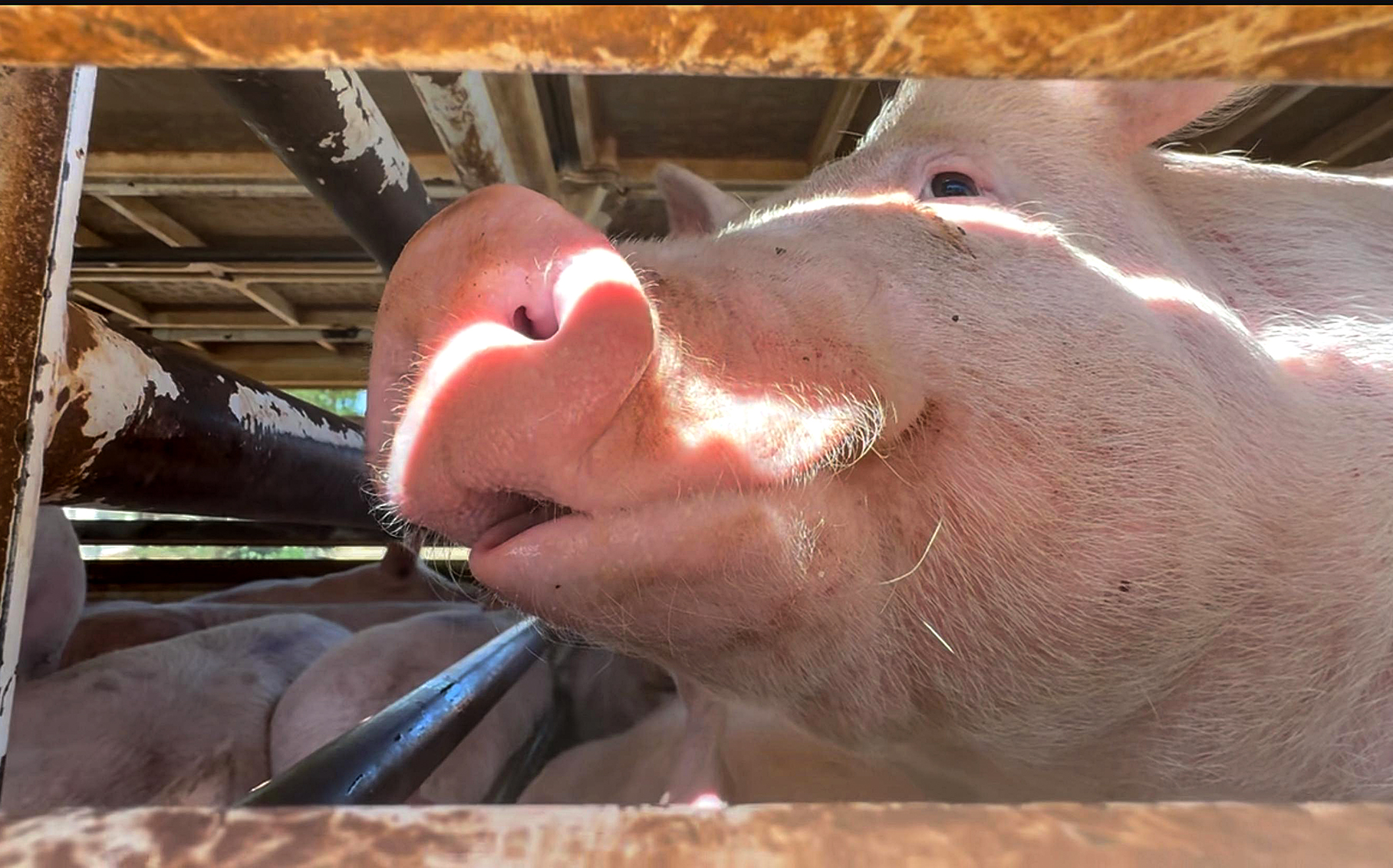
 Inside the truck carrying pigs destined for slaughter as it arrives at Molare Abattoir, Olifantsfontein. (Screenshot from video: Gabriella Fischer)
 Warning: This report contains distressing content that may disturb sensitive readers.
Molare Abattoir in Olifantsfontein is one of the largest pork abattoirs in South Africa, with up to 9,000 pigs slaughtered a week. The abattoir has recently come under fire from activists who claim the animals are being slaughtered in an inhumane way.
The production of meat is a reality most would rather not think about, but meat does not arrive shrink-wrapped in supermarket fridges without a process that begins with slaughter.
The complexities of humane slaughter
/file/dailymaverick/wp-content/uploads/2025/10/WhatsApp-Image-2025-10-01-at-14.14.29_ec1baa37.jpg "Inside a truck tightly packed with pigs, some stacked on top of one another, arriving for slaughter at Molare Abattoir in Olifantsfontein. (Screenshot from Video: Gabriella Fischer)")
On arrival at an abattoir, pigs are rendered unconscious before slaughter, either by electrical stunning or, in rare cases, carbon dioxide (CO₂) gas. Stunning is intended to prevent pain and distress. Once unconscious, the animals are bled by severing major blood vessels, with the aim of a humane death, after which carcasses are cleaned and processed into pork products.
South African law tightly regulates pig slaughter. The Meat Safety Act (Act 40 of 2000) mandates that slaughter may occur only at registered and inspected facilities. These regulations require humane handling from arrival through to slaughter, covering stunning methods, sanitary processing and welfare monitoring. Authorities such as the NSPCA are responsible for enforcing these standards through regular inspections.
/file/dailymaverick/wp-content/uploads/2025/10/WhatsApp-Image-2025-10-01-at-13.45.14_8170da65.jpg "Inside the truck carrying pigs destined for slaughter as it arrives at Molare Abattoir, Olifantsfontein. (Screenshot from video: Gabriella Fischer)")
According to the NSPCA, Molare Abattoir in Olifantsfontein is the only facility in South Africa known to use CO₂ stunning; other abattoirs rely on head-only, head-to-heart electrical stunning or manual methods. In the CO₂ process, pigs are herded into gondola crates that are lowered into pits filled with high concentrations of the gas. Oxygen deprivation renders the animals unconscious within 30 to 60 seconds, after which they are shackled, bled and processed. While legal, this method has drawn significant concern from animal welfare advocates.
For months, activists from Gauteng Animal Rights Defenders (Gard) have demonstrated outside Molare, calling for an end to CO₂ stunning.
“I’ve stood beside the trucks. I’ve looked into their eyes – those of animals moments away from death,” said Gard founder Veronica Groenewald. “I had no say in their fate. The gates open. They smell the air. And then the screaming begins … anything that has the will to fight for breath deserves the right to live – free from oppression, free from pain.”
Daily Maverick visited the protests on 18 September. Periodically, you could hear the pigs’ scream – it sounded like tyres screeching on tarmac.
trucks arrived within 10 minutes, with pigs packed closely together. In one case, a pig vomited yellow-white liquid through the bars of the truck.
/file/dailymaverick/wp-content/uploads/2025/10/DSC_4882.jpg "Three double-decker trucks, each carrying pigs packed side by side on two levels, arrived at Molare Abattoir within a 10-minute span. (Photo: Julia Evans)")
Speaking to Daily Maverick, Jacques Peacock, spokesperson for the NSPCA, said, “while we have always encouraged thoughtful consumption of animal products, we recognise that animal agriculture remains a reality”.
But, as Peacock explained, the NSPCA has “to ensure animals are protected and treated humanely within their current utilisation in society at large”.
So debate, and ethical considerations, come into how those animals are slaughtered.
Peacock emphasised that pigs were naturally vocal social animals: “Pigs are very vocal prior to feeding – this does not indicate distress.
“Pigs have approximately 20 different vocalisations that indicate different experiences. Vocalisation alone is therefore not necessarily an indicator of distress.”
/file/dailymaverick/wp-content/uploads/2025/10/DSC_4783.jpg "Gauteng Animal Rights Defender activists Brian Graham (left) and Gabriella Fischer protest outside Molare Abattoir in Olifantsfontein on 18 September 2025. (Photo: Julia Evans)")
The NSPCA has conducted numerous inspections at Molare since 2013, including unannounced visits, to ensure compliance with the Animals Protection Act and Meat Safety Act. Footage from complainants alleging overcrowding has not provided sufficient evidence of legal contraventions.
Despite these regulations, the CO₂ stunning process itself continues to provoke debate.
Controversy around CO2 stunning
Carbon dioxide stunning is not illegal in any country and is widely practised, including in the EU, Australia and the US.
Compared with electrical stunning, it allows pigs to be handled in groups, can reduce pre-slaughter stress (less handling), and produces pork with fewer quality defects.
However, welfare concerns remain. Studies and animal welfare organisations report that exposure to high concentrations of CO₂ causes severe distress during the induction phase.
The European Food Safety Authority found in 2020 that high-concentration CO₂ exposes pigs to pain, fear and respiratory distress for up to a minute before they lose consciousness. The gas provokes panic behaviours such as gasping, squealing and frantic escape attempts.
In the UK, vet Dr Steven McCulloch’s 2025 report for the Conservative Animal Welfare Foundation echoed these findings: CO₂ stunning takes 30-60 seconds, during which pigs often gasp, squeal and attempt to escape. By contrast, head-to-cardiac electrical stunning renders pigs unconscious instantly. Physiologically, CO₂ causes lung irritation and a sensation of “air hunger” caused by excess carbon dioxide in the blood.
/file/dailymaverick/wp-content/uploads/2025/10/DSC_4781.jpg "A Gauteng Animal Rights Defender protest outside Molare Abattoir in Olifantsfontein, Gauteng. (Photo: Julia Evans)")
Because this distress is unnecessary and avoidable, Dr McCulloch’s report called for a legislative ban. The NSPCA has long opposed any form of slaughter that does not kill an animal instantaneously or render it insensible to pain through pre-stunning.
“There is a large ongoing debate/studies surrounding the best practices, and currently there are a lot of opinions about which practice is most humane,” Stephaan Matthee from Molare told Daily Maverick.
“Our stunning methods are listed as one of the recommended preferred stunning methods by the OIE [World Organisation for Animal Health], and it complies with the National Standards of the Meat Safety Act.”
He said Molare reassured the public of the highest guaranteed standard in terms of food safety and animal welfare requirements. “Our facility is extensively monitored [and] evaluated by various regulatory bodies to ensure compliance and customer satisfaction,” said Matthee.
NSPCA’s investigations and stance
The NSPCA has challenged CO₂ stunning for more than a decade. In 2013, when Molare was known as Pork Packers and owned by Tiger Brands, the NSPCA obtained a warrant and installed cameras inside the stunning pits. Footage showed pigs in distress, emitting high-pitched screams and gasping desperately for air.
Peacock noted that the NPSCA’s interventions had shortened aversion periods and eliminated previously documented extreme escape behaviours.
But its shocking investigation prompted further research into pig welfare at slaughter. A 2024 University of Pretoria study compared four methods: CO₂ stunning, head-only electrical stunning, head-to-heart electrical stunning and an experimental argon-CO₂ mix. The study concluded that all current methods were “sub-optimal” in terms of welfare.
/file/dailymaverick/wp-content/uploads/2025/10/DSC_4877.jpg "Gauteng Animal Rights Defender activist Brian Graham protests outside Molare Abattoir in Olifantsfontein on 18 September 2025, as a truck of pigs enters the facility. (Photo: Julia Evans)")
“But the study’s findings, released in late December 2024, do not give a clear indication of what action to take to make the method humane, and are a scathing indictment of the industry’s failure to prioritise animal welfare,” said the NSPCA.
“In the year 2025, to simply accept that all methods are “sub-optimal”, the industry and government do not appear to view this dilemma as an urgent matter.”
The NSPCA has also supported international trials using inert gases, such as argon-CO₂ mixes, but these revealed welfare concerns and are not currently viable.
“Our interventions have shortened aversion periods and eliminated extreme escape behaviours previously documented,” said Peacock.
He said the Kempton Park SPCA conducted unannounced inspections of Molare, and earlier this year, the NSPCA carried out an inspection covering all handling from offloading and lairaging through to the point where pigs descended into the gondolas.
Peacock said that the stunning process itself was not currently visible, and the NSPCA had formally requested that Molare install cameras inside the gondolas to enable independent monitoring. “If this directive is not implemented, we reserve our rights to consider further enforcement action,” the organisation said.
As a matter of protocol, inspection reports are not made public. The NSPCA explained that inspections were conducted in terms of the law and were treated similarly to police dockets. They confirmed, however, that two issues were identified and rectified: priority slaughter was initially not observed, and a truck was found without adequate shelter. Both were corrected following warnings and no further action was required in terms of the Animals Protection Act 71 of 1962.
Head to heart electrical stunning advised
“The most practical alternative remains head-to-heart electrical stunning, provided equipment and handling standards are rigorously maintained and used correctly,” said Peacock.
In the NSPCA’s view, after having observed first-hand the different stunning methods used in South Africa, head-to-heart stunning results in immediate unconsciousness and cardiac arrest, so the animal cannot recover. From a welfare point of view, this represents a more humane and instant stunning process.
Head-to-cardiac stunning passes electric current through both the brain and the heart, inducing immediate unconsciousness followed quickly by cardiac arrest. This prevents any possibility that the animal could regain consciousness during subsequent handling, hoisting or bleeding, unlike head-only electrical stunning, which produces reversible unconsciousness that can allow recovery if bleeding is delayed.
The NSPCA has recommended that animals be slaughtered as close as possible to production sites to minimise stress from long-distance transport. They have also called on the government to mandate camera surveillance in all abattoirs and strengthen enforcement by state veterinarians.
The NSPCA reported that Molare had purchased a head-to-heart stunning apparatus as a back-up system, although the phasing out of CO₂ had not been confirmed.
NSPCA demands reform
In January this year, the NSPCA called on the government to urgently amend regulations to phase out head-only electrical stunning across the industry in favour of automated head-to-cardiac stunning – while continuing to oppose CO2 stunning outright.
“The Department of Agriculture must urgently amend the regulations in terms of the Meat Safety Act No 40 of 2000 to phase out head-only electrical stunning, to implement automated head to cardiac pre-stunning of pigs and at the very least until refinement occurs, ensure that simple mitigations are put in place,” said the NSPCA.
Daily Maverick reached out to the Department of Agriculture, but has yet to receive a response.
Consumer power
“Consumers hold significant power in driving change, and we urge them to support retailers that prioritise humane practices,” said the NSPCA. “By making informed choices and through research, consumers can help create a more compassionate food system.”
Woolworths and Shoprite claim to uphold animal welfare standards through their “kinder to sows” policies, which can be seen on the packaging of their products, committing to more humane farming practices such as cage-free or enriched housing systems aimed at reducing stress and improving the treatment of breeding pigs.
Rachel Alberts, a Woolworths spokesperson, said the company goes “far beyond the legal requirements” to ensure its values are applied across its business, including during livestock slaughter.
Each supplier is required to employ a trained Animal Welfare Officer responsible for overseeing the slaughter process, ensuring animals are handled properly, herded and stunned with minimal distress, Alberts said. Suppliers are also subject to regular audits by independent third parties to verify compliance.
When it comes to CO₂ gas stunning, Alberts acknowledged the complexity of the discussion. Alberts said that Woolworths recognised two acceptable methods for stunning pigs: CO₂ and electrical stunning. According to the company, both methods are, on balance, “more or less equal in their ability to mitigate discomfort”.
Alberts said Woolworths continued to monitor ongoing research and innovations in animal welfare, and remained committed to improving practices where possible.
Shoprite, Africa’s largest food retailer, emphasised a compliance-based approach. In an email response from its media team, the company said it sourced meat only from approved suppliers required to adhere to industry legislation and standards. Slaughtering guidelines were determined and enforced by the Department of Agriculture in collaboration with health and other regulatory authorities.
When pressed about whether Molare was among its suppliers, Shoprite did not confirm, stating that any concerns about animal welfare compliance should be raised directly with the Department of Agriculture.
Pick n Pay did not respond to repeated requests for comment.
“We want retailers to stop making animal welfare claims that they are not living up to,” said Gard’s Groenewald.
“We expect the government to take the science about CO2 gassing seriously and start engaging the meat industry to change their methods.”
“I’ll go to my death standing here,” said
Graham, a Gard activist in his seventies, standing in front of Molare Abattoir during his weekly protests. “We will try as hard as we can to bring the word out to the world.” DM