




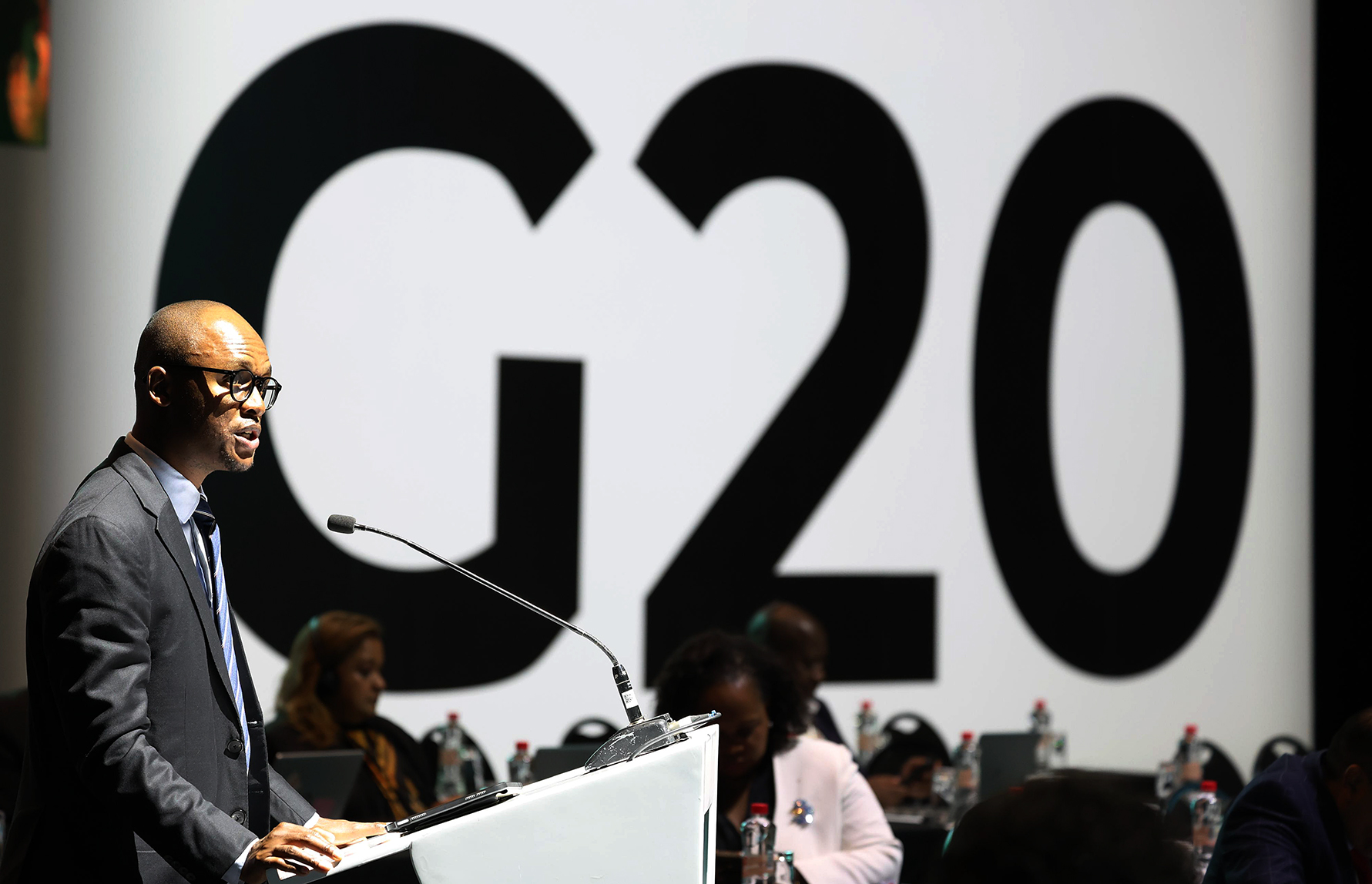
 Minister of Communications and Digital Technologies Solly Malatsi delivers the opening address at the launch of the G20 AI Task Force in Cape Town. (Photo: Lerato Septokele / DCDT)
 Using an example of how an AI-powered self-driving car may not recognise an African as human because it wasn't trained to recognise Africans – of course, referring to black people – was probably not the best way to start the AI policymaking conversation.
That very strange anecdote is extremely revealing of the baseline understanding of how AI models see the world and shows the Department of Communications and Digital Technologies’ AI regulation hand.
To be fair to Dumisani Sondlo, the department’s AI policy lead, he was not actually scheduled to present at GovTech 2025, it was a late change. But aside from his technical faux pas in opening the discussion, he was refreshingly candid about South Africa’s approach to artificial intelligence regulation.
Read more: Wisdom of Solomon — Malatsi’s gospel for a digital South Africa
The forthcoming National AI Policy, which has completed its cluster approval process and awaits Cabinet presentation before a 60-day public comment period, is an exercise in pragmatic ambition, or perhaps ambitious pragmatism.
“We are not going to go for legislation at all with this policy,” Sondlo explained. Instead, the policy will offer each sector a menu of governance options for risk-based frameworks, guardrails and other approaches; with government bodies coordinating between sectors rather than imposing top-down rules.
It’s an oddly light-touch approach for a country positioning itself, through its G20 Presidency, as Africa’s voice in global AI governance conversations. But it’s also a strategy born from self-awareness. The policy’s development was, in Sondlo’s words, “an act of acknowledging that we don’t know enough”.
Six pillars and one big question
The language used to describe the policy vibes includes the typical tech bro tongue twisters: “intergenerational equity”, “inclusive economic growth”, and a uniquely South African, but still unsurprising, “ubuntu principles”. Sondlo even posed a pointed question in his breakdown: “Why is it that in the debate on AI ethics that we cannot bring in the idea of ubuntu?”
It’s a fair challenge. But the policy’s philosophical grounding raises practical questions about implementation. To quote from the AI industry jargon: how do you operationalise ubuntu in a procurement process? How do you translate cultural principles into technical standards? And how do you ensure that a flexible, non-legislative framework doesn’t become a regulatory vacuum?
Minister of Communications and Digital Technologies Solly Malatsi frames the challenge in an interesting way: “Innovation without ethical guardrails can deepen inequality, amplify bias and erode trust.” His emphasis at the G20 AI Task Force launch in Cape Town last week was on positioning Africa as “an active shaper of global AI governance, not merely a consumer of imported technologies”.
Read more: Worry about graduates being replaced with AI, not call centre agents
Malatsi’s deputy, Mondli Gungubele, echoed this when he launched the AI for Africa Initiative the next day, declaring that “too often, the Global South has been left behind or treated as a site of extraction of data, of labour, of raw materials, without being allowed to share fairly in the value created.”
Where the policy falls short
A recent Boston Consulting Group (BCG) report on global AI adoption identifies agentic AI (autonomous systems that can reason and act independently) as the next frontier, expected to nearly double its share of AI value by 2028. South Africa’s policy framework doesn’t explicitly address this emerging technology, a strategic gap that could leave the country playing catch-up even as it finalises its foundational framework.
 BCG also found that a key differentiator for AI leaders is an “aggressive multiyear strategic AI ambition” from the C-suite. While the national policy provides a government framework, its success depends entirely on whether public and private sector leaders adopt this bold, top-down model. The policy can create conditions; it cannot mandate vision.
Ravi Bhat, Microsoft’s chief solutions and AI transformation officer for Africa, offers a more grounded perspective on what’s actually happening on the ground. His assessment is both encouraging and cautionary.
The good news: parts of the public sector are already moving. “Sars, our revenue services, were the fastest in South Africa to adopt Copilot,” Bhat points out. The Department of International Relations and Cooperation, the City of Cape Town, and the Public Investment Corporation have also adopted AI use cases. This suggests the policy’s goal of using the public sector as a key lever is already being realised, to some degree.
Sars manages an extensive volume of data, serving 14 million taxpayers across more than 200 sites, and Commissioner Edward Kieswetter is an early AI adopter, proving that driving change from the top is the way to go.
“We must come to terms that our future is a co-existence with AI agents that, in many ways, will replace some of the work we do, augment all our work and significantly enhance our abilities as a species,” Kieswetter has previously said.
Tanya Strauss, a director of tax and accounting at PH Attorneys, says Sars uses AI-powered tools to streamline tax assessments and detect non-compliance faster. “These models can analyse taxpayer data in real-time and flag inconsistencies or anomalies for further investigation. This proactive approach has enabled Sars to recover significant revenue, with reports indicating a record R2.155-trillion collected in the 2023/24 financial year, partly attributed to AI-driven tools,” she says.
The challenge: “Organisations which have a lot of government and regulatory framework and have not actually been on the cloud journey or a digital first journey could struggle,” Bhat warns. These sectors get stuck on governance and security approvals, which limit scale.
Tuning test
This is where Sondlo’s flexible, non-legislative approach will be tested. The policy design may be attempting to sidestep these bottlenecks, but Bhat’s experience suggests that institutional and regulatory hurdles within government remain a major obstacle, regardless of how the national policy is structured.
He offered Daily Maverick some practical, if a bit salesman-ish, advice for government departments: “Use commercially available assets. You don’t waste money because we’ve already spent that money.”
By adopting established tools first, like Sars did with Copilot, the public sector can achieve quick productivity gains and build momentum before moving to more complex, custom-built solutions.
He also reinforced what BCG found about leadership: “AI is not something which is done by the lowest person in the organisation. It’s leadership.”
There’s something genuinely admirable about a policy framework that insists on maintaining human oversight over AI and demands that “you cannot say the AI made this decision. There must be a human who is held accountable”. Sondlo lumps this in with an emphasis on the principle of humans in the loop and requirements for sufficient explainability in AI systems.
Read more: AI helps SA banks to include informal economy
The focus on digitising indigenous languages, protecting cultural archives and ensuring that AI development aligns with ubuntu principles also deserves a special mention. These are attempts to ensure that South Africa’s AI future doesn’t erase its past.
Blind ambition
But the policy also reveals a tension between ambition and capacity.
It calls for integrating AI into education at all levels, establishing dedicated research centres, supporting AI startups through accelerators and sandboxes, and formally establishing and funding an AI Institute.
Other notable ambitions include:
- Changes to procurement rules so the government can directly buy from SMMEs it has supported; and
- The creation of an “AI safety infrastructure” and the ability to ensure data governance.
These are significant challenges for a government that, by its own admission, is still learning. The policy’s flexibility may be a strength, allowing sectors to adapt governance to their needs, or a weakness – if it becomes an excuse for inaction.
South Africa’s AI policy is a big bet on coordination. It assumes that sectors will develop robust governance frameworks when given options rather than mandates.
It assumes that leadership will emerge within government departments to drive adoption. It assumes that institutional hurdles can be overcome through flexibility rather than legislative force.
These are not unreasonable assumptions. But they’re also not guaranteed outcomes. DM